Christmas Wishes in Spanish: 72 Messages With English Translations
72 Christmas wishes in Spanish with English translations: family, partner, friends, work (usted), blessings, Nochebuena and Reyes, plus spelling rules.
By GreetingBirds EditorsPublished October 14, 202617 min read
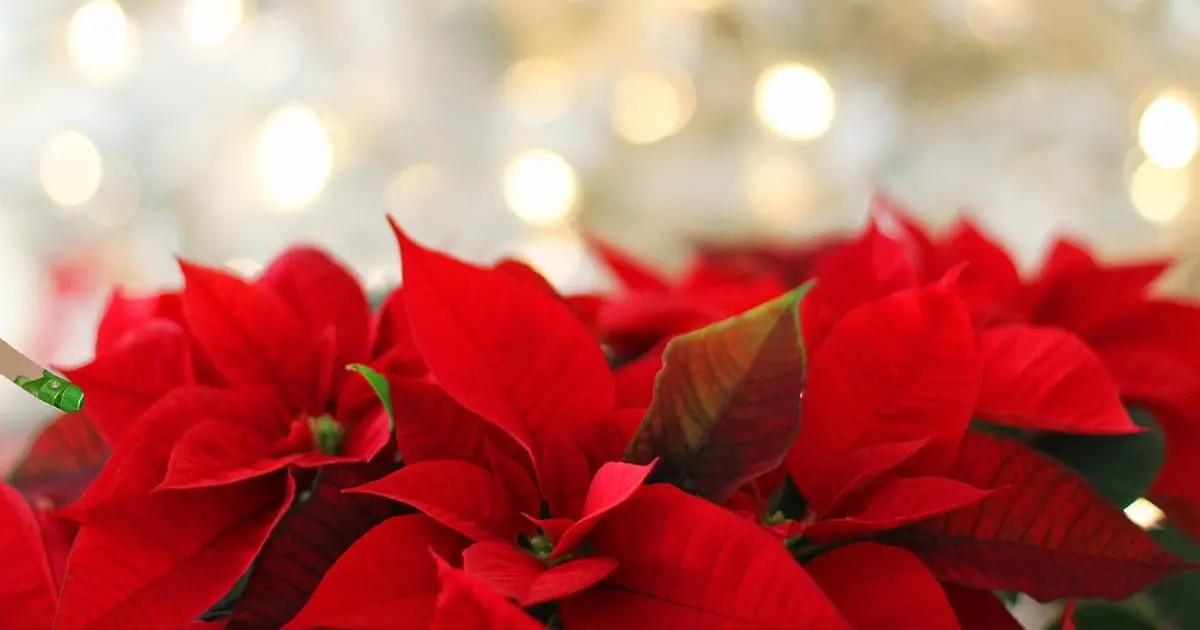
In Mexico the poinsettia isn't called a poinsettia. It's the flor de Nochebuena, the Christmas Eve flower, and the plant on the cover of this page grows wild in Mexico and Central America. That one name tells you a lot about Christmas in Spanish: the night of December 24 often matters as much as the 25th, and a good Spanish Christmas wish usually covers more than one day.
The short answer: "Merry Christmas" in Spanish is ¡Feliz Navidad! (feh-LEES nah-vee-DAHD). To add the new year, say ¡Feliz Navidad y próspero año nuevo! For a card or a text you can copy right now, start with one of these five, each with its English meaning:
- ¡Feliz Navidad! Que esta Navidad llene tu casa de paz y alegría. Merry Christmas! May this Christmas fill your home with peace and joy.
- Te deseo una feliz Navidad y un año nuevo lleno de cosas buenas. I wish you a merry Christmas and a new year full of good things.
- Felices fiestas para ti y toda tu familia. Un abrazo grande. Happy holidays to you and your whole family. A big hug.
- Que la magia de la Navidad te acompañe todo el año. May the magic of Christmas stay with you all year.
- Gracias por estar siempre ahí. ¡Feliz Navidad, con todo mi cariño! Thank you for always being there. Merry Christmas, with all my love!
Below are 67 more, 72 in all, grouped by who you're writing to: family, a partner, friends, coworkers and clients, plus religious blessings, Nochebuena and Three Kings' Day wishes and a few funny ones. Every message was written by our editors in natural, everyday Spanish that works across Latin America, the US and Spain, and each comes with an English translation so you know exactly what you're sending. You'll also find the key phrases explained, the spelling rules most people get wrong, and the two poems and verses we quote, with their sources.
The Five Phrases Behind Almost Every Spanish Christmas Card
Most Spanish Christmas messages are built from a handful of set phrases. Learn these and you can read any card you receive and adjust any message below.
| Phrase and meaning | When to use it |
|---|---|
| ¡Feliz Navidad! Merry Christmas | The default for anyone, any time in December. Navidad means Christmas (from the Latin for "birth"). |
| ¡Felices fiestas! Happy holidays | Covers Christmas, New Year and Three Kings' Day in one go. Good for coworkers, clients, or when you're not sure the person celebrates Christmas. |
| ¡Próspero año nuevo! Prosperous new year | Almost always added after "Feliz Navidad". Feliz año nuevo (happy new year) works too. |
| ¡Feliz Nochebuena! Happy Christmas Eve | On December 24, the big family night in most Spanish-speaking homes. |
| ¡Felices Reyes! Happy Three Kings' Day | On January 5–6, when in many countries the Three Kings bring the children's presents. |
One more you'll hear everywhere: "Feliz Navidad, próspero año y felicidad" (merry Christmas, a prosperous year and happiness). It's the opening line of José Feliciano's song "Feliz Navidad," released in November 1970, and it's a perfectly good greeting on its own.
Tú or Usted: Pick the Register Before You Pick the Words
Spanish has two ways to say "you," and a Christmas message sounds off if you mix them up. Use tú (te, tu, contigo) for family, friends, a partner and coworkers you're close to. Use usted (le, su, con usted) for a boss you don't know well, clients, older relatives who expect it, a priest or a teacher. When you write to a whole family or team, Latin American Spanish uses ustedes (les, sus); in Spain you'll often see vosotros (os, vuestra) among people who know each other well.
The messages below are marked by the groups they're written for, so the register is already right. If you move a line to a different person, change te to le and tu to su, or the other way around.
Short Lines for a Text, WhatsApp or Gift Tag
These fit on a tag, under a photo or in a quick message. All use tú, so they suit anyone you'd text.
- ¡Feliz Navidad! Te quiero mucho. Merry Christmas! I love you lots.
- Paz, amor y mucho turrón. ¡Felices fiestas! Peace, love and plenty of turrón. Happy holidays!
- Pensando en ti esta Navidad. Thinking of you this Christmas.
- Un abrazo enorme y feliz Navidad. A huge hug and merry Christmas.
- Que no te falte nada esta Navidad, sobre todo cariño. May you lack nothing this Christmas, above all love.
- Felices fiestas. Nos vemos pronto, ¡con tamales! Happy holidays. See you soon, with tamales!
- Para ti, con cariño. ¡Feliz Navidad! For you, with love. Merry Christmas! (a classic gift-tag line)
- Brindo por ti esta Navidad. I'm raising a glass to you this Christmas.
- Que esta Navidad te traiga mucha luz. May this Christmas bring you lots of light.
- ¡Feliz Navidad desde lejos y con todo el corazón! Merry Christmas from far away and with all my heart!
For Mamá, Papá and the Abuelos
Family cards in Spanish are often warmer and more direct than English ones; "te quiero" and "gracias" are normal here, not too much. Use tú for parents and grandparents unless your family always uses usted with them, which is still common in some Mexican and Central American homes.
- Mamá, gracias por hacer de cada Navidad un hogar. Te quiero muchísimo. Mom, thank you for turning every Christmas into a home. I love you so much.
- Papá, este año entendí cuánto trabajas para que estemos bien. ¡Feliz Navidad! Dad, this year I understood how hard you work for us to be okay. Merry Christmas!
- Para mis papás: la mejor parte de la Navidad sigue siendo volver a casa. To my parents: the best part of Christmas is still coming home.
- Abuela, ninguna cena sabe como la tuya. Feliz Navidad y gracias por todo. Grandma, no dinner tastes like yours. Merry Christmas and thank you for everything.
- Abuelo, tus historias son mi regalo favorito. Que pasemos muchas Navidades más juntos. Grandpa, your stories are my favorite gift. Here's to many more Christmases together.
- Querida familia, que esta Navidad nos encuentre unidos, sanos y con la mesa llena. Dear family, may this Christmas find us together, healthy and with a full table.
- Para mi hermana: gracias por aguantarme otro año. ¡Feliz Navidad! To my sister: thanks for putting up with me another year. Merry Christmas!
- A mis tíos y primos: aunque estemos lejos, esta Navidad los llevo conmigo. To my aunts, uncles and cousins: even though we're far apart, I carry you with me this Christmas.
For Your Partner: Mi Amor, Mi Vida
Spanish has a deep bench of pet names: mi amor (my love), mi vida (my life), cariño (darling), corazón (sweetheart). Pick the one you already use; a new one in a card can feel odd.
- Feliz Navidad, mi amor. Mi regalo favorito eres tú. Merry Christmas, my love. My favorite gift is you.
- Contigo cada Navidad se siente como la primera. With you, every Christmas feels like the first.
- Mi vida, gracias por este año a tu lado. Quiero muchos más. My love, thank you for this year by your side. I want many more.
- No necesito nada bajo el árbol si te tengo a ti. I don't need anything under the tree if I have you.
- Nuestra primera Navidad juntos, y ya es mi favorita. Our first Christmas together, and it's already my favorite.
- Aunque esta Navidad nos separen los kilómetros, mi corazón está contigo. Even though miles separate us this Christmas, my heart is with you.
- Cariño, que el año nuevo nos encuentre igual de enamorados. Darling, may the new year find us just as in love.
For Friends, Near and Far
With friends you can be playful and mention something you shared. Amigo for a man, amiga for a woman, amigos for a group.
- Amiga, gracias por las risas, los consejos y los audios de diez minutos. ¡Feliz Navidad! Friend, thank you for the laughs, the advice and the ten-minute voice notes. Merry Christmas!
- Los amigos son la familia que uno elige. Feliz Navidad a la mía. Friends are the family you choose. Merry Christmas to mine.
- Que esta Navidad te dé todo lo que te mereces, que es mucho. May this Christmas give you everything you deserve, which is a lot.
- Brindo por otro año de amistad. ¡Salud y feliz Navidad! Here's to another year of friendship. Cheers and merry Christmas!
- Te extraño, amigo. Feliz Navidad y que pronto nos veamos. I miss you, my friend. Merry Christmas, and I hope we see each other soon.
- Felices fiestas, amigos. Este año fue mejor gracias a ustedes. Happy holidays, friends. This year was better because of you.
- Para mi compañero de aventuras: feliz Navidad y que el año que viene traiga más. To my partner in adventures: merry Christmas, and may next year bring more.
For Coworkers, a Boss or Clients (Usted and Ustedes)
At work, keep it polite and brief. These use usted for one person and ustedes for a team or a company. Felices fiestas is the safe choice when you don't know everyone's traditions.
- Le deseo una feliz Navidad y un próspero año nuevo. Gracias por su confianza. I wish you a merry Christmas and a prosperous new year. Thank you for your trust.
- Felices fiestas a usted y a su familia. Ha sido un gusto trabajar con usted este año. Happy holidays to you and your family. It's been a pleasure working with you this year.
- Gracias por su apoyo durante este año. Le deseamos unas felices fiestas. Thank you for your support this year. We wish you happy holidays.
- Estimado equipo: gracias por su esfuerzo. Que disfruten estas fiestas con los suyos. Dear team: thank you for your hard work. Enjoy these holidays with your loved ones.
- Les deseamos unas fiestas llenas de paz y un año nuevo lleno de éxitos. We wish you holidays full of peace and a new year full of success.
- Feliz Navidad, compañeros. Nos vemos en enero con energía renovada. Merry Christmas, colleagues. See you in January with fresh energy. (tú/ustedes, for a friendly team)
- Con nuestros mejores deseos para estas fiestas y para el año que comienza. With our best wishes for the holidays and for the year ahead. (signed by a company)
Religious Christmas Blessings in Spanish
For family and friends who celebrate the birth of Jesus, a blessing is often the heart of the card. Bendiciones (blessings) is also a common sign-off on its own. Many Spanish-speaking Protestant churches read the Christmas story in the Reina-Valera 1960 translation, where the angel's words to the shepherds read:
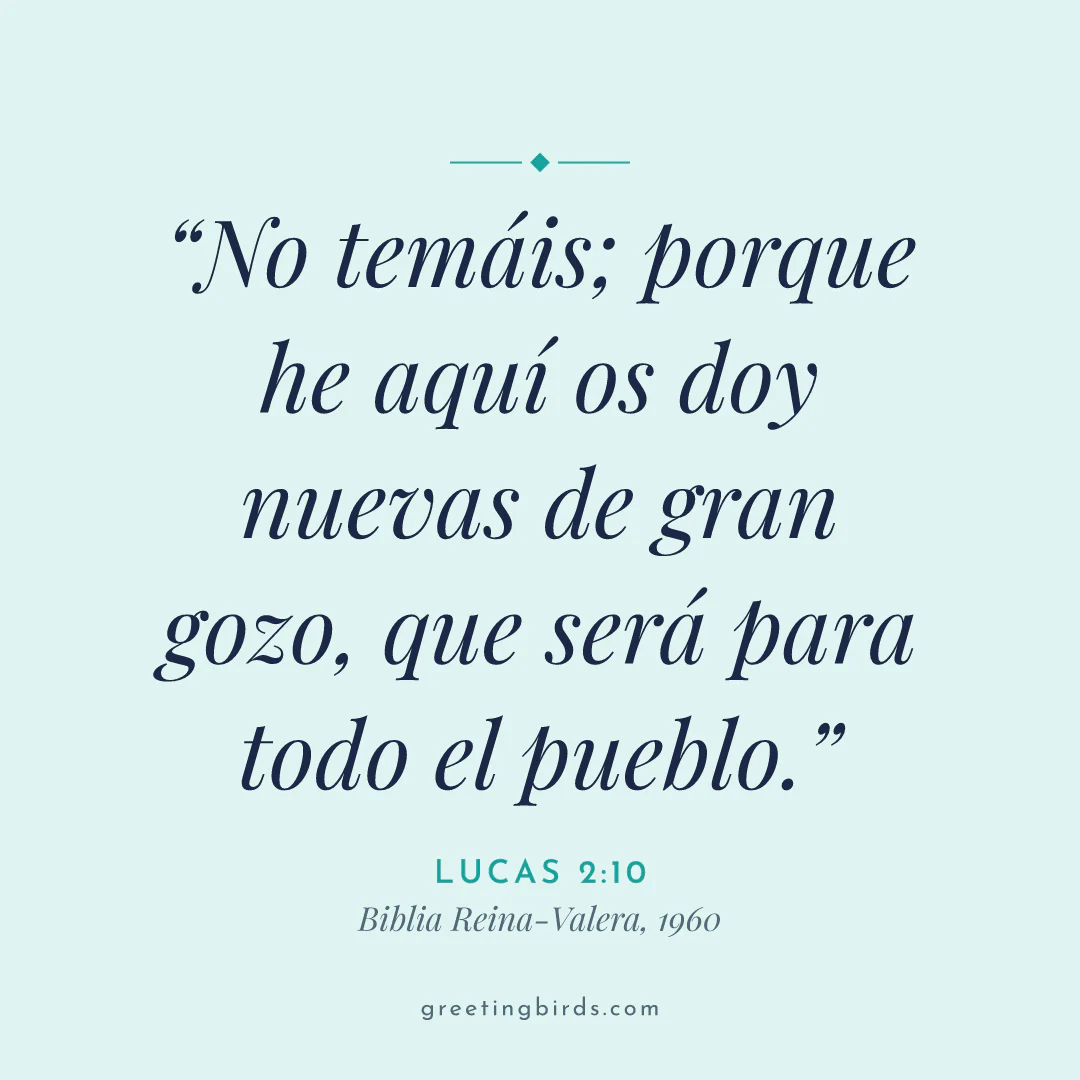
"No temáis; porque he aquí os doy nuevas de gran gozo, que será para todo el pueblo."
— Lucas 2:10, Reina-Valera 1960
In English that's Luke 2:10, "Fear not: for, behold, I bring you good tidings of great joy, which shall be to all people." It suits a card for someone who has had a frightening or heavy year, because it starts with "don't be afraid" before it gets to the joy. Write it out in full with the reference, and add one line of your own underneath. Catholic families may know other wordings from their own Bible editions; any of them is fine in a card.
- Que el Niño Dios bendiga tu hogar esta Navidad y siempre. May the Christ Child bless your home this Christmas and always.
- Celebremos el nacimiento de Jesús con el corazón abierto. ¡Feliz Navidad! Let's celebrate the birth of Jesus with an open heart. Merry Christmas!
- Que la paz que trajo Jesús al mundo llegue a tu familia. May the peace Jesus brought into the world reach your family.
- Dios te bendiga en esta Navidad y te acompañe en el año nuevo. God bless you this Christmas and be with you in the new year.
- Que la luz de Belén ilumine tu camino. Bendiciones. May the light of Bethlehem light your path. Blessings.
- Jesús es la razón de esta fiesta. Feliz Navidad y muchas bendiciones. Jesus is the reason for this celebration. Merry Christmas and many blessings.
- En esta Navidad, pido a Dios salud y alegría para ti y los tuyos. This Christmas I'm asking God for health and joy for you and yours.
For English-language blessings and more scripture, see our religious Christmas messages.
Navidad and Año Nuevo in One Message
Because the season runs from Christmas Eve to January 6, most Spanish cards wish for both holidays at once. These are written for one person (tú); swap to ustedes for a family.
- Feliz Navidad y que el año nuevo te traiga salud, amor y trabajo. Merry Christmas, and may the new year bring you health, love and work.
- Que cierres el año con alegría y empieces el próximo con esperanza. May you end the year with joy and start the next one with hope.
- Felices fiestas y que en el año nuevo se cumplan todos tus deseos. Happy holidays, and may all your wishes come true in the new year.
- Doce uvas, doce deseos, y todos para ti. ¡Feliz año! Twelve grapes, twelve wishes, and all of them for you. Happy new year!
- Gracias por este año. Que el que viene sea todavía mejor. Thank you for this year. May the next one be even better.
- Feliz Navidad y próspero año nuevo, de nuestra familia a la tuya. Merry Christmas and a prosperous new year, from our family to yours.
The grapes line refers to the custom of eating twelve grapes at midnight on December 31, one on each stroke of the clock, for luck in each month of the year. It's strongest in Spain, where the chimes from Madrid's Puerta del Sol have been broadcast on television since 1962, and it has been taken up in Latin America, the Caribbean and Hispanic communities in the US.
Nochebuena: Wishes for December 24
In many Spanish-speaking families, Christmas Eve is the main event: the big dinner, often Midnight Mass (la Misa de Gallo), and in a lot of Latin American homes the presents at midnight. A message on the afternoon of the 24th lands at exactly the right time.
- ¡Feliz Nochebuena! Que disfrutes la cena con todos los que quieres. Happy Christmas Eve! Enjoy dinner with everyone you love.
- Esta noche brindo por ti. ¡Feliz Nochebuena! Tonight I'm raising a glass to you. Happy Christmas Eve!
- Que esta Nochebuena haya abrazos, risas y comida de sobra. May this Christmas Eve bring hugs, laughter and more than enough food.
- Una noche buena para gente buena. Feliz Nochebuena a ti y a tu familia. A good night for good people. Happy Christmas Eve to you and your family.
- Aunque no estemos en la misma mesa esta Nochebuena, te guardo un lugar. Even if we're not at the same table this Christmas Eve, I'm saving you a seat.
If your family follows Las Posadas, the nine nights from December 16 to 24 when neighbors act out Mary and Joseph's search for shelter, the same lines work for each evening of the celebration. For English Christmas Eve lines, see our Christmas Eve greetings.
Rubén Darío's Three Kings: A Poem for the Last Day of the Season
The Spanish-speaking Christmas season ends on January 6 with el Día de Reyes, when Gaspar, Melchor and Baltasar, the Three Wise Men, arrive. In Spain and much of Latin America children leave their shoes out on the night of January 5 and wake up to presents, and families share a ring-shaped cake called rosca or roscón de Reyes.
The Nicaraguan poet Rubén Darío gave each king a voice in a sixteen-line poem, "Los tres Reyes Magos," first published in his collection Cantos de vida y esperanza (Madrid, 1905). Gaspar speaks first:
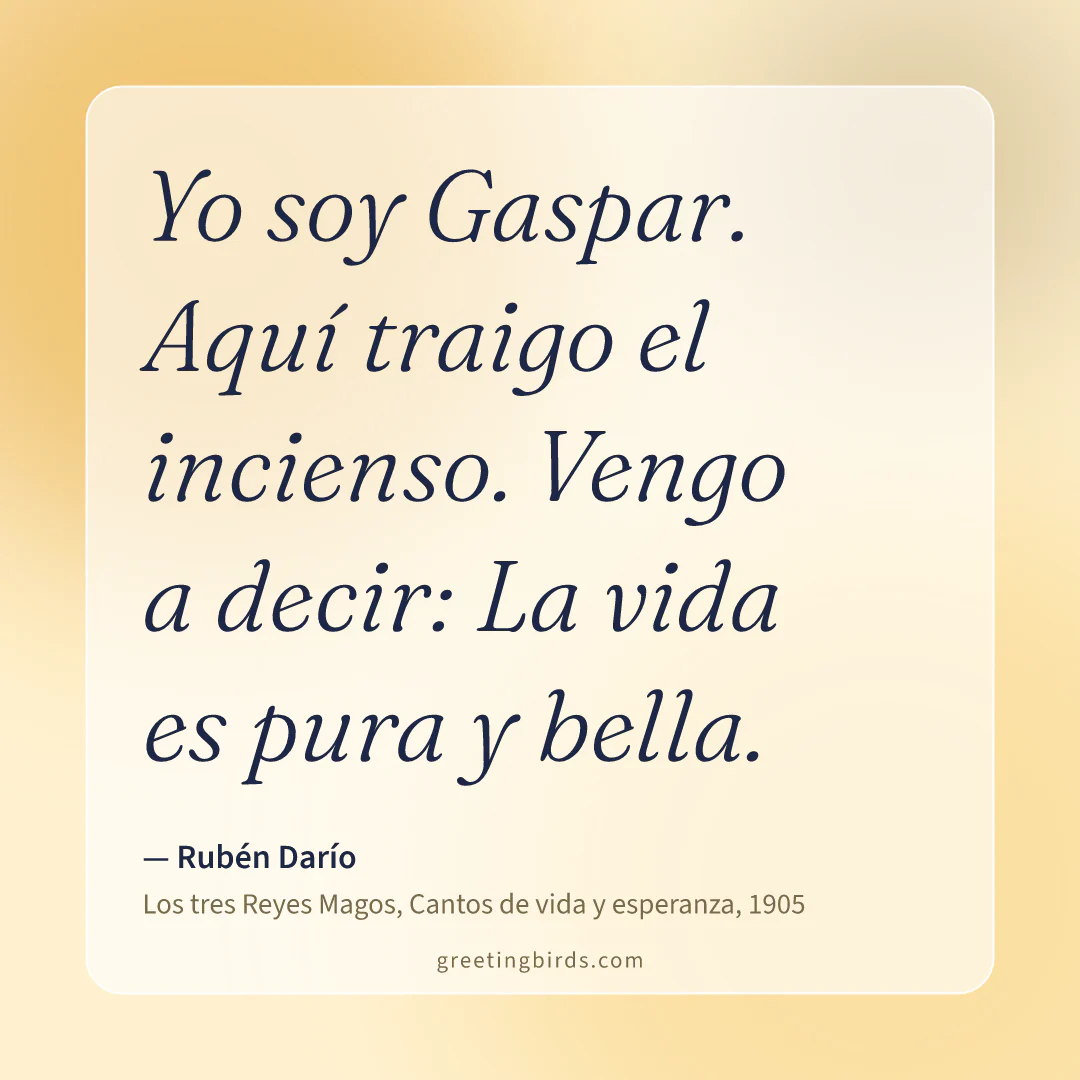
"Yo soy Gaspar. Aquí traigo el incienso. / Vengo a decir: La vida es pura y bella."
— Rubén Darío, "Los tres Reyes Magos," Cantos de vida y esperanza (1905)
"I am Gaspar. Here I bring the incense. I come to say: life is pure and beautiful." Each king brings his gift and a statement of faith; Melchor's is "Existe Dios. Él es la luz del día" (God exists. He is the light of day). The text is in the Wikisource transcription. Gaspar's two lines make a lovely opening for a card to someone who reads Spanish poetry, or to a Nicaraguan friend who probably learned Darío at school. Credit him by name; it's part of the gift.
Wishes for Día de Reyes (January 5–6)
A message on the evening of January 5 or the morning of the 6th is a thoughtful extra, especially for families with children. The poem's last stanza has the most quotable line, spoken to the three kings themselves:
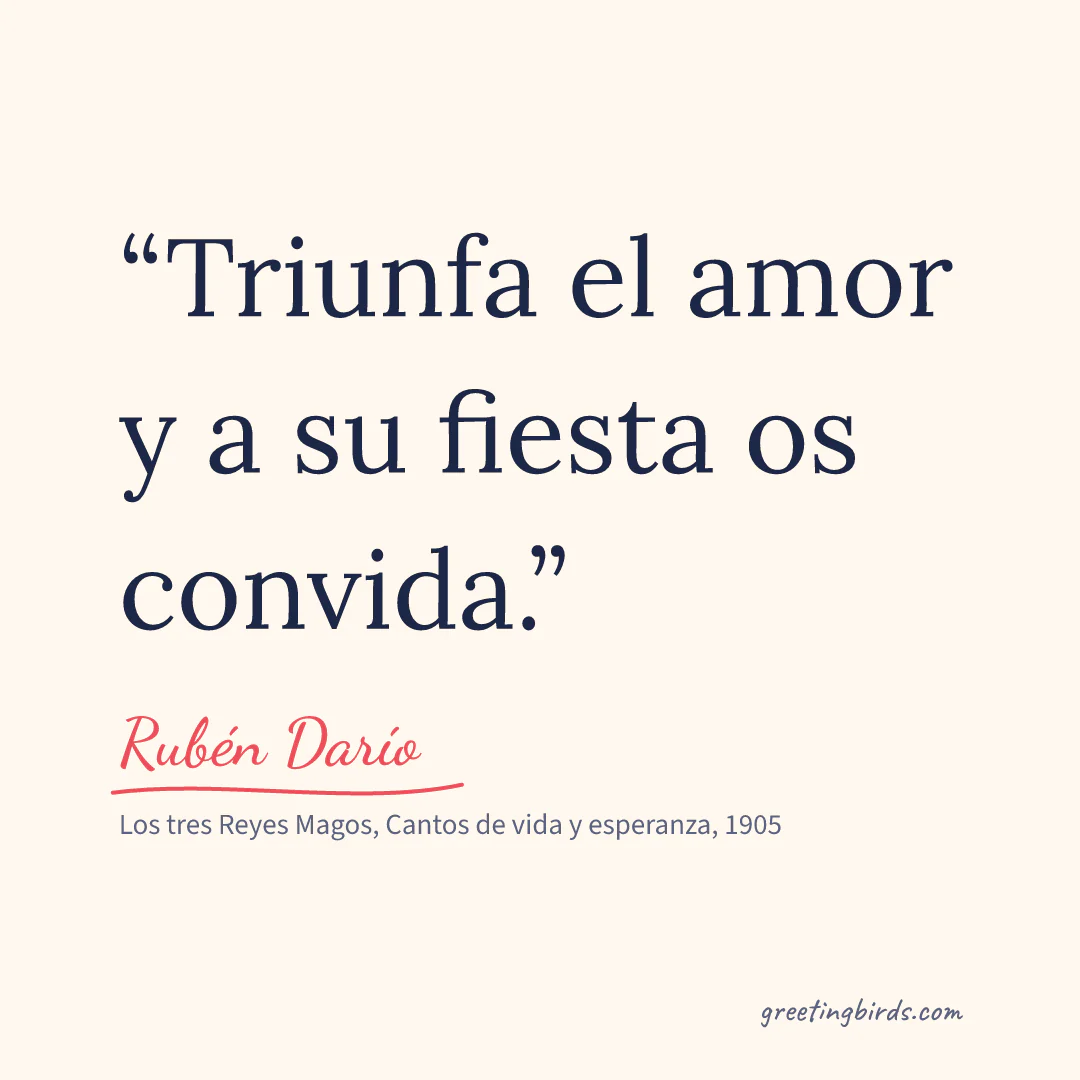
"Triunfa el amor y a su fiesta os convida."
— Rubén Darío, "Los tres Reyes Magos," Cantos de vida y esperanza (1905)
"Love triumphs and invites you to its feast." It works as a closing line for a Three Kings' Day card, or as a caption under a photo of the family around the rosca.
- ¡Felices Reyes! Que los Reyes Magos te traigan todo lo que pediste. Happy Three Kings' Day! May the Wise Men bring you everything you asked for.
- Que te toque el muñequito de la rosca… y que lo celebres con tamales. May you get the little figurine in the rosca… and celebrate it with tamales. (In Mexico, whoever finds the baby figurine in the cake is expected to host a party on Candlemas, February 2.)
- Niños, pongan los zapatos en la puerta: esta noche llegan los Reyes. Kids, put your shoes by the door: the Kings arrive tonight.
- Feliz Día de Reyes. Que la estrella que los guió también te guíe a ti este año. Happy Three Kings' Day. May the star that guided them guide you too this year.
- Con los Reyes se acaban las fiestas, pero no el cariño. ¡Felices Reyes! The holidays end with the Kings, but the love doesn't. Happy Three Kings' Day!
Funny Spanish Christmas Wishes (and the December 28 Warning)
Keep these for people who'll laugh, and send them in a text, not a formal card.
- Te iba a regalar algo increíble, pero luego me acordé de que mi presencia ya es un regalo. ¡Feliz Navidad! I was going to give you something amazing, then I remembered my presence is already a gift. Merry Christmas!
- Que esta Navidad comas mucho, engordes poco y no te toque lavar los platos. May you eat a lot this Christmas, gain little and not get stuck washing the dishes.
- Santa me preguntó si te portaste bien. Le dije que más o menos. Ya veremos. Santa asked me if you were good. I said sort of. We'll see.
- Mi propósito de año nuevo es el mismo del año pasado: empezar el gimnasio. ¡Felices fiestas! My new year's resolution is the same as last year's: start going to the gym. Happy holidays!
- Feliz Navidad a la única persona que se come más tamales que yo. Merry Christmas to the only person who eats more tamales than I do.
A warning if you're writing on December 28: in Spain, Spanish-speaking America and the Philippines that's el Día de los Santos Inocentes, a day for pranks much like April Fools' Day. Big news sent that day may be read as a joke, so save announcements for the 27th or the 29th.
Write Your Own Spanish Christmas Message
A natural Spanish card has three parts. You don't need perfect grammar; a short, correct message beats a long one with mistakes.
- Greeting with a name: Querida Ana, / Querido Luis, (dear) or simply Hola, familia:. In Spanish a colon after the greeting is standard in letters.
- One wish: start with Te deseo… (I wish you…) or Que… + the subjunctive: Que tengas (may you have), Que disfrutes (may you enjoy), Que pases (may you spend).
- A warm sign-off: Un abrazo (a hug), Con cariño (with affection), Besos (kisses, for family and close friends), Bendiciones (blessings), or Saludos cordiales (kind regards) for work.
Worked example for a neighbor who helped you this year:
Querida señora Rosa: le deseo una feliz Navidad y un próspero año nuevo. Gracias por cuidar a nuestro perro en el verano. Con cariño, la familia Torres.
(Dear Mrs. Rosa: I wish you a merry Christmas and a prosperous new year. Thank you for looking after our dog in the summer. With affection, the Torres family.) Note the usted forms (le deseo) for an older neighbor.
Spelling and punctuation people get wrong
- Open the exclamation. Spanish writes ¡Feliz Navidad!, with an upside-down mark at the start. On a phone, hold down the ! key to find ¡.
- Capitals: the Fundéu RAE guide to Christmas writing (December 2025) says the holiday names Navidad, Nochebuena, Nochevieja, Año Nuevo (January 1) and Reyes take a capital letter, while feliz, próspero, paz and amor don't, except at the start of a sentence. So: "Te deseo una feliz Navidad."
- One word: Nochebuena and Nochevieja are preferred over Noche Buena and Noche Vieja.
- Never drop the ñ. Año means year; without the tilde, ano is an anatomical word you don't want in a card. If your keyboard can't type ñ, write "Felices fiestas" instead.
- Feliz has no accent. It's feliz, not "felíz"; the plural is felices.
The Spanish Christmas Calendar at a Glance
The season in Spanish-speaking countries is longer than in the US, which gives you more than one chance to send a message.
| Date | What it is and what to say |
|---|---|
| Dec 16–24 | Las Posadas (Mexico, Guatemala, El Salvador, Honduras and US communities), nine nights of processions and parties. A good time for an early "¡Feliz Navidad!" |
| Dec 24 | Nochebuena, the family dinner. "¡Feliz Nochebuena!" |
| Dec 25 | Navidad. "¡Feliz Navidad!" |
| Dec 28 | Día de los Santos Inocentes, a prank day. Avoid serious news. |
| Dec 31 | Nochevieja, the twelve grapes at midnight. "¡Feliz año nuevo!" |
| Jan 5–6 | Noche de Reyes and Día de Reyes, presents for children. "¡Felices Reyes!" |
For US mailing, Christmas 2026 falls on a Friday, so a card for a Spanish-speaking relative in another state should be in the mail by mid-December. A card meant for Día de Reyes can go out after Christmas.
Quick Questions
How do you say "Happy Christmas" in Spanish?
The same way as "Merry Christmas": ¡Feliz Navidad! Spanish doesn't separate "merry" and "happy" the way English does. For the whole season, say ¡Felices fiestas!
What is Spanish for "best wishes"?
Mis mejores deseos (my best wishes) or, signed by a family or company, nuestros mejores deseos. On a card: "Con mis mejores deseos para estas fiestas" (with my best wishes for the holidays).
What does "Felices fiestas" mean?
"Happy holidays." The plural fiestas covers the whole stretch from Christmas Eve to Three Kings' Day, which is why it's the safe choice for work messages or for people who may not celebrate Christmas.
Is it "Feliz Navidad" or "Feliz Navidades"?
For the greeting, Feliz Navidad. The plural navidades means the whole season, as in "Pasa unas felices navidades" (have a happy holiday season), which you'll hear more in Spain.
Want the same ideas in English? Our guide to what to write in a Christmas card has lines for every recipient, and if someone on your list has a birthday in December, we have birthday wishes in Spanish too.