
Encouragement Messages for Someone Going Through a Hard Time: 74 Notes That Don't Rush Them
74 original encouragement messages for a friend, partner or coworker going through a hard time, plus what to leave out and a 3-step way to write your own.
By GreetingBirds EditorsPublished October 24, 202615 min read

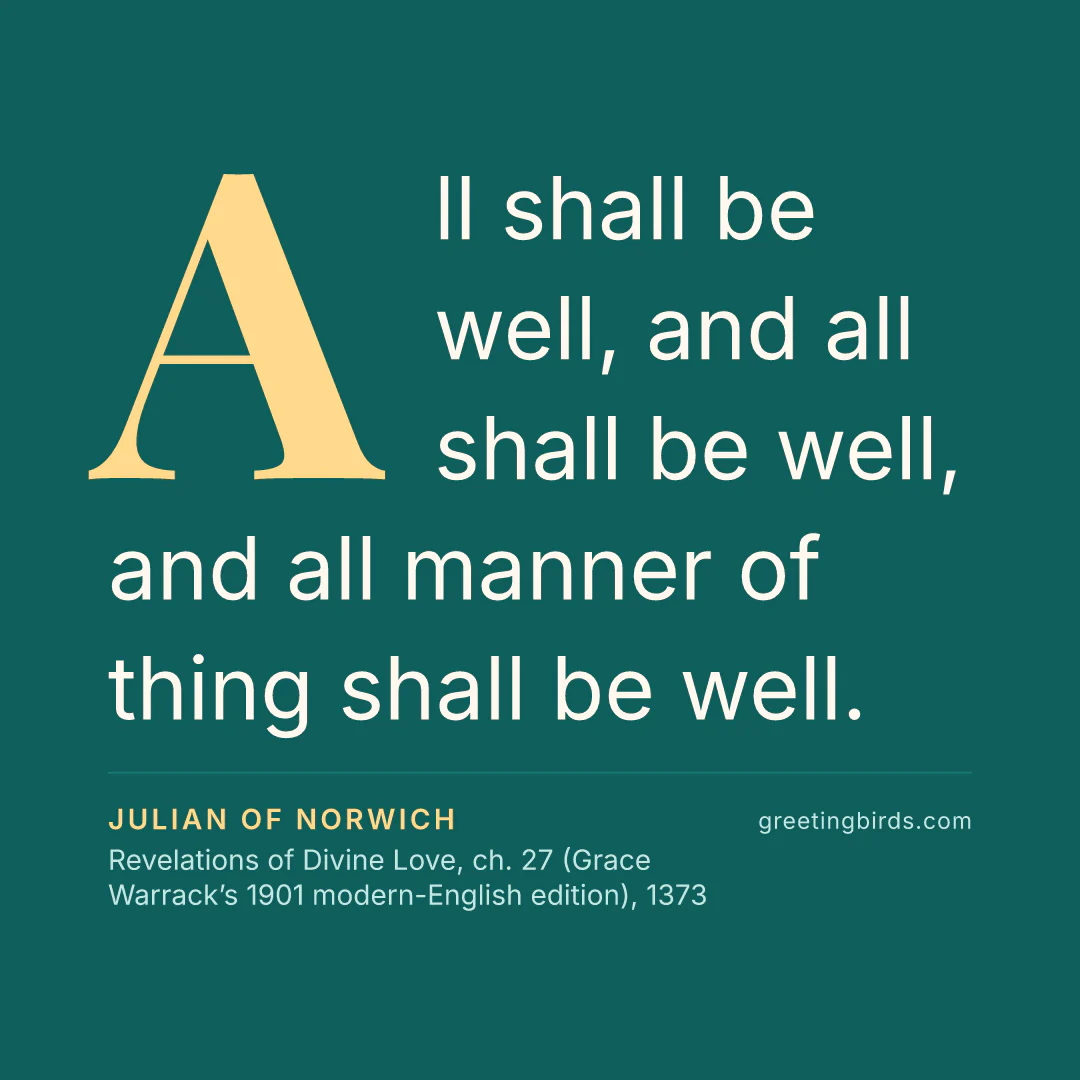
In May 1373 a woman in Norwich, England, was thirty and a half years old and so ill that a priest was called to her bed. She recovered, and over the next twenty years she wrote down what she had seen in those hours. We know her as Julian of Norwich. One sentence from her book has outlived almost everything else written in English in that century: "all shall be well, and all shall be well, and all manner of thing shall be well." It is still the line people reach for when someone they love is struggling. It works because it does not pretend the trouble isn't there.
That is the short answer to what to write to someone going through a hard time: name what is hard, say you're staying, and offer one real thing. Skip the fixes and the silver linings. Here are five encouragement messages that fit almost any card or text:
- I'm not going to pretend I know how this feels. I just want you to know I'm here, today and next week too.
- You don't have to be strong in front of me. Be however you are, and I'll still be right here.
- This is a lot, and you're carrying it better than you think. Thinking of you all day.
- No need to reply. I just didn't want another day to go by without telling you I care.
- I can't fix this, but I can bring dinner, walk the dog, or sit with you. Pick one and it's done.
All 74 messages on this page were written by the GreetingBirds editors for you to copy, sign or change. They are grouped by what the person is going through, because a note for a friend waiting on test results should not sound like one for a student before finals. The few borrowed lines (Julian of Norwich, Shakespeare and the King James Bible) were checked against their original texts.
Why "All Shall Be Well" Still Works, and When It Doesn't
Julian did not write her famous line as a cheerful slogan. In the chapter where it appears, she says she had been mourning and asking why so much went wrong in the world. The answer she records does not deny the wrong. It promises that the wrong is not the end of the story:
"It behoved that there should be sin; but all shall be well, and all shall be well, and all manner of thing shall be well."
— Julian of Norwich, Revelations of Divine Love, chapter 27, from Grace Warrack's 1901 modern-English edition
Julian lived the rest of her life as an anchoress, enclosed in a cell beside St Julian's church in Norwich, where people came to her window for advice. Six centuries later T. S. Eliot repeated her words in his poem "Little Gidding" (1942), and they turn up today on hospital chapel walls and in text messages alike. The lesson for anyone writing encouragement is in the order of her sentence: she admits the trouble first, then offers hope. A message that jumps straight to "everything happens for a reason" skips the first half, and the person reading it can tell.
Use "all shall be well" when you know the person finds comfort in faith or in old words, or when the trouble is long and uncertain and you can't promise a specific outcome. Leave it out when the loss is fresh and final (a death, a diagnosis with no good path), because "well" can sound like you're asking them to feel better before they can. For grief in its first weeks, our sympathy messages for the loss of a mother are a closer fit.
| What they're facing | What helps most | What to skip |
|---|---|---|
| Illness or waiting on results | Presence, practical help, no pressure to update you | Cures, stories about other people's cases |
| Job loss | Respect for their skills, a concrete lead or reference | "It was probably for the best" |
| Breakup or divorce | Loyalty, an invitation, room to be angry or sad | Opinions on the ex, "plenty of fish" |
| Grief, months later | Saying the name, remembering dates | "Are you over it yet?" in any wording |
| Exams, a big test, a deadline | Belief in their effort, a plan for after | "Don't stress" (they will anyway) |
| A general rough season | A check-in that doesn't need a reply | Comparing it to your own worst year |
Encouragement Messages for a Friend Who's Struggling
With a close friend you can be plain and a little informal. The best friend messages show that you've noticed without making them explain.
- You've shown up for me more times than I can count. Let me return the favor. What do you need this week?
- I know things are heavy right now. You don't have to talk about it, but if you want to, my phone is on.
- Reminder from your biggest fan: a hard chapter is not the whole book.
- I'm proud of you for getting through today. That counts, even if it doesn't feel like much.
- Coffee on Saturday? We can talk about it or talk about absolutely anything else. Your call.
- You're allowed to fall apart a little. I'll hold the pieces until you want them back.
- Nobody gets to have a perfect year, but you deserve a better one than this. I'm in your corner for all of it.
When Someone Is Sick or Waiting on Test Results
Waiting is its own kind of hard. Keep these messages free of medical opinions and predictions; your job is company, not a forecast. If they're already on the mend, our recovery wishes have lighter lines for that stage.
- Waiting is the worst part, and you shouldn't have to do it alone. Want me to come with you on the day?
- I'm thinking of you before your appointment. Whatever you hear, you'll hear it with people who love you around you.
- No need to keep me updated. I'll check in on Friday, and you can tell me as much or as little as you like.
- Sending you a quiet evening, a good show and the kind of sleep that actually helps.
- I dropped soup at your door. No need to answer, just wanted you to have one less thing to think about.
- You are so much more than this diagnosis. I still see you, the same funny, stubborn person I love.
- Rest is not giving up. Take all the time you need, and let the rest of us carry the small stuff.
After a Job Loss or a Career Setback
A lost job hits both income and identity. Encouragement here works best when it is specific about their skills and, if you can, comes with something useful: a lead, a reference, an introduction.
- That company just lost the best person on its team. I'd hire you again in a heartbeat.
- I know this stings. Take a few days to be mad, and then let me help with the résumé.
- Your skills didn't go anywhere. The right place is going to be lucky to get them.
- I'm happy to be a reference, or to introduce you to Dana at my office. Just say the word. (Swap in a real name and a real offer.)
- Losing a job is a hard event, not a verdict on who you are.
- You've rebuilt before and you'll do it again. This time you won't be doing it alone.
- Thinking of you this week. Lunch is on me whenever you need a break from job boards.
Encouragement During a Breakup or Divorce
People going through a breakup often hear a lot of opinions. Offer loyalty instead, and leave the ex out of it: today's villain can be next year's co-parent or even partner again.
- I'm not here to say anything about them. I'm here for you, as long as this takes.
- You don't have to have it figured out. You just have to get through tonight, and I can help with that.
- Endings take courage, even the ones you didn't choose. I see how brave you're being.
- The house feels quiet, I bet. Come stay over this weekend. I'll make up the couch.
- Some days you'll feel free and some days you'll miss them. Both are allowed.
- You are still the person who makes everyone laugh at dinner. That person is coming back.
- Whatever you need this month (a plus-one, a moving truck, a long walk), I'm your person.
For Someone Who Is Grieving, Weeks or Months Later
Cards come in the first two weeks after a death; then most people go quiet. A note in month three or on a hard date can mean more than anything sent at the funeral.
- I've been thinking about your dad this week. I hope it's okay to say his name. I miss him too.
- I know the world has gone back to normal for most people. I haven't forgotten, and I'm still here.
- Her birthday is coming up. If you want company that day, or want to be left alone, both are fine with me.
- There's no timeline for this. Take as long as you need, and don't let anyone rush you.
- I keep remembering the way he laughed at his own jokes. Thank you for sharing him with us.
- Just checking in. You don't need to be okay to answer.
Encouragement Messages for Him, for Her, for Your Partner
With a husband, wife, boyfriend or girlfriend, the message can be more personal, and it often lands best as a note left where they'll find it: the bathroom mirror, a lunch bag, a coat pocket.
- I married you for better or worse, and I meant both. We'll get through this one together.
- You've been carrying so much lately. Tonight, I've got dinner and the kids. You've got a hot shower and a nap.
- I believe in you even on the days you don't. Especially on those days.
- Whatever happens at that meeting tomorrow, you're coming home to someone who thinks you're amazing.
- You don't have to be the strong one all the time. Lean on me for a while.
- I noticed how hard you tried today. I'm proud of you, and I love you.
- Rough week, I know. Saturday morning, pancakes, no phones. My treat.
Students, Exams and Finals Week
For a student, encouragement means trusting their preparation and giving them something to look forward to afterward. For the night before a specific exam, our best wishes for exams have shorter good-luck lines.
- You've put in the work. Now trust it, get some sleep and go show them what you know.
- One grade doesn't decide who you are. I'm proud of how hard you've been working, whatever the result.
- Finals week survival kit: water, snacks, eight hours of sleep, and a reminder that I believe in you.
- It's okay that this semester was hard. You stuck with it, and that's the part that matters.
- Call me after your last exam. We're celebrating, no matter how it went.
- Take a break, eat something green and come back to it. Your brain works better when you're kind to it.
Short Encouragement Texts You Can Send Today
A short text is the easiest message to send and often the most welcome, because it asks for nothing back. Send one, then actually follow up a few days later.
- Thinking of you. No reply needed.
- Just a reminder that you're doing better than you think.
- One day at a time. I'm here for every one of them.
- Hey, I'm proud of you. That's it, that's the text.
- Rough day? Want me to call, or just send dog pictures?
- You've handled every hard day so far. Today's no different.
- Sending a hug through the phone. Real one this weekend.
Christian Messages of Encouragement
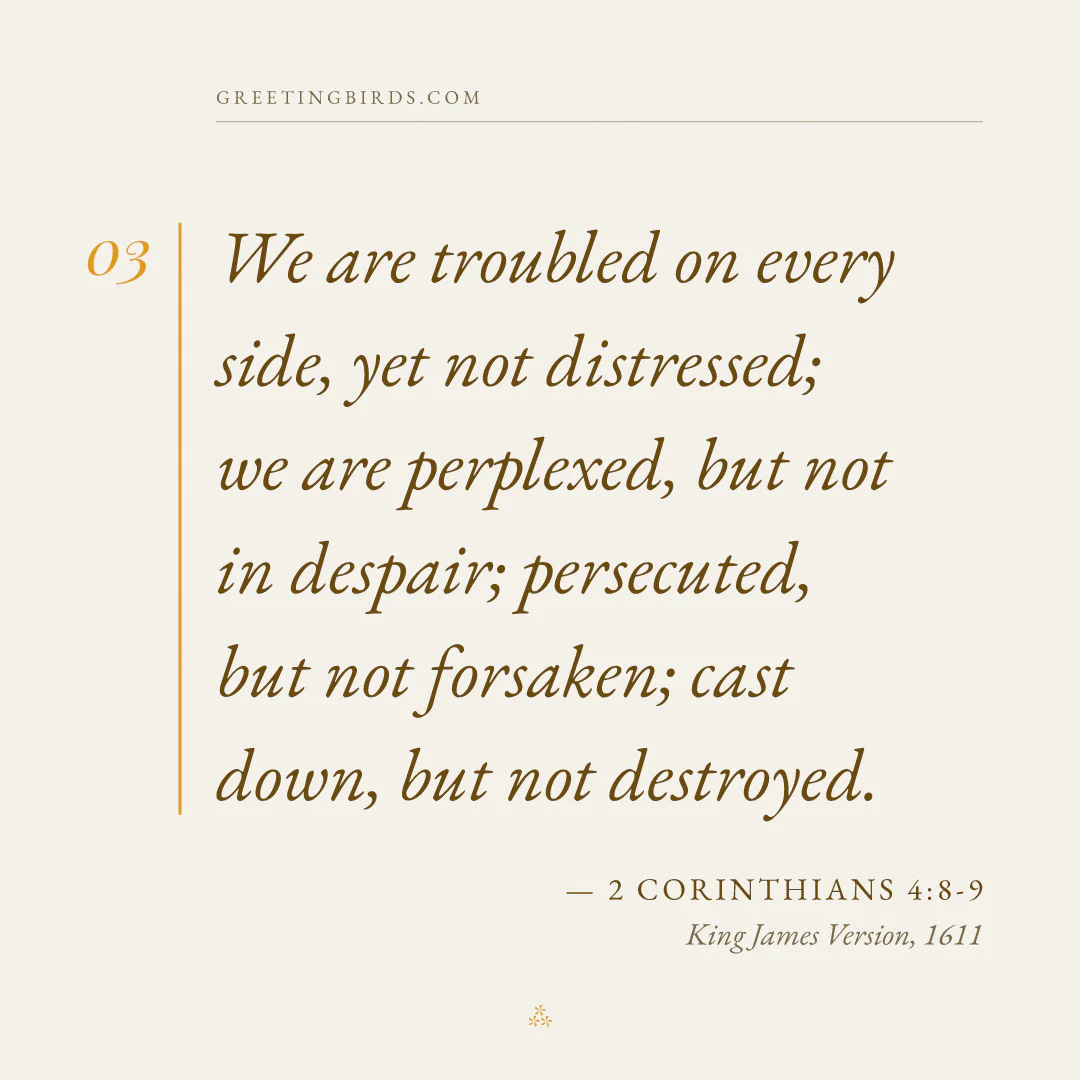
If the person shares your faith, a verse can say what you can't. Pair it with a sentence of your own so it reads as a message from you, not a sermon. One passage that names the trouble before the hope is Paul's description of hard times in his second letter to the church at Corinth:
"We are troubled on every side, yet not distressed; we are perplexed, but not in despair; persecuted, but not forsaken; cast down, but not destroyed."
— 2 Corinthians 4:8–9, King James Version (1611)
Paul's list works for the same reason Julian's line does: every phrase admits the blow before the "but." It suits a long illness, a job loss or a season of doubt. Other verses that fit encouragement cards: Joshua 1:9 ("Be strong and of a good courage; be not afraid, neither be thou dismayed: for the LORD thy God is with thee whithersoever thou goest"), Isaiah 41:10 ("Fear thou not; for I am with thee"), Matthew 11:28 ("Come unto me, all ye that labour and are heavy laden, and I will give you rest") and Galatians 6:2 ("Bear ye one another's burdens").
- Praying for you every morning this week. "Cast down, but not destroyed." That's you, friend.
- God hasn't forgotten you, and neither have I. Holding you in prayer and here for anything you need.
- Joshua 1:9 has been on my mind for you: "Be strong and of a good courage." You don't have to find the courage alone.
- Our small group is praying for you by name. Let us carry part of this for a while.
- Asking God to give you rest tonight and strength for tomorrow. Love you, sister.
- When you can't pray, I'll pray for you. That's what we're here for.
Give Sorrow Words: Lines That Invite Them to Talk
In Macbeth, Act IV, Scene 3, the nobleman Ross brings Macduff the news that his wife and children have been killed. Macduff pulls his hat down over his face and says nothing, and Malcolm tells him:
"Give sorrow words. The grief that does not speak
Whispers the o’er-fraught heart, and bids it break."
— William Shakespeare, Macbeth, Act IV, Scene 3 (c. 1606)
Four hundred years later it's still good advice for anyone trying to encourage someone: the most helpful message is often an invitation to talk, with no pressure to accept. "O’er-fraught" means overloaded, like a boat with too much cargo. The lines below open the door without pushing them through it.

- If you ever want to talk about it, I'm a good listener and I won't try to fix anything.
- You can tell me the messy version. I won't think less of you.
- How are you really doing? You can answer that honestly with me.
- I'm free Thursday night. We can talk, or just sit somewhere quiet together.
- If texting is easier than talking, text me at 2 a.m. I mean that.
Good Morning Encouragement Messages
A morning message gives someone a better start to a day they may be dreading. Keep it light and send it early.
- Good morning! New day, same you, and I'm cheering for you.
- Morning. You don't have to conquer the whole day, just the next hour. You've got this.
- Good morning to one of the bravest people I know. Coffee's on me later.
- Rise and shine, or just rise. Both count. Thinking of you today.
Write Your Own in Three Moves: See It, Stay, Offer
The messages above are starting points. The one that will mean the most is the one only you could write. Use three short sentences:
- See it. Name what is hard without dramatizing it: "I know this month has been brutal."
- Stay. Say you're not going anywhere: "I'm here, and I'll keep checking in."
- Offer. Give one specific, easy-to-accept help: "I'm dropping off dinner Tuesday unless you tell me not to."
Worked example. Say your coworker Sam (a sample name) is caring for a parent after a stroke. Put together: "Sam, I know the last few weeks have been exhausting, and you've still been showing up for everyone. I'm here, and I'm not going to stop asking how you're doing. I've got your Thursday report covered so you can take the afternoon." Three sentences, no advice, one real offer.
What to Leave Out of an Encouragement Card
Most discouraging messages come from good intentions. These are the phrases to skip, with a better version of each:
- "Everything happens for a reason." It asks them to find meaning in pain right now. Try: "I'm so sorry this is happening."
- "At least…" Any sentence that starts with "at least" shrinks the problem. Try: "That is a lot to carry."
- "I know exactly how you feel." Even if you've been through something similar, let them tell you how they feel. Try: "I went through something like this, and I'm here if you want to compare notes."
- "Let me know if you need anything." Kind, but it gives them a job. Try a specific offer with a day attached.
- "Stay positive!" It can make people feel they're failing when they feel bad. Try: "You don't have to be positive with me."
- Medical or legal advice. Unless it's your profession and they asked, leave treatments, diets and lawsuits out.
When It's More Than a Hard Week
Sometimes encouragement isn't enough, and that is not your failure. If someone tells you they're thinking about ending their life, or you're worried they might be, you don't have to handle it alone. In the United States you can call or text 988 to reach the 988 Suicide & Crisis Lifeline, or chat at 988lifeline.org. The Lifeline says its counselors are available 24/7, that conversations are free and confidential, and that you can contact them to get help for a friend or loved one as well as for yourself. If someone is in immediate danger, call 911.
A simple message that keeps the door open: "I care about you too much not to ask. Are you thinking about hurting yourself? Whatever the answer, I'm staying right here."
Timing, Follow-Up and Card Etiquette
- Send it sooner than feels polite. A text the day you hear the news is better than a perfect card two weeks later. The card can come too.
- Follow up. The second message, a week or a month later, is the one people remember. Put a reminder in your phone.
- Text or card? Texts are best for quick check-ins and anything that needs no reply. A handwritten card is better for long troubles, grief and anything they might want to keep.
- Sign it plainly. "Thinking of you," "With you all the way," or "Love" all work. Avoid "Cheers" and anything that sounds like a sign-off at work.
- Group cards. If a team or a congregation sends one card, add a sentence each rather than just names, and let one person deliver it with an offer of practical help.
- If they don't answer, don't take it personally and don't stop. Silence often means "I read it and I can't reply yet." When they do write back, our thank-you messages include lines for thanking people who helped through a hard time, if they ask what to say.
Questions People Ask About Encouragement Messages
How do I comfort someone going through a hard time?
Listen more than you talk, say plainly that you're sorry it's happening, and offer one specific kind of help with a day attached, like dinner on Tuesday or a ride to an appointment. Then check in again a week later. You don't need the perfect words; showing up twice matters more than saying it beautifully once.
What do you write in an encouragement card?
Write three short sentences: name what's hard ("I know this has been a rough few months"), say you're staying ("I'm in your corner"), and offer something real ("Saturday coffee is on me"). Sign it with a warm closing like "Thinking of you" or "With you all the way."
What is a short message of encouragement?
A short message of encouragement is one or two lines that show you care without asking for a reply, such as "Thinking of you. No reply needed" or "One day at a time. I'm here for every one of them." Short texts work well because they are easy to read on a bad day.
How do you encourage someone without sounding fake?
Be specific and skip the slogans. Mention the real situation, something true about the person ("you've rebuilt before"), and a concrete offer. Avoid "everything happens for a reason" and "stay positive," which can sound like you're asking them to feel better for your sake.