
Sympathy Messages for Loss of Mother: 64 Words of Comfort for a Friend, a Son, a Coworker or a Late Card
64 original sympathy messages for the loss of a mother, sorted for friends, sons, coworkers and late cards, plus three checked verses and what not to say.
By GreetingBirds EditorsPublished October 22, 202613 min read

What do you say to someone whose mother has died? Less than you fear you need to. Say her name or call her their mom, say you are sorry, and offer one true thing: a memory, a quality you saw in her, or a plain promise that you are around. The 64 sympathy messages for loss of mother below are written to be copied or adapted, and they are sorted by who you are to the person grieving and how she died, from a close friend to a coworker you barely know, from a sudden loss to a long illness, and for cards that arrive late.
If the card is in front of you right now, start with one of these:
- I'm so sorry about your mom. I'm thinking of you and holding you close.
- Your mother's love is all over the person you are. I'm so sorry she's gone.
- There is no replacing a mother. I'm here for whatever you need, for as long as you need it.
- With deepest sympathy on the loss of your mother, and love to all of your family.
- No words are big enough. I'm just so sorry, and I'm here.
Pick the Opening by How Well You Know Them
Most of the worry about these cards comes from not knowing how personal to be. Use the row that matches you, then borrow a line from the matching section further down.
| You are… | Lead with | Example opening |
|---|---|---|
| A close friend or relative | Love and a specific offer | "I'm coming by Thursday with dinner, and I'll stay as long or as short as you want." |
| Someone who knew their mother | A real memory of her | "I still think about the way your mom laughed at her own jokes before she finished them." |
| A coworker or manager | Sympathy plus practical relief | "Please don't think about work. The team has your projects covered." |
| An acquaintance or neighbor | Short, warm, no assumptions | "We were so sorry to hear about your mother. You're in our thoughts." |
| Writing weeks or months later | Name the delay once, then the feeling | "I've thought of you so often since your mom died, and I'm sorry I'm only writing now." |
Short Sympathy Messages for a Card or a Text
A short message is not a lazy one. A grieving person reads dozens of cards, often in one sitting, and two honest sentences land better than a paragraph that strains for meaning. These fit a small card, a flower note or a text.
- So sorry about your mom. Sending you all my love.
- Thinking of you and your family as you say goodbye to your mother.
- She raised someone wonderful. I'm so sorry for your loss.
- Holding you in my heart today and in the days ahead.
- I'm sorry. I don't have the right words, but I have you in my thoughts.
- May the love your mother gave you carry you through this.
- Wishing you peace and gentle days while you grieve your mom.
- Your mother will be missed by so many. I'm one of them.
For a Close Friend Who Just Lost Their Mom
With a close friend you can drop the formal phrases and speak the way you normally do. The most useful thing you can add is something concrete you will do, because a grieving person rarely calls to take you up on "let me know if you need anything."
- I love you, and I'm so sorry about your mom. I'll text you every day this week, and you never have to answer.
- I'm dropping off groceries on Saturday. You don't need to come to the door.
- Your mom treated me like one of her own. I'm grieving with you, not just for you.
- There's no right way to do this. Cry, laugh, be angry, sleep all day. I'll be right here for all of it.
- I know how much you talked to her. If you ever need someone to call at that same hour, call me.
- You took such good care of her. She knew it, and I hope you know it too.
- I'll handle the kids' school runs next week. Just focus on your family.
- Whenever you want to tell me stories about her, I want to hear every one.
If You Knew Their Mother Too
A memory is the most treasured thing in a sympathy card, because it tells the family that their mother mattered outside their own house. Swap in a real detail; the brackets show where it goes. A small, specific memory (her garden, her cooking, how she answered the phone) beats a big general compliment.
- I'll always remember your mom at [the school gate / church / the block party], knowing everyone's name. She made people feel seen.
- Your mother taught me how to [make pie crust / drive stick / stand up for myself]. I think of her every time I do it.
- Her kitchen was the warmest room I knew growing up. Thank you for sharing her with all of us.
- I can still hear the way she said your name across the yard. I'm so sorry she's gone.
- Your mom's [laugh / notes in the mailbox / Sunday calls] made our neighborhood feel like a family. We'll miss her so much.
- She was the first adult who ever asked what I thought about things and actually listened. I've never forgotten it.
- Every birthday card she sent came with a little note in the corner. I kept them all, and I'm reading them tonight.
Words for a Son Who Has Lost His Mother
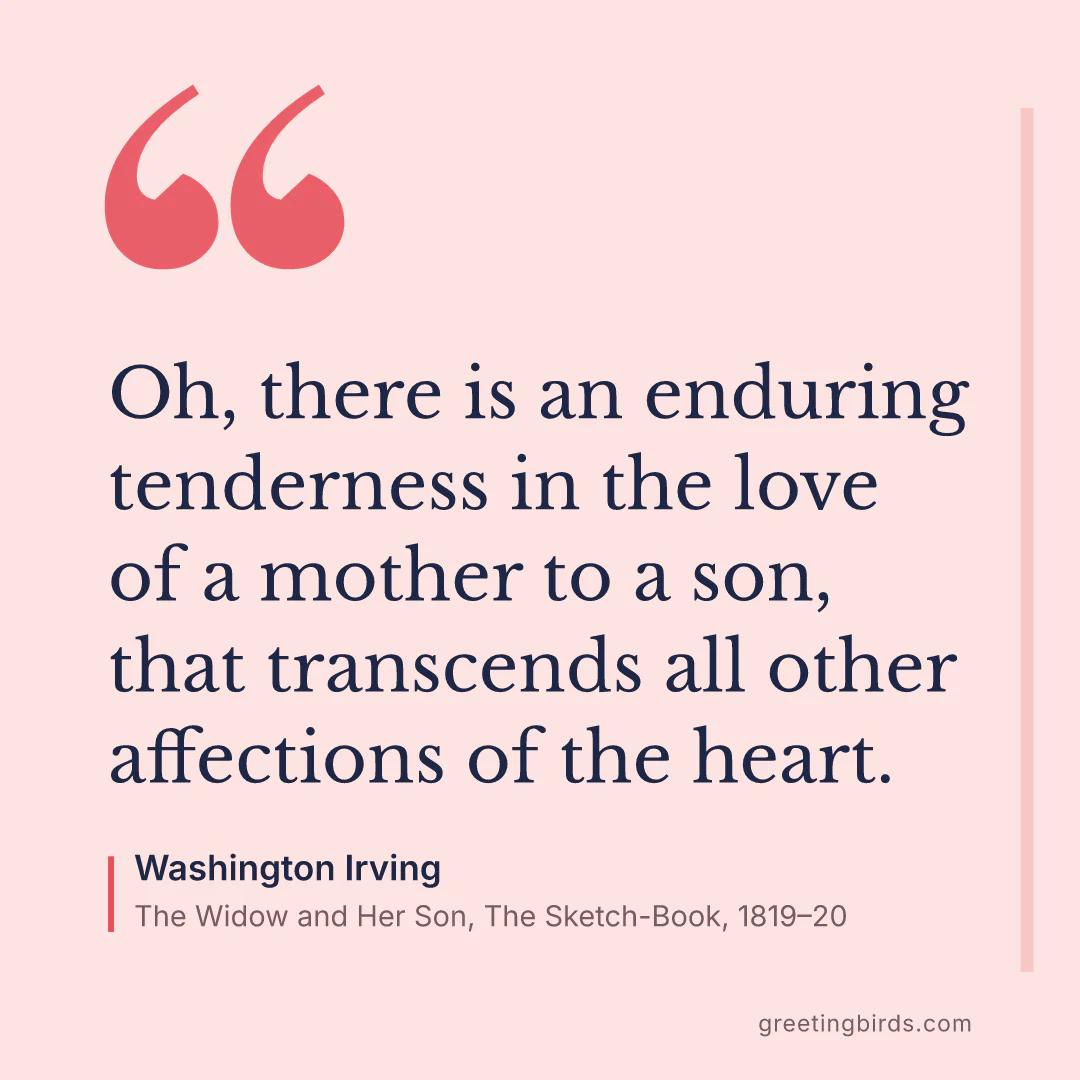
Sons are often expected to hold everything together at the funeral: handle the arrangements, steady a father, speak at the service. A card is a quiet place to tell him he doesn't have to be the strong one with you. The writer Washington Irving put the bond between a mother and her son into words in "The Widow and Her Son," a sketch about a mother nursing her grown son, published in The Sketch-Book of Geoffrey Crayon (1819–20):
"Oh, there is an enduring tenderness in the love of a mother to a son, that transcends all other affections of the heart."
— Washington Irving, "The Widow and Her Son," The Sketch-Book (1819–20)
The line works in a card for a man who was close to his mom, especially if the family is older or literary. Write it out in full, credit Irving, and add one personal sentence underneath so it doesn't read like a borrowed caption. (Text checked against the Project Gutenberg edition of The Sketch-Book.)
- You were her pride. I'm so sorry, my friend. You don't have to be strong around me.
- Your mother raised a good man, and it showed in how you cared for her at the end.
- I'm sorry about your mom. Let's get breakfast next week. We can talk about her or about nothing at all.
- Thinking of you, man. She was one of a kind, and so is the love she left you with.
- You've been looking after everyone else. Let someone look after you for a while. I'm here.
Sympathy Messages for a Coworker Whose Mother Died
At work, keep the message warm but brief, and take the work worry off the table. If you're signing a group card, one or two sentences is plenty; leave space for others. A manager's note can be a little longer and should say clearly that time off is covered.
- We're so sorry to hear about your mother. Please take all the time you need; we've got things covered here.
- Thinking of you and your family. Don't give work a second thought.
- With sympathy from all of us on the [team name] team. We're here when you're ready, and not a minute before.
- I'm very sorry for your loss. If there's anything I can take off your plate, consider it done.
- Sending you strength and our sincere condolences on the passing of your mom.
- From your manager: your leave is approved for as long as you need, and your projects are in good hands. Take care of yourself and your family.
- For a client: please accept my sincere condolences on the loss of your mother. Our deadlines can wait; I'll follow up whenever it suits you.
Religious Messages and Bible Verses for the Loss of a Mother
Use faith language only when you know the family shares it. Then a single verse, written out with its reference, can say what you can't. Three that fit a mother's death especially well, all quoted from the King James Version:
"As one whom his mother comforteth, so will I comfort you."
— Isaiah 66:13, King James Bible (1611)
Isaiah 66:13 compares God's comfort to a mother's comfort, so it speaks to the exact thing the person has lost: the one who used to comfort them. It suits a card to an adult child of faith, and it is gentle enough to read at a graveside.

"Her children arise up, and call her blessed."
— Proverbs 31:28, King James Bible (1611)
Proverbs 31:28 comes from the poem in praise of a capable woman at the end of Proverbs, and it is a tribute rather than a comfort. Use it when you want to honor the mother herself, for example in a card to the whole family or on a memorial table, and pair it with a sentence about her.
"Blessed are they that mourn: for they shall be comforted."
— Matthew 5:4, King James Bible (1611)
Matthew 5:4 is part of the Beatitudes in the Sermon on the Mount. It promises comfort without saying anything about the dead, so it fits even when you didn't know the mother well. (All three verses checked against the Project Gutenberg text of the King James Bible.)
- Praying for you and your family as you grieve your mother. May God hold you close.
- Your mom's faith was a light to everyone who knew her. May it comfort you now.
- Rest in peace to a faithful woman. We are praying for every one of you.
- May the God of all comfort give you rest and peace in the days ahead.
- She is home now, and she left so much love behind. Keeping you in my prayers.
- Lighting a candle for your mother tonight and praying for your heart.
When It Was Sudden, or After a Long Illness
How she died changes what helps. After a sudden death the family is in shock, so avoid anything that sounds like an explanation. After a long illness they are often exhausted, and may feel relief mixed with grief; let them know that is allowed, but don't call the death a blessing for them.
Sudden or unexpected:
- I'm so shocked and sorry. Nobody was ready for this, least of all you.
- There's no making sense of losing her so suddenly. I'm here for you, and I'm not going anywhere.
- I can't imagine how you're feeling. Whatever you need this week, from phone calls to dog walks, I'll do it.
After a long illness:
- You were by her side through all of it. She was so lucky to have you.
- I'm sorry. I hope you can rest now, and remember her as she was before she got sick.
- You've been grieving for a long time already. Be gentle with yourself; there's no schedule for this part.
- Her fight was long, and so was your love. Thinking of you all.
When You Can't Be There: Texts and Notes From Far Away
If distance or health keeps you from the funeral, say so simply and say what you'll do instead. Don't apologize at length; the person shouldn't have to comfort you.
- I wish I could be there with you today. I'll be thinking of your mom at 11, when the service starts.
- I can't make it to the funeral, but I'm sending flowers and all my love. I'll call next week when things are quieter.
- I'm so far away and I hate it. Please let me know if a phone call would help, at any hour.
- Not being there with you feels wrong. I'm sending a meal to your house on Friday so nobody has to cook.
- Your mom's service is in my calendar, and I'll be lighting a candle for her here. Sending love across the miles.
A Card That Arrives Late, and the Days That Come Back Every Year
A sympathy card is never too late. After the funeral, the flowers stop and the visitors go home, and a note weeks or months later often means more because the person feels forgotten by then. Mention the delay once, and then talk about their mother.
- I've thought of you so often since your mom passed, and I'm sorry it took me this long to write. She's still on my mind.
- I know the cards have slowed down by now. I'm still thinking of you and of your mother.
- It's been a few months, and I wanted you to know that I haven't forgotten her, or you.
- Thinking of you on her birthday. I hope today holds some good memories along with the missing.
- One year already. I'm remembering your mom with you today.
- I know Mother's Day is hard this year. Sending you love and remembering her with you.
Why Mother's Day is so hard after a loss: the holiday itself began as a memorial. On May 10, 1908, three years after her own mother's death, Anna Jarvis organized a service honoring her mother and all mothers at Andrews Methodist Episcopal Church in Grafton, West Virginia, and sent 500 white carnations for the people who came. By the 1920s a custom had grown up of a red carnation for a living mother and a white one for a mother who had died (Anna Jarvis, Wikipedia). A short note to someone facing their first Mother's Day without her is one of the kindest things you can send; our Mother's Day messages for mom show the other side of the day.
How to Write Your Own in Three Sentences
If none of the lines above sounds like you, write your own. Use this order:
- Say it plainly. "I'm so sorry about your mom" is better than euphemisms you would never say out loud.
- Add one true thing. A memory of her, a quality you saw, or something you noticed about how they loved her.
- Close with presence or a specific offer. "I'm bringing soup on Sunday," "I'll call next week," or simply "I'm here."
Worked example: "I'm so sorry about your mom. I'll never forget how she cheered louder than anyone at our high school games, even when we lost by thirty. I'm bringing dinner over on Sunday, and I'll leave it on the porch if you'd rather not have company."
What to Leave Out
- "She's in a better place" or "everything happens for a reason," unless you are certain of the family's beliefs. Even then, it can sound like an argument against their grief.
- "At least she lived a long life." Any sentence that starts with "at least" shrinks the loss.
- "I know how you feel." If you have lost a parent yourself, mention it in half a sentence at most ("I remember how hard the first weeks were") and then turn back to them.
- Questions about the cause of death in a card or text. If they want to tell you, they will.
- "Let me know if you need anything" on its own. Replace it with one specific offer.
Sympathy Card Etiquette for the Loss of a Mother
- Who to address: write to the person you know. If you knew the whole family, address the card to the surviving parent or "The [Last name] family," and mention the children by name inside.
- Timing: within the first two weeks is ideal, but as the section above says, a late card is still welcome.
- Signing off: "With love," "With deepest sympathy," "Thinking of you," or "Holding you close." Avoid "Best regards" or anything that sounds like an email.
- Group cards: keep your line to one or two sentences and sign your full name; the family may not know every coworker.
- Flowers or a donation: if the obituary asks for donations in lieu of flowers, follow it, and write "A donation has been made in your mother's memory to [charity]" in the card, without the amount.
- Handwrite it if you can. A text is fine for the first news, but a card is something the family keeps.
For other losses, such as a spouse, a child or a friend, our condolence messages for cards and texts are sorted by relationship, and what to say at a funeral covers the words for the service itself. If the first holidays without her are coming up, see Thanksgiving wishes for someone who lost a loved one.
Questions People Ask
What do you say when someone's mother dies?
Say you're sorry, name their mom, and offer one true thing: a memory, a quality you admired, or a specific way you'll help. For example: "I'm so sorry about your mom. She always made me feel welcome. I'll drop dinner off on Sunday."
What is a short sympathy message for loss of mother?
"So sorry about your mom. Sending you all my love," or "She raised someone wonderful. I'm so sorry for your loss." Two honest sentences are enough for a card, a text or a flower note.
Is it too late to send a sympathy card for the loss of a mother?
No. A card weeks or months later often means more, because by then the other cards have stopped. Mention the delay once ("I'm sorry it took me this long to write"), then talk about their mother.
What do you write in a sympathy card for a coworker whose mother died?
Keep it brief and take work off their mind: "We're so sorry to hear about your mother. Please take all the time you need; we've got things covered here."