
Farewell Wishes to a Colleague: 67 Messages for the Card, the Email and the Last Day
67 farewell messages for a colleague: new job, retiring, laid off, funny, short, or when you're the one leaving. Plus card etiquette and checked sources.
By GreetingBirds EditorsPublished October 19, 202613 min read
The typical American worker has been with their current employer for 4.1 years, according to the Bureau of Labor Statistics' January 2026 tenure survey. That means in any team of a dozen people, a farewell card goes around several times a year, and most of us stare at the blank space wondering what to write. The short answer: a good farewell wish to a colleague names one specific thing they did, says thank you, and wishes them well in what comes next. Two or three sentences is plenty.
Five farewell wishes you can copy into the card today:
- Thank you for making the hard weeks easier and the good weeks better. Wherever you go next is lucky to have you.
- I learned more from sitting next to you than from any training. All the best in the new role.
- The office will be quieter without you, and not in a good way. Keep in touch.
- You set the bar for this team. Go set it somewhere new. Good luck!
- It was a real pleasure working with you. Wishing you every success, and a great first day.
Below are the questions people ask most about farewell messages for coworkers, each with a plain answer and lines written by our editors for that exact situation: 67 messages in all, plus a few famous farewell lines that are actually sourced.
What Should You Write in a Farewell Card for a Colleague?
Use a three-part formula. It works for a coworker you saw every day and for someone you only knew from meetings.
- A specific memory or quality. Not "you're great," but what they were great at: the spreadsheet that saved the audit, the way they ran onboarding, the snacks drawer.
- A thank-you that names the effect. "Thanks for covering my calls in March; it made a stressful month survivable."
- A forward-looking wish. Mention the new job, the move or the retirement if you know it; keep it general if you don't.
Worked example. Say your colleague Dana is leaving the accounts team for a job in another city. Part one: "Dana, you were the person everyone went to when a number didn't add up." Part two: "Thank you for answering my questions without once making me feel silly." Part three: "Denver is getting a great accountant and a better neighbor. Good luck with the move." Read together, that is a warm, personal card message, and it took three sentences.
If you don't know the person well, the formula still works with a smaller first part: "It was good to work alongside you on the spring launch. Thank you for your help, and all the best in the new job."
How the reason for leaving changes the tone:
| Why they're leaving | Tone that fits | One-line example |
|---|---|---|
| New job or promotion elsewhere | Congratulating, upbeat | "Congratulations on the new role. They chose well." |
| Retirement | Grateful, celebratory | "Thank you for the years. Enjoy every slow morning." |
| Moving away for family or a partner | Warm, personal | "Wishing you an easy move and a happy new home." |
| Transfer to another team or office | Light, "see you around" | "Not goodbye, just a different floor. Lunch soon?" |
| Laid off or contract ended | Kind, low-key, no cheerfulness | "You were good at this job. I'm glad I worked with you." |
| Internship or short project ends | Encouraging | "You did real work here. Keep going." |
What Do You Say to a Colleague Who Is Leaving for a New Job?
This is the most common farewell, and the easiest: there is good news to celebrate. Congratulate first, then thank them. If you know where they are going, name it; it shows you were listening.
- Congratulations on the new job! They are getting someone who actually reads the whole email.
- I'm sad to see you go and happy to see you grow. Both things are true. Good luck!
- Thank you for every time you said "let me take a look." The new team will figure out quickly how lucky they are.
- You made coming to work better. I hope the next place does the same for you.
- Go show them what you showed us. Wishing you a great start.
- Every project you touched got a little more organized. Thank you, and congratulations on the next step.
- I'll miss our Monday debriefs more than I'll admit in a group card. All the best in the new role.
- You earned this move. Enjoy the new title, the new desk and the new coffee machine.
- Thanks for being the calmest person in every crisis. May your new job have fewer crises.
- We're losing a great colleague and somebody else is gaining one. Congratulations, and keep in touch.
Once they've started, a short note in their first week lands well too; our new job wishes have lines for that moment.
What Is a Short Farewell Message for a Colleague?
When thirty people are signing one card, a long paragraph crowds everyone else out. Short lines also work for a team chat, a sticky note on a box of donuts or the top of a farewell cake (keep cake text under six words).
- Thank you for everything. Good luck!
- You'll be missed. All the best.
- Best desk neighbor ever. Keep in touch.
- Go get 'em. We're proud of you.
- So long, and thanks for all the help.
- It won't be the same without you.
- Congratulations and farewell, friend.
- Thanks for the laughs and the lessons.
- Wishing you a great next chapter.
- Lucky them. Unlucky us. Good luck!
How Do You Say Goodbye to a Colleague Who Became a Friend?
When a coworker has become a real friend, the card is not the main goodbye; the drink after work is. Use the card for the thing you might not say out loud, and promise the follow-up plan in writing so it happens.
- You were the best part of a lot of ordinary Tuesdays. That doesn't stop because the badge does.
- I came here for the job and stayed partly for you. Thank you for being a friend first and a colleague second.
- Who's going to roll their eyes with me in meetings now? Lunch on the first Friday of every month. I mean it.
- You've heard all my complaints and still sat with me at lunch. That's friendship. Good luck out there.
- I'm not saying goodbye, I'm saying "text me when you get there."
- Work friends are rare. Work friends who stay friends are rarer. Let's be the second kind.
- You made a job feel like a team and a team feel like a group of friends. I'll miss you every day.
- Thank you for the late-night pep talks, the shared snacks and the honest feedback. The next round is on me.
What Do You Write to a Boss or Senior Colleague Who Is Leaving?
Keep it a notch more formal and focus on what they did for you or the team: a skill they taught you, a decision they backed, a chance they gave you. Avoid anything that sounds like flattery or a request.
- Thank you for your guidance and for trusting me with work I wasn't sure I was ready for. I've grown a great deal under your leadership.
- You showed this team what good management looks like: clear, fair and on our side. We'll carry that forward.
- Working for you has been a privilege. Wishing you every success in your next role.
- Thank you for always making time for questions, even on your busiest days. It made a real difference to me.
- Your advice to "write it down before you argue about it" has saved me more than once. Thank you, and all the best.
- The standards you set will outlast your time here. Congratulations on the next chapter.
- It has been an honor to learn from you. I hope our paths cross again.
If your manager is staying but you want to thank them for something specific, our thank-you messages cover work favors in more detail.
What Can You Write When a Colleague Is Laid Off or Leaving Unhappily?
Here the card is not a celebration, so skip "Congratulations!" and "Exciting times!" Acknowledge them as a good colleague, keep it short, and only offer help you will actually give (a reference, an introduction, a LinkedIn recommendation).
- I'm sorry this is how it ended. You were very good at your job, and I'm glad we worked together.
- This team was better because you were on it. Please reach out if a reference would help; I'd be glad to give one.
- No card can fix this, but I wanted you to know you'll be missed, and not just for the work.
- Thank you for your patience and your humor, especially this last year. Wishing you a much better next chapter.
- Whatever comes next, you bring real skill and decency to it. I'm rooting for you.
- You deserved a better goodbye than this. Let me buy you lunch soon and do it properly.
What to leave out here: "Everything happens for a reason," "At least you'll get a break," and questions about what happened. If they want to talk about it, they will.
Is It OK to Be Funny in a Farewell Message?
Yes, if the joke is about the job and not about the person, and if a stranger reading the card over their shoulder would smile too. Inside jokes are fine in a private note; in a group card, keep them understandable. Never joke about why they're leaving if the reason is unhappy.
- Congratulations on escaping. Please send help.
- Who is going to fix the printer now? Seriously. Who?
- We'll keep your mug as a shrine. And your stapler. The stapler is ours now.
- Your new coworkers have no idea how many snacks are about to appear.
- We tried to make you stay, but HR said we can't hide your car keys.
- Remember us when you're famous. Or at least when you get the corner office.
- Good luck finding a team that laughs at your jokes. We'll miss pretending to.
- The meeting that could have been an email will never be the same without your sigh.
What Do You Say to a Retiring Colleague?
Retirement is a farewell after years, sometimes decades, so the thank-you can be bigger. Mention how long they served if you know it, and wish them the specific thing they're looking forward to: travel, grandkids, the garden, sleeping past six. For a longer list sorted by who's retiring, with quotes checked against the original letters and poems, see our retirement wishes and quotes.
- Thirty years of showing up and making it better. Thank you, and enjoy every minute of what comes next.
- You taught half this office how to do the job right. Now go teach the fish who's boss.
- Congratulations on your retirement. May your mornings be slow and your coffee be hot.
- The place won't run quite as smoothly without you, and we all know it. Happy retirement.
- Thank you for your patience with every new hire, including me. Enjoy the travel, the grandkids and the freedom.
- You've earned the long weekends, the late breakfasts and the empty calendar. Happy retirement, and stay in touch.
What Should You Say When You Are the One Leaving?
Your goodbye is usually an email or a short message in the team chat, sent on your last day, ideally in the morning so people can reply before you log off. Thank people, name a few highlights, and leave your personal contact details if you want to stay in touch. It is not the place for complaints about the company.
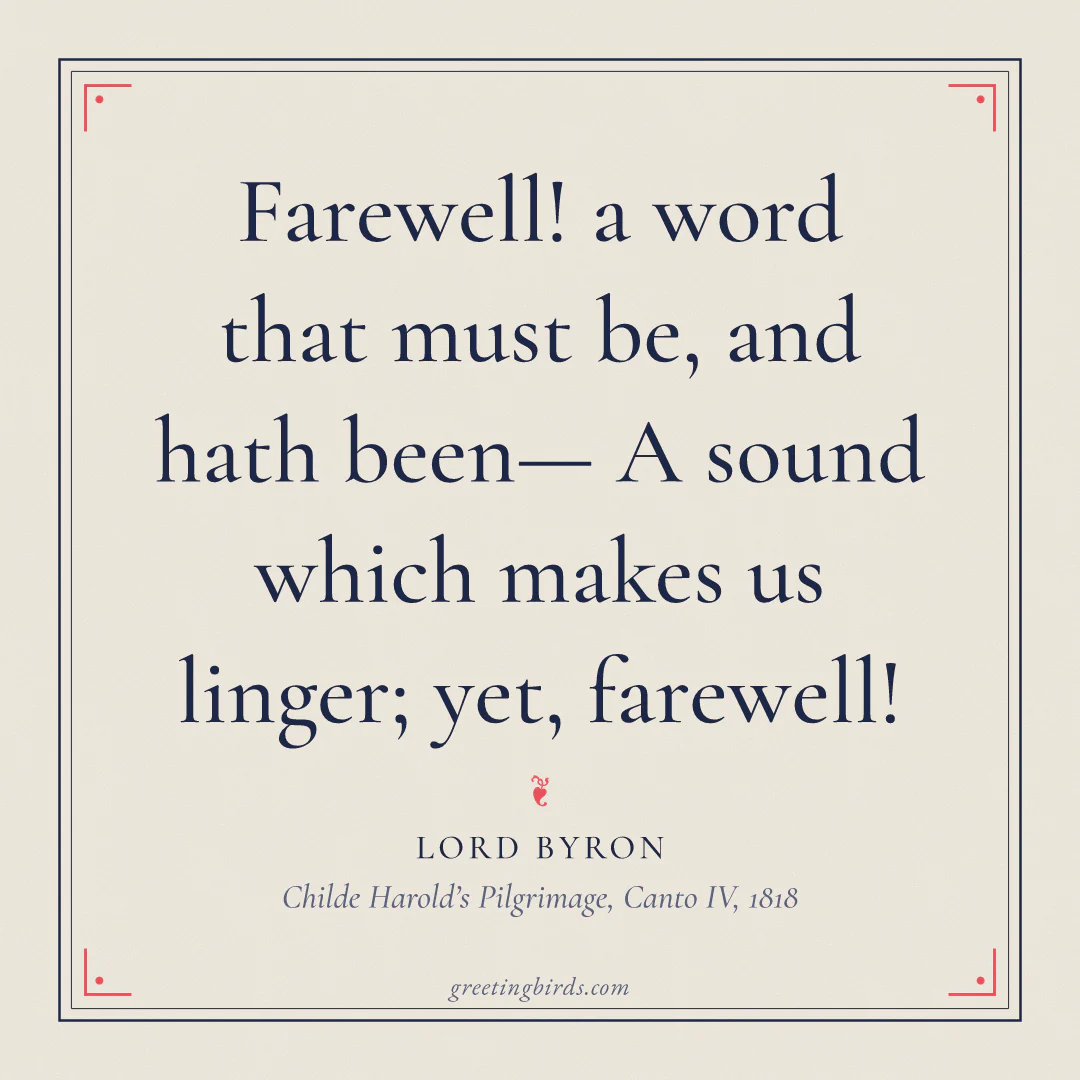
Poets have written their own goodbyes for centuries. Byron ended the last canto of his long poem by turning to the readers who had followed him to the end:
"Farewell! a word that must be, and hath been—
A sound which makes us linger; yet, farewell!"— Lord Byron, Childe Harold's Pilgrimage, Canto IV, stanza 186 (1818)
That "makes us linger" is the real temptation of a goodbye email: it's tempting to write two pages. Byron used two lines to say it, and that's the right instinct for an office goodbye too. Say the thing, thank the people, and go.
Lines for your own farewell to colleagues when you're leaving the company:
- Today is my last day. Thank you all for making this a place I was glad to come to, even on Mondays.
- I'm leaving with new skills, a few good stories and some friends I hope to keep. Thank you for all of it.
- I'll miss the people far more than the commute. Please stay in touch; my personal email is below.
- Thank you for your patience while I learned, your help when I was stuck, and your company the rest of the time.
- It's hard to leave a team this good. I'm grateful for every project we did together.
- To everyone who answered my questions, covered for me or brought cake: thank you. You made the work better.
- I'm off to a new adventure, but I'll be cheering for this team from wherever I am. Thanks for everything.
A simple goodbye email structure. Subject line: "Thank you, and goodbye" or "My last day." First line: today is your last day and where you're going, if you want to share it. Second paragraph: two or three thank-yous with specifics. Last line: personal email or LinkedIn. Send individual notes to the handful of people who mattered most; a group email can't say what those deserve.
Are There Famous Farewell Lines Worth Borrowing?
A quote can finish a card nicely, but only if it is real. Two lines from Shakespeare suit a colleague's goodbye, and both are easy to check in the plays themselves.
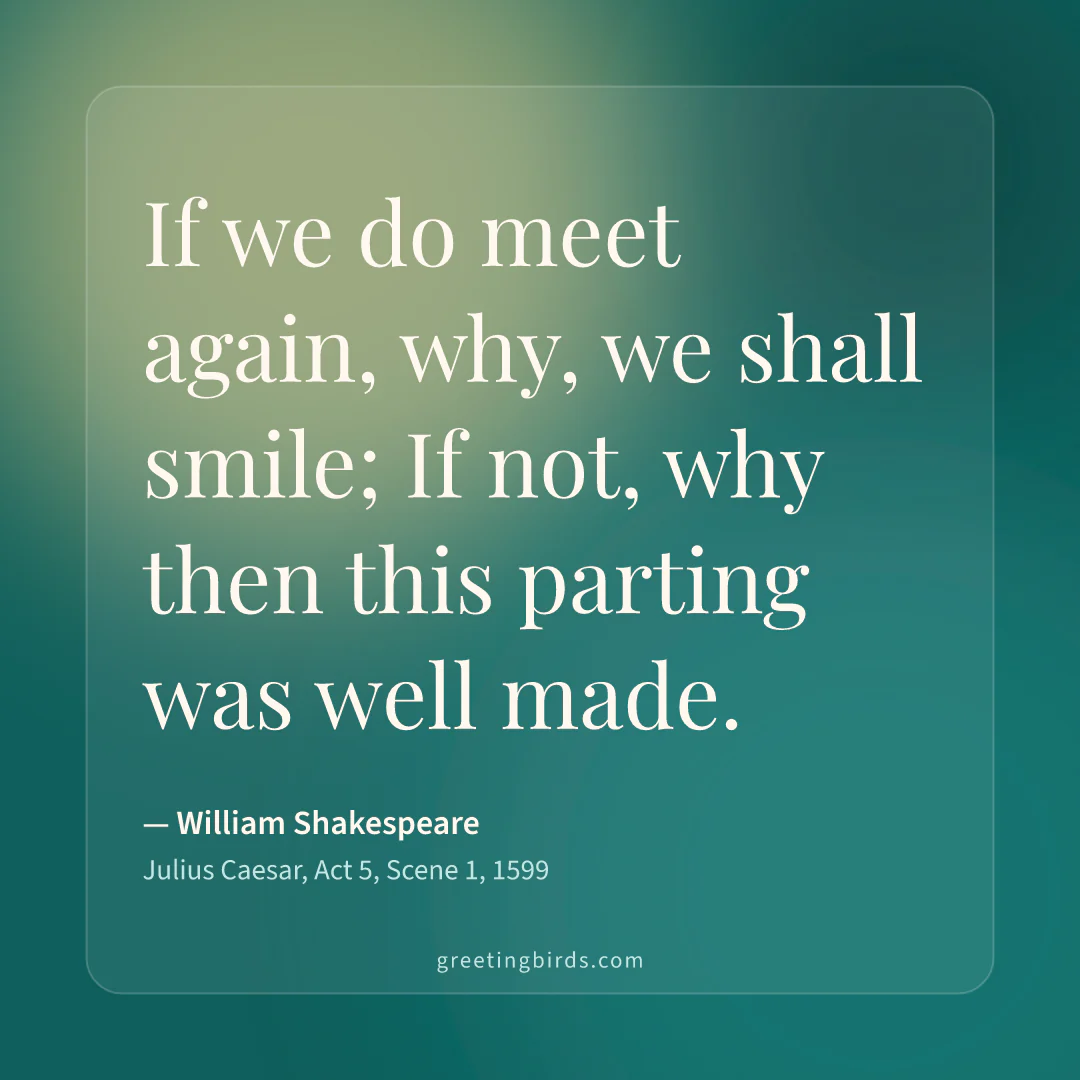
"If we do meet again, why, we shall smile;
If not, why then this parting was well made."— William Shakespeare, Julius Caesar, Act 5, Scene 1 (first performed 1599)
Brutus says this to his friend Cassius on the morning of the battle at Philippi, not knowing whether they will see each other again; Cassius answers with almost the same words. Out of that grim context, the couplet is a graceful card line for a coworker: if we cross paths again, wonderful; if not, we parted on good terms.
The other is Juliet's "Good night, good night! Parting is such sweet sorrow" from Romeo and Juliet, Act 2, Scene 2. It is romantic in the play, so use it with a work friend who will take it as a wink, not with your manager.
Two popular "farewell quotes" that aren't what they seem:
- "Don't cry because it's over, smile because it happened." Usually credited to Dr. Seuss, but Quote Investigator found no evidence he wrote or said it. The idea goes back to the German poet Ludwig Jacobowski, who wrote in 1899: "Nicht weinen, weil sie vorüber! / Lächeln, weil sie gewesen!" ("Do not cry because they are past; smile because they once were"). The Seuss link appears only from 1998, in a newspaper report on a graduation speech. If you use it, leave the name off.
- "How lucky I am to have something that makes saying goodbye so hard." Shared everywhere as a Winnie-the-Pooh quote. We searched the full texts of A. A. Milne's Winnie-the-Pooh (1926) and The House at Pooh Corner (1928): it is in neither. We found no reliable primary source, so treat it as anonymous.
What Should You Leave Out of a Farewell Message?
- "Don't forget about us!" on its own. It puts the job on them. Say "Keep in touch" and give them a way to.
- Guilt. "How could you leave us?" reads as a joke to you and as pressure to them.
- Company gossip or complaints. Cards get passed around, photographed and kept.
- Salary or "I heard they're paying you..." Never.
- Promises you won't keep. "Let's get lunch every week" is lovely once; it is awkward the fourth time you cancel.
Who Signs the Group Card, and When Should It Go Around?
- Timing: start the card about a week before the last day so it reaches everyone, including people on leave or in other offices. Hand it over on the last day, or at the farewell lunch.
- Signing: in a big team, sign with your first name and last initial (or full name) so the person knows who wrote what years later. Leave room for others; aim for the size of your hand.
- Remote teams: an online group card or a shared document works; give people a deadline two days before the last day so nobody misses it.
- Gift collections: keep contributions voluntary and anonymous. The card should never list who chipped in what.
- Your own private note: for a close colleague, a separate handwritten card or message says more than one line among forty.
Farewell cards are a cousin of the other work occasions: if your team marks milestones, our work anniversary wishes and New Year wishes for colleagues use the same "specific, short, sincere" approach.
Sources checked by our editors: U.S. Bureau of Labor Statistics, "Employee Tenure in January 2026" (released September 24, 2026); Shakespeare's Julius Caesar and Romeo and Juliet and Byron's Childe Harold's Pilgrimage (Project Gutenberg texts); A. A. Milne's Winnie-the-Pooh and The House at Pooh Corner (Project Gutenberg texts); Quote Investigator, "Don't Cry Because It's Over; Smile Because It Happened" (2016). All farewell messages above are original, written by the GreetingBirds editors.


