Thank You Messages for Coworkers: 81 Notes for Help, Support, Gifts and Your Last Day
81 original thank-you messages for coworkers, sorted by what they did: covered a shift, supported you, trained you, sent a gift. Plus a 2-step formula.
By GreetingBirds EditorsPublished October 25, 202615 min read
Work is the place where people are least likely to say thank you. In a 2,000-person survey for the John Templeton Foundation, reported by UC Berkeley's Greater Good Science Center in 2013, almost everyone said thanking colleagues made them happier, yet only 10 percent did it on a given day, and 60 percent said they never thank anyone at work or do it maybe once a year. So a short note stands out. A good thank-you message for a coworker does two things: it names exactly what they did, and it says what difference it made to you. All the messages below are original lines written by our editors, grouped by what your coworker did for you, so you can copy one or change a few words.
If you only need one line right now:
- Thank you for jumping in on [project] this week. I couldn't have hit the deadline without you.
- Thanks for having my back. It made a hard week a lot easier.
- I really appreciate you taking the time to walk me through [task]. It finally clicked.
- Thank you for the thoughtful gift, and for remembering. It made my whole day.
- Working next to you makes this job better. Thanks for everything you do.
Start With What They Did, Not With "Thanks for Everything"
"Thanks for everything" is kind, but it's forgettable. The note people keep is the one that shows you noticed something specific. Find the row that matches your reason, and use the middle column as your first sentence.
| What they did | Name this | Best channel |
|---|---|---|
| Covered a shift or a task | The day, the task, what it let you do | Direct message or sticky note, same day |
| Helped on a deadline | The deliverable and the hours they gave | Message, and mention it to your shared manager |
| Supported you through something hard | That they noticed, not the details | Handwritten card or private message |
| Trained or mentored you | One skill or habit you picked up from them | Card or email they can keep |
| Gave a gift or chipped in for one | The gift, and how you'll use it | Card, or a reply in the group thread |
| Wished you happy birthday | The cake, the card or the song | One group message |
| Carried a big team project | The result and each person's part | Team channel or a short speech |
When a Coworker Covered for You or Saved a Deadline
This is the most common reason to thank a colleague, and the easiest to get right because the favor is concrete. Say what they took on and what it gave you: time with a sick kid, a calm morning, a project that shipped on time.
- Thank you for covering my Friday shift. I got to be at my daughter's recital, and that means more than I can say.
- You stayed late to finish the slides when I was stuck. Thank you. The client loved them, and half the credit is yours.
- I owe you one (actually, I owe you several). Thanks for taking my calls while I was out.
- Thanks for catching that error before the report went out. You saved me from a very awkward Monday.
- I know you had your own deadline this week, and you still made time for mine. I won't forget it.
- Thank you for picking up the [account/project] while I was on leave. Everything was in better shape than I left it.
- You turned a panic into a plan in about ten minutes. Thanks for the help today.
- Thanks for stepping in at the meeting when I lost my train of thought. That was a real save.
Thank You Messages to Coworkers for Support
Support is harder to name than a covered shift, because often the person just noticed you were struggling and was kind about it. You don't need to retell what happened. Thank them for showing up, and keep the note private: a card in their mailbox or a direct message, never the team channel.
- Thank you for checking in on me these last few weeks. You noticed before I said anything, and that meant a lot.
- I'm grateful for your patience while I was dealing with things at home. Thank you for making work feel like a safe place.
- Your support during my [surgery/move/family emergency] made it so much easier to come back. Thank you.
- Thanks for listening without trying to fix it. That was exactly what I needed.
- You've been such a steady person to work next to this year. Thank you for your kindness.
- Thank you for the coffee, the encouragement and the reminder to take a lunch break. I needed all three.
- Thank you for standing up for me in that meeting. It took courage, and I noticed.
- Thanks for being in my corner. I hope I can do the same for you someday.
If the hard time was a death in their family rather than yours, our condolence messages for a coworker cover what to write to them.
For the Person Who Taught You the Job
The coworker who trained you, answered your questions in month one, or showed you how things really work deserves a longer note, and it can be the most meaningful one on this page. The trick is to name something you learned from them.
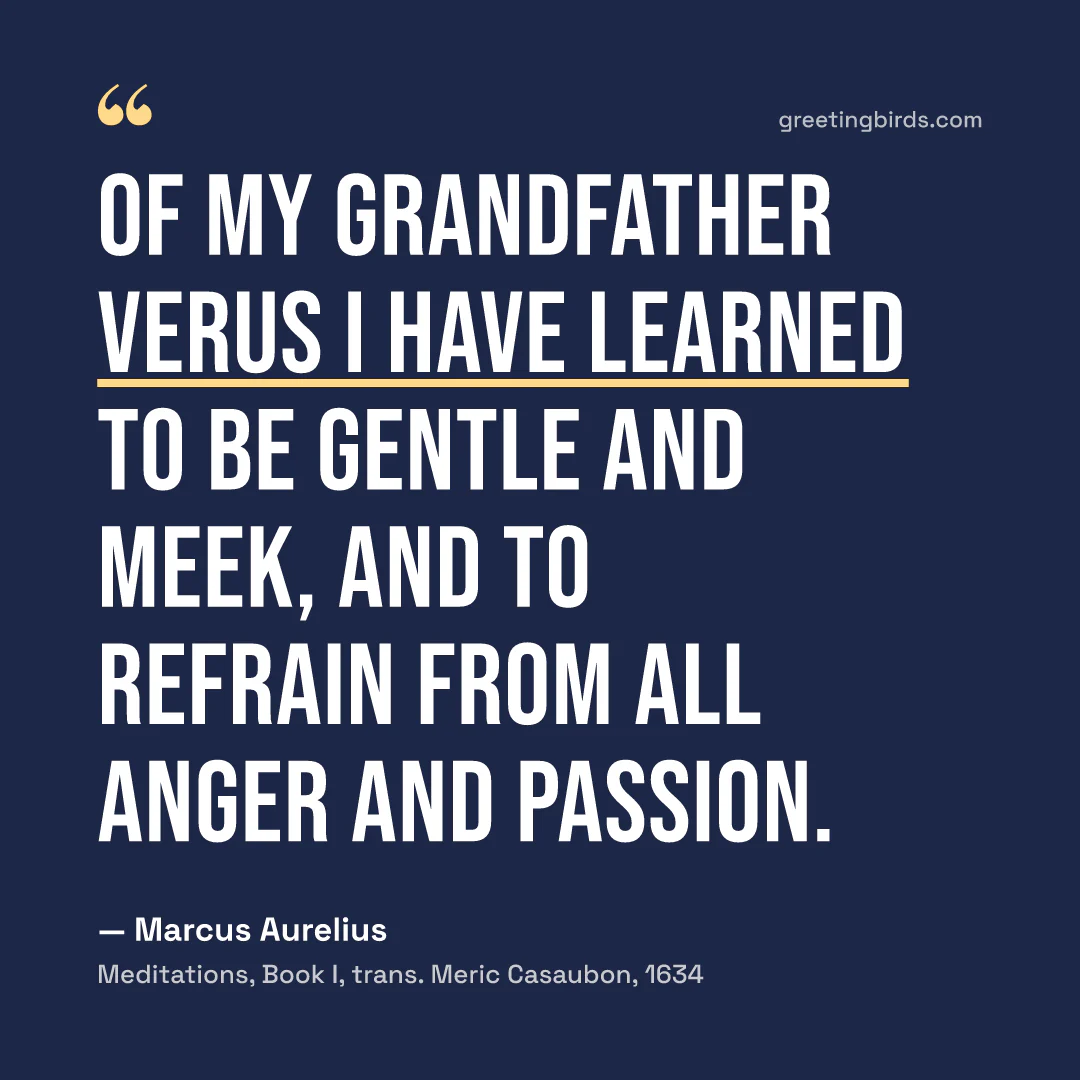
There is an old model for this kind of thanks. The entire first book of the Roman emperor Marcus Aurelius's Meditations, written around 170–180 AD, is a list of the people who taught him something, each one named and paired with the lesson. It opens like this in Meric Casaubon's 1634 English translation:
"Of my grandfather Verus I have learned to be gentle and meek, and to refrain from all anger and passion."
— Marcus Aurelius, Meditations, Book I.1, translated by Meric Casaubon (1634)
He goes on for seventeen sections the same way: from this teacher, patience; from that one, not to believe every rumor. It's a private notebook, not a card, but the pattern is the one to copy at work. "From you I learned how to [skill]" says more than any adjective. Use it in a mentor's thank-you card, or in your goodbye note to the person who trained you.
- You answered every one of my "quick questions" my first month, and there were a lot of them. Thank you for your patience.
- From you I learned how to run a meeting that ends on time. I still use your agenda template.
- Thank you for showing me the ropes, and for telling me which ropes to ignore.
- I'm better at this job because you took the time to teach me. Thank you for mentoring me this year.
- You never made me feel silly for not knowing something. That's a rare gift in a trainer, and I'm grateful.
- Thanks for the honest feedback on my first project. It stung for a day, and it helped for a year.
- When people ask who taught me [skill], I say your name. Thank you.
Thanking Coworkers for a Gift, a Card or a Collection
Whether one colleague bought you something or the whole floor chipped in, thank them within a few days and say how you'll use it. For a group gift, one message to everyone plus a word to whoever organized it is enough. Our guide to thank-you notes for gifts has lines for gift cards, money and holiday presents.
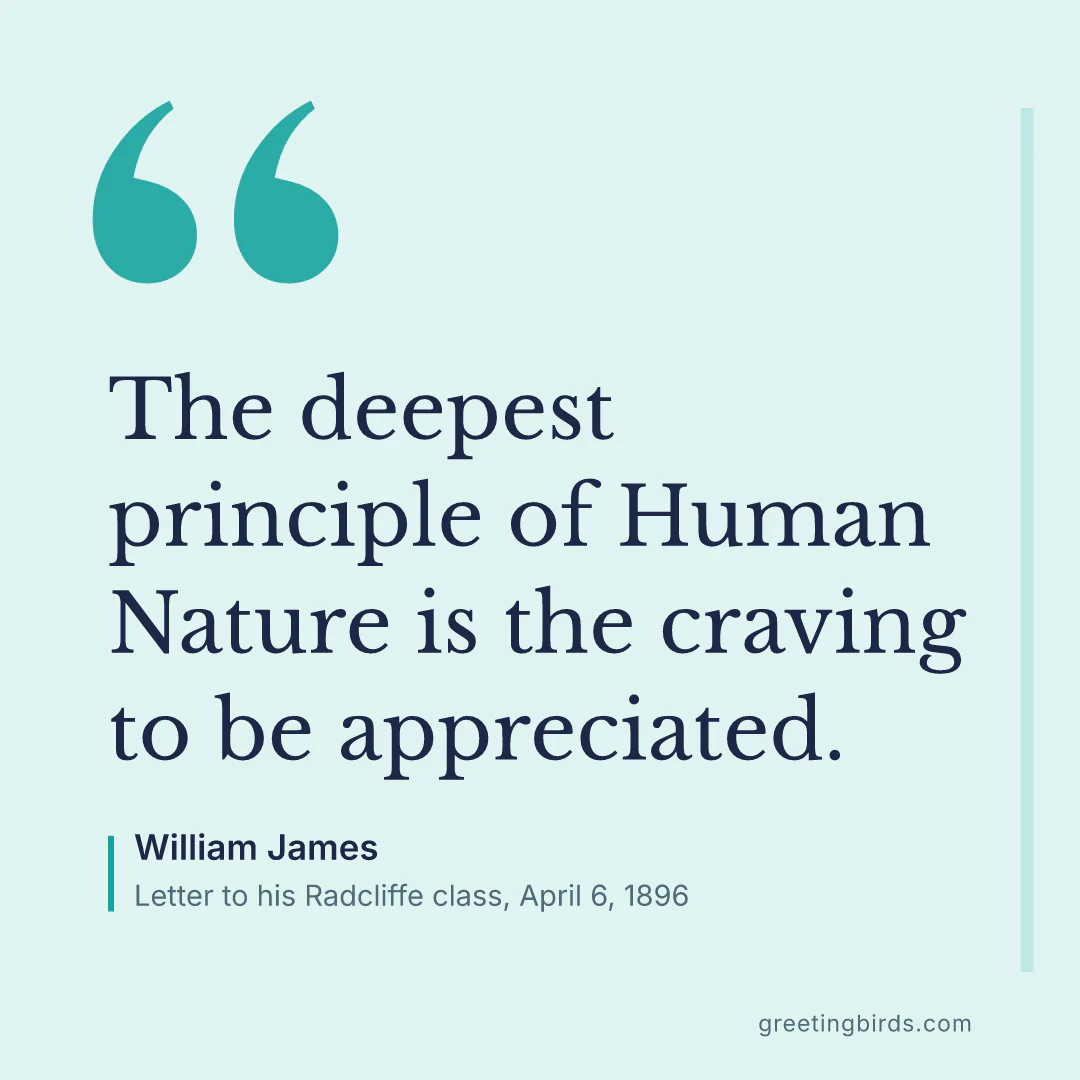
The best-known line about being appreciated came from exactly this kind of note. In April 1896, the philosopher William James wrote to his class at Radcliffe College, whose students had sent him a potted azalea at Easter:
"I now perceive one immense omission in my Psychology,—the deepest principle of Human Nature is the craving to be appreciated, and I left it out altogether from the book, because I had never had it gratified till now."
— William James, letter to his class at Radcliffe College, April 6, 1896, in The Letters of William James, Vol. 2 (1920)
The line is usually quoted on its own, slightly smoothed, as solemn advice: "The deepest principle in human nature is the craving to be appreciated." That version spread mainly through Dale Carnegie's How to Win Friends and Influence People (1936), which credits James. The real letter is funnier: James goes on to promise he'll water the azalea "even with my tears." It's a reminder that a thank-you can be warm and a little playful at the same time. Quote the short version in a card for a colleague who always remembers everyone's birthday, and credit James.
- Thank you all for the beautiful [gift]. It's already on my desk, and it makes me smile every morning.
- I was so surprised by the card and the gift card. Thank you for thinking of me. Lunch tomorrow is on me.
- Thank you for the baby gifts! [Baby's name] is already wearing the tiny [team] onesie.
- Thanks to everyone who signed the card. I read every single note, some of them twice.
- [Name], thank you for organizing this. I know how much work goes into collecting from twenty people.
- Thank you for the plant. I promise to keep it alive, or at least to try very hard.
- Your gift was so thoughtful. You clearly listened when I talked about [hobby]. Thank you.
Replying to Birthday Wishes From the Office
Office birthdays usually end with a pile of messages in a channel or an email thread. One reply to everyone is fine; you don't need to answer each person. Mention the cake, the card or the song, and keep it to two lines.
- Thank you all for the birthday wishes and the cake. You made a regular Tuesday feel like a party.
- I'm lucky to work with people who sing this badly and this loudly. Thank you for a great birthday.
- Thanks, everyone, for the kind messages today. I really appreciate this team.
- Thank you for the card and all the lovely notes. Another year with you all sounds good to me.
- So many kind words today. Thank you for making me feel celebrated.
- Thank you for remembering my birthday, and for not mentioning the number. Much appreciated.
After Get-Well Wishes, Sympathy or a New Baby
When coworkers send flowers to the hospital, sign a sympathy card or set up a meal train, a short thank-you when you return closes the loop. You don't owe anyone details. Thank them for the kindness, and tell them it helped.
- Thank you for the flowers and the get-well card while I was out. It was good to know I was missed.
- Your kind words after my [mother's] passing meant more than I can say. Thank you for the card and for your patience while I was away.
- Thank you for the meals while we adjusted to life with a newborn. We didn't cook for two weeks, and we're grateful.
- Coming back was easier because of all of you. Thank you for the welcome.
- Thanks for covering my work so I could focus on getting better. I'm back, and I'm buying the coffee.
- Thank you for your sympathy and for the donation in [name]'s memory. Our family was very touched.
Thanking the Whole Team After a Big Project
A team thank-you works best when it names more than one person and one specific result. If you lead the team, say it in the channel or the next meeting, and send a private line to anyone who went well beyond their role.
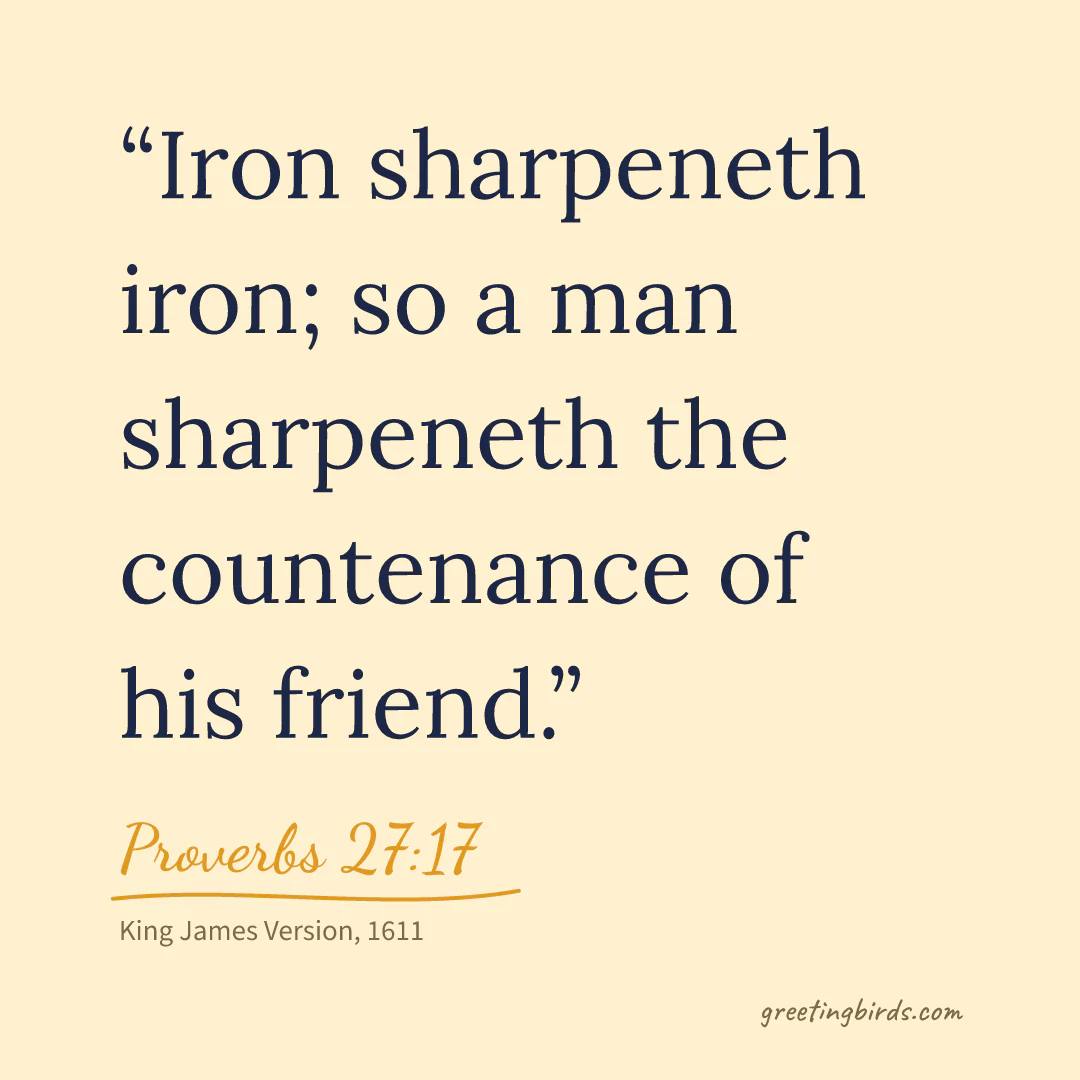
The Book of Proverbs has a line that fits a team which made each other better:
"Iron sharpeneth iron; so a man sharpeneth the countenance of his friend."
— Proverbs 27:17, King James Version (1611)
It means people who work closely together sharpen each other, sometimes through friction. It suits a team that argued its way to a good result, and it reads well on a launch-day card or the last slide of a project wrap-up.
- We shipped it. Thank you, every one of you, for the late nights and the good humor that got us here.
- Special thanks to [name] for the data, [name] for the design and [name] for keeping us on schedule. What a team.
- This project was hard, and you made it look easy from the outside. Thank you for your work.
- I've never been prouder of a group of people. Thank you for trusting each other.
- Thanks for the hard work this quarter. The numbers are great, and so was the way we got them.
- Every one of you made this better. Thank you for sharpening my ideas, and each other's.
- Thank you for pulling together when the plan changed three times. That's what a good team looks like.
Thank You and Goodbye: When You're the One Leaving
A last-day email is a thank-you note to everyone at once. Thank the group, name the people who helped you most (in the email or in separate notes), and leave a personal email or LinkedIn if you want to stay in touch. If you're the one saying goodbye to a colleague who is leaving, our farewell messages for colleagues are written for that side.
- Today is my last day, and I wanted to say thank you. I've learned more here than I could fit in this email.
- Thank you for [number] great years. I'll miss the people far more than the commute.
- To my team: thank you for the help, the laughs and the patience with my questions. I'm better at my job because of you.
- I'm excited for what's next, but I'm sad to leave a team this good. Thank you for everything.
- Thank you for making me feel welcome from my first day to my last. Please stay in touch at [email].
- Leaving is easier knowing the work is in such good hands. Thank you, all of you.
- As I head into retirement, thank you for [number] years of good work and better company.
- Thanks for every coffee run, every brainstorm and every save. I'll be cheering for you from wherever I land.
Short Thank-You Lines for Slack, Teams or a Sticky Note
Most workplace thanks happen in a chat window. One sentence is plenty, as long as it names the thing. Put it in the thread where the help happened so others see it too, unless the help was personal.
- Thanks for the quick turnaround on this. Lifesaver.
- Huge thanks for the review. Your notes made it so much better.
- Appreciate you jumping on that call with me.
- Thank you for the heads-up. That saved me an hour.
- Thanks for always answering my questions so fast.
- Couldn't have done this one without you. Thank you!
- You made my morning a lot easier. Thanks.
- Shout-out to [name] for fixing [problem] before anyone noticed.
Inspirational Lines That Still Sound Like You
Some people want a thank-you with a bit of lift, for a card or a recognition board. Keep the inspiration about the person, not about work in general, or it starts to sound like a poster.
- You make the hard parts of this job feel possible. Thank you for showing us how it's done.
- People like you are the reason this place works. Thank you for leading without a title.
- Your kindness is contagious. Thank you for setting the tone for all of us.
- You never just do the job, you make it better for everyone around you. Thank you.
- Thank you for proving that being good at your work and being good to people go together.
Funny Thank-You Messages That Are Safe for the Office
Humor is welcome between colleagues who already joke together. Keep it about the situation (the printer, the coffee, the meeting that could have been an email) and never about the person's looks, age or personal life.
- Thank you for being the only person here who knows how to unjam the printer. You're a hero.
- Thanks for listening to me complain about [project] for three weeks. Your therapy bill is in the mail.
- Thank you for keeping me caffeinated and mostly sane.
- Thanks for laughing at my jokes in meetings. That's real teamwork.
- If there were an award for best coworker, I'd nominate you. There isn't, so here's this note and a donut.
- Thanks for covering for me. Your reward is my eternal gratitude and first pick of the snacks.
Write Your Own in Two Sentences: Name It, Then Say What It Changed
A thank-you note to a coworker can be built from two parts. Most of the lines above follow this shape.
- Name it. Say exactly what they did, as specifically as you can: "covering my Friday shift," "your notes on the budget draft," "checking in on me after the move."
- Say what it changed. What could you do because of it? Meet the deadline, be with your family, feel less alone, learn a skill. This is the part people remember.
Add a third line only if it's true: an offer to return the favor, or a word of what you admire about them.
Worked example. Say a coworker (we'll call her Priya; she's a made-up example) rebuilt a spreadsheet for you the night before a review. Name it: "Thank you for rebuilding the forecast sheet on Wednesday night." What it changed: "I walked into the review calm instead of panicking, and the numbers held up to every question." Optional third: "Next time you're buried, I'm taking something off your list." Three sentences, no adjectives needed, and Priya knows exactly what she did right.
Where Workplace Thank-Yous Go Wrong
- Being vague. "Thanks for all you do" could go to anyone. Add one detail.
- Thanking in public for something private. Thank people for project help in the channel, but thank them for personal support privately.
- Burying the thanks in a request. "Thanks for yesterday! Also, can you do the next one too?" undoes the first sentence. Send the ask separately.
- Waiting weeks. A late thank-you is still better than none, but within a few days it feels most sincere.
- Over-the-top praise. "You're a legend, the best ever" can read as sarcasm at work. Specific beats superlative.
- Forgetting quieter people. On a team note, the person who did the unglamorous part (testing, scheduling, cleanup) is the one most worth naming.
Card, Chat or Out Loud? A Little Etiquette
For an everyday favor, a chat message the same day is right. For something bigger (weeks of help, support through a hard time, mentoring), a handwritten card means more, because almost nobody gets them at work anymore. If someone helped you look good to your manager, it's generous to copy that manager on the thank-you or mention it in your next one-on-one, so the credit lands where it counts. Gifts aren't expected for a thank-you between peers; a coffee or a treat is plenty, and many offices have rules on gifts to managers. When a whole team helps, thank them together, then send a private line to anyone who went far beyond their role. For thank-yous beyond the office, such as to friends, teachers or hosts, see our general thank-you messages.
Quick Answers
How do you say thank you to your colleagues?
Name exactly what they did and say what it made possible for you, in one or two sentences: "Thank you for covering my calls on Friday. It let me be at my son's game." A chat message works for everyday help; a handwritten card is better for bigger favors or support.
How do you write a short appreciation message?
Keep one specific detail and drop the rest: "Thanks for the quick review on the proposal. Your notes made it much stronger." One detail plus one result is enough for a short message that doesn't sound generic.
What is a good thank you message to send off to colleagues?
On your last day, thank the whole group, mention what you learned or will miss, and leave a way to stay in touch: "Thank you for making me feel welcome from my first day to my last. I've learned more here than I could fit in this email. Please stay in touch at [email]."
What is a powerful gratitude message?
The most powerful ones are specific, not grand: they name a moment the other person may not know you noticed, and say what it changed. "You noticed I was struggling before I said anything, and that meant a lot" will be remembered longer than any quote.