
Quotes About Being Thankful: 14 Traced to the Source, Plus 32 Lines to Use
14 quotes about being thankful, from Cicero to JFK, each with its real source and story, plus 6 viral lines we couldn't source and 32 lines to use freely.
By GreetingBirds EditorsPublished October 11, 202614 min read
In 54 BC, defending a friend in a Roman court, Cicero stopped to call gratitude "the parent of all the other virtues." People have been writing thankful lines ever since, and plenty of the ones shared online today were never written by the person they're credited to. This page keeps only the ones we could trace. That's 14 quotes about being thankful, each with who said it, where it first appeared and when, plus a note on when it fits.
Want one fast? These five are short enough for a card or a caption:
- "Gratitude is the sign of noble souls." (the moral of "Androcles," The Fables of Æsop, ed. Joseph Jacobs)
- "It is not happiness that makes us grateful. It's gratefulness that makes us happy." (Brother David Steindl-Rast, 2013)
- "In every thing give thanks." (1 Thessalonians 5:18)
- "Gratitude is happiness doubled by wonder." (G. K. Chesterton, 1917)
- "The highest appreciation is not to utter words but to live by them." (John F. Kennedy, 1963)
After the quotes you'll find a list of popular "thankful" quotes we couldn't source, a simple way to pair a quote with your own words, and 32 lines our editors wrote that you can use freely.
Being thankful for what you already have
Most of the oldest gratitude writing isn't about thanking someone. It's about noticing what's already in your hands. The Stoics treated this as a daily habit, almost an exercise.
"A grateful mind is not only the greatest of virtues, but the parent of all the other virtues."
— Cicero, Pro Plancio (54 BC)
Cicero said this while defending Gnaeus Plancius, who had sheltered him during his exile. The Latin (section 80) calls gratitude "mater virtutum omnium reliquarum," the mother of all the remaining virtues. His point was personal: he owed Plancius, and he'd rather be grateful, and be seen to be grateful, than have any other quality. That background makes it a good line for thanking someone who stood by you when it cost them something.
"Think not so much of what thou hast not as of what thou hast: but of the things which thou hast, select the best, and then reflect how eagerly they would have been sought, if thou hadst them not."
— Marcus Aurelius, Meditations VII.27, trans. George Long (1862)
This is the Marcus Aurelius gratitude line people search for most. He wrote the Meditations as private notes to himself while he was emperor, and he never meant them for readers. The passage goes on with a warning that's usually cut: don't get so attached to the good things that losing them would wreck you. For a card, the first sentence is enough. For a speech or a reflection post, the full passage is more honest.
"He is a wise man who does not grieve for the things which he has not, but rejoices for those which he has."
— Epictetus, Fragment CXXIX, in George Long's translation of the Discourses, with the Encheiridion and Fragments
Epictetus was born into slavery and later taught philosophy, and he wrote nothing down himself. This line survives as a fragment, mostly through the anthologist Stobaeus, so the wording depends on the translator. Long's version is the one most quoted in English. It fits a note to someone going through a lean year, because it doesn't pretend the losses aren't real.
"Reflect upon your present blessings—of which every man has many—not on your past misfortunes, of which all men have some."
— Charles Dickens, "A Christmas Dinner," Sketches by Boz (1836)
Dickens first published this sketch as "Christmas Festivities" in Bell's Life in London on December 27, 1835, eight years before A Christmas Carol. You'll often see it online as "every man has plenty," but the original says "many." It's a natural fit for a holiday card or a toast at a family table where the year wasn't easy for everyone.
Short thankful quotes that fit inside a card
A card usually has room for one line of quote and two of your own. These are short enough to leave space.
"Gratitude is the sign of noble souls."
— Moral of "Androcles," The Fables of Æsop, ed. Joseph Jacobs (1894)
In the fable, a runaway slave pulls a thorn from a lion's paw. Years later he's thrown to a lion in the arena, and it's the same lion, which lies down at his feet instead of attacking. Strictly speaking the moral is Jacobs's retelling, not words Aesop is known to have said, so "from Aesop's fables" is the fair credit. It's a good line for thanking someone who returned a kindness long after you'd forgotten it.
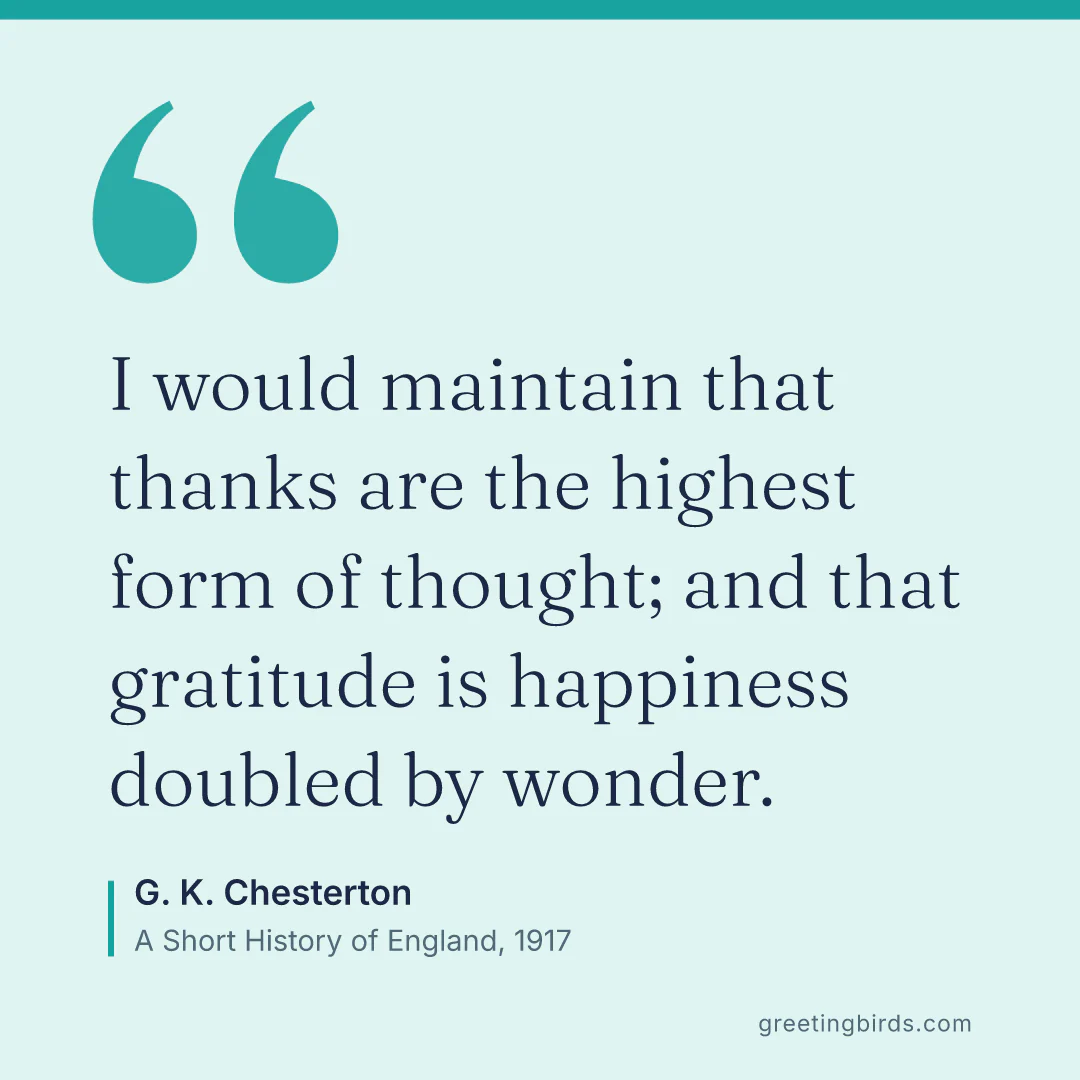
"I would maintain that thanks are the highest form of thought; and that gratitude is happiness doubled by wonder."
— G. K. Chesterton, A Short History of England (1917)
It's a surprising place for it. The sentence sits in Chesterton's chapter on the Crusades, where he's arguing that medieval people had a talent for gratitude that the modern world lost. "Happiness doubled by wonder" works on its own as a caption.
"We can only be said to be alive in those moments when our hearts are conscious of our treasures."
— Thornton Wilder, The Woman of Andros (1930)
Wilder's short novel is set on a Greek island before the birth of Christ, and it's quieter than Our Town, which came eight years later, but it circles the same idea: people rarely notice their lives while they're living them. Use it in an anniversary or retirement card, where you're thanking someone for years rather than one favor.
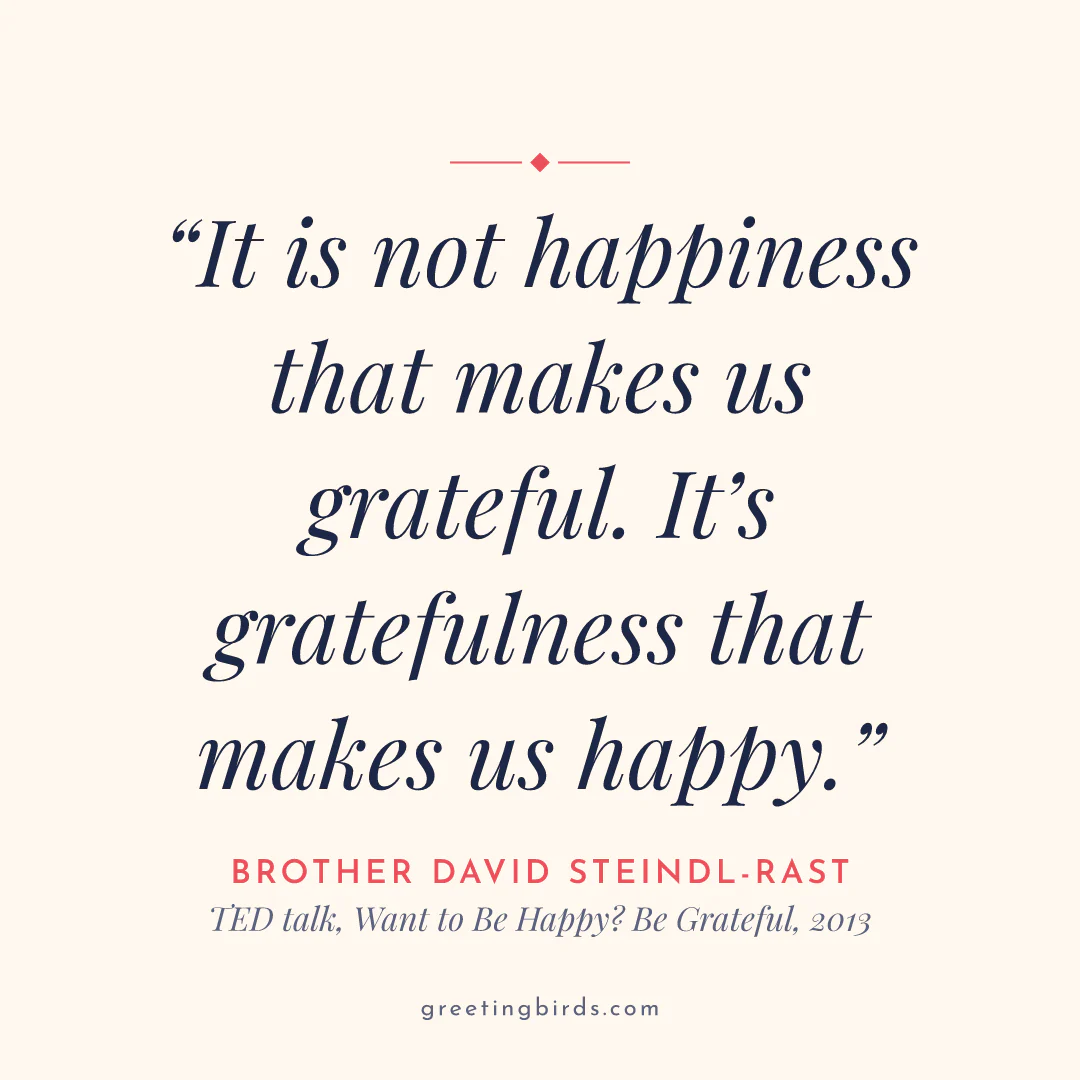
"It is not happiness that makes us grateful. It's gratefulness that makes us happy."
— Brother David Steindl-Rast, TED talk, "Want to Be Happy? Be Grateful" (2013)
Steindl-Rast is a Benedictine monk who spent decades writing about gratefulness. He gave this talk at TEDGlobal in June 2013. Quote sites usually write "It is gratefulness"; the transcript says "It's." It's the most modern line here, and it suits people who'd find scripture or Roman philosophy too formal.
Thankful to God: verses and an old prayer
If you're writing to someone with faith, or you search for "thankful quotes to God," these are the lines with the deepest roots. The verses are from the King James Version, still the most quoted in cards.
"O give thanks unto the LORD, for he is good: for his mercy endureth for ever."
— Psalm 107:1, King James Version (1611)
Several psalms open with nearly these words, and Psalm 107 goes on to list people rescued from deserts, prisons, sickness and storms at sea. It's a natural fit for a card after someone has come through a hard stretch: recovery, a safe journey home, a job found after a long search.
"In every thing give thanks: for this is the will of God in Christ Jesus concerning you."
— 1 Thessalonians 5:18, King James Version (1611)
Paul wrote this to a young church facing persecution, so "in every thing" was never meant as "only when things go well." The first four words make a complete card line. The full verse belongs in a church newsletter or a devotional post.
"O Lord, that lends me life,
Lend me a heart replete with thankfulness!"
— William Shakespeare, Henry VI, Part 2, Act 1, Scene 1 (written c. 1591)
King Henry says this on meeting his new queen, Margaret, so in the play it's a thank-you for a marriage. Taken out of the scene, it reads like a two-line prayer, and that makes it unusually good for a wedding card or a grace before a family meal.
"If a man had no more to do with God than to be thankful, that would suffice."
— Meister Eckhart, Sermon 27, Sermons and Treatises, trans. Maurice O'C. Walshe (written early 14th century)
This is the real Eckhart line behind a famous quote. The version you've probably seen, "If the only prayer you ever say in your entire life is thank you, it will be enough," doesn't appear in his writings (more on that below). The original Middle High German says "dankbaere," grateful. If you like the popular version, this one says the same thing and is actually his.
Thanksgiving quotes with a story behind them
Searches for "Thanksgiving quotes, inspirational" usually lead to the same few anonymous lines. These two come from documents you can read for yourself. For the 1621, 1789 and 1863 lines from Winslow, Washington and Lincoln, see our Thanksgiving wishes guide.
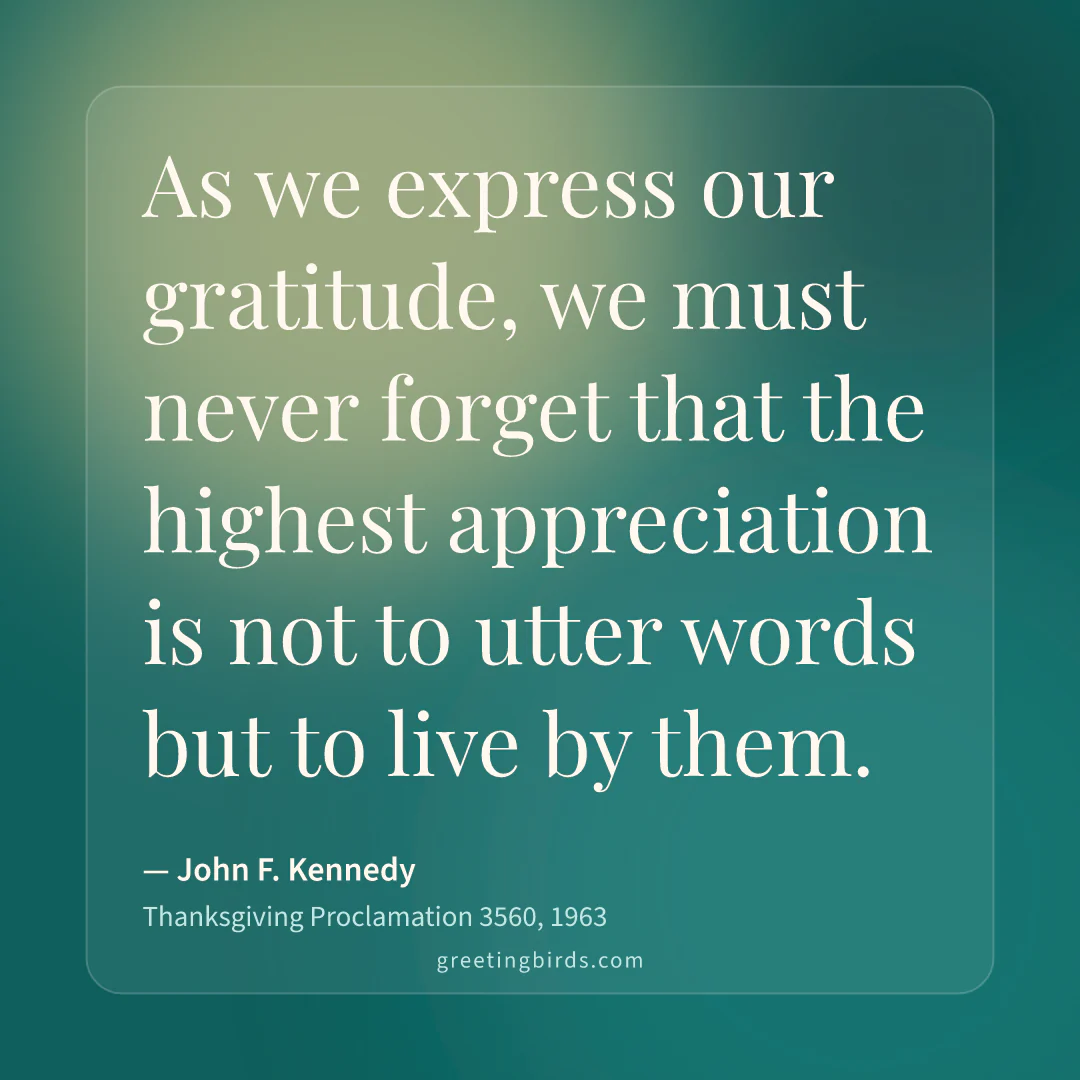
"As we express our gratitude, we must never forget that the highest appreciation is not to utter words but to live by them."
— John F. Kennedy, Thanksgiving Proclamation 3560 (1963)
Kennedy signed this proclamation on November 5, 1963, naming Thursday, November 28 as Thanksgiving Day. He was killed in Dallas 17 days later, so the country spent that Thanksgiving in mourning, and the line is often read with that in mind. Its point is practical: thanks counts most when it shows up in what you do. That makes it a strong close for a speech to volunteers or a team.
"There is one day that is ours. There is one day when all we Americans who are not self-made go back to the old home to eat saleratus biscuits and marvel how much nearer to the porch the old pump looks than it used to."
— O. Henry, "Two Thanksgiving Day Gentlemen," The Trimmed Lamp (1907)
This is the opening of O. Henry's story about a homeless man in New York, Stuffy Pete, and the old gentleman who treats him to a Thanksgiving dinner every year in Union Square. Saleratus was an early baking soda. The quote captures the going-home feeling of the holiday better than most greeting-card verse, and it works as a caption for a photo of the family porch.
Which quote fits which moment
| Moment | Quote to try |
|---|---|
| Thank-you card for a big favor | Cicero: "the parent of all the other virtues" |
| Someone having a lean year | Epictetus: "rejoices for those which he has" |
| Holiday card or family toast | Dickens: "Reflect upon your present blessings" |
| Instagram caption | Chesterton: "happiness doubled by wonder" |
| Anniversary or retirement | Wilder: "conscious of our treasures" |
| Card after an illness or hard time | Psalm 107:1 |
| Grace before a meal or wedding card | Shakespeare: "a heart replete with thankfulness" |
| Speech to volunteers or a team | Kennedy: "not to utter words but to live by them" |
Popular thankful quotes we couldn't source
These turn up on almost every gratitude list. None of them has a source we could check, and some are credited to the wrong person. You can still use the words, but don't put a name under them.
- "If the only prayer you ever say in your entire life is thank you, it will be enough." Credited to Meister Eckhart, but it isn't in his sermons or treatises. Wikiquote lists it as disputed. The genuine line is in the section above.
- "Let us rise up and be thankful, for if we didn't learn a lot today, at least we learned a little…" Shared as a Buddha quote. The researcher behind Fake Buddha Quotes traced it to Leo Buscaglia's Born for Love (1992), where he credits a Buddhist teacher he knew in Thailand, not the Buddha.
- "Feeling gratitude and not expressing it is like wrapping a present and not giving it." Always credited to William Arthur Ward, an American writer of inspirational sayings, but we found no book or article where it first appeared.
- "When I started counting my blessings, my whole life turned around." Credited to Willie Nelson. We couldn't tie it to any of his books or interviews.
- "You say grace before meals. All right. But I say grace before the concert and the opera…" Credited to G. K. Chesterton. Chesterton's 1943 biographer, Maisie Ward, says it comes from his private notebook. We couldn't check her page, so treat the exact wording with care.
- "Gratitude unlocks the fullness of life…" Melody Beattie, The Language of Letting Go (1990). The book is right, but the wording varies from site to site and nobody agrees on which day's entry it is. If you quote it, credit the book and keep it short.
How to pair a quote with your own words
A quote on its own can feel like you grabbed it from a list, which you probably did. What makes it personal is the line you write next to it. A simple three-part shape works for almost any card:
- The quote, credited correctly.
- One sentence that connects it to them: what they did, or what you noticed this year.
- A plain thank-you or wish in your own voice.
Here's a worked example for a neighbor who watered the garden and fed the cat for three weeks while you were away:
"Gratitude is the sign of noble souls." (from Aesop's fables)
Three weeks of watering, cat food and mail, and you wouldn't even let us pay you. That's the kind of neighbor the fable is about. Thank you, truly. Dinner's on us when the tomatoes come in.
A few things to avoid:
- Two quotes in one card. One borrowed line plus your own words reads warmer than a pair of famous lines.
- A quote that's bigger than the favor. Marcus Aurelius on the meaning of life is too much for someone who lent you a ladder.
- Scripture for someone who isn't religious, unless you know they'll take it kindly.
- Unsourced names. If you're not sure who said it, write "as the saying goes" instead of guessing.
For thank-you notes where you'd rather skip quotes entirely, our thank-you messages are sorted by situation: favors, gifts, hard times and work. If you're thanking one particular person for being in your life, the grateful-for-you quotes are written for exactly that.
32 thankful lines our editors wrote, for when a quote feels too big
Sometimes a famous quote is more than the moment needs. A text to a friend who drove you to the airport doesn't call for Cicero. These lines are original to GreetingBirds, so you can copy them, change them, and sign your own name without crediting anyone.
For a friend
Plain and specific works best with friends. Name the favor or the habit, and keep the thanks short enough that it doesn't get awkward.
- I don't say it enough: I'm thankful you're the person I call first.
- Thank you for showing up when it wasn't convenient. That's the kind I remember.
- This year was a lot. You made it lighter, and I'm grateful.
- Thankful for you, your terrible playlists, and every ride to the airport.
- You listened more than you talked this year. I noticed, and I'm thankful.
- Some friends are for the good times. You were there for all of it. Thank you.
For family
Family thanks can go a little deeper. A line that points to something they did years ago often means more than one about this week.
- Thankful for the table you set, every year, whether we were easy to feed or not.
- Everything I know about showing up for people, I learned watching you.
- Grateful for the phone calls I used to rush and now look forward to.
- Thank you for the ordinary days. They turned out to be the good ones.
- We don't say it out loud much in this family, so here it is in writing: thank you.
- Thankful for a home I can still come back to.
Blessed and thankful (faith)
For church friends, a grandparent, or anyone who'd welcome a blessing. These pair well with the verses above.
- Counting my blessings this year, and you are near the top of the list.
- Thanking God for the people He put at my table, and you're one of them.
- Blessed beyond what I deserve, and thankful for every bit of it.
- May you feel how much you're appreciated, today and every day.
- Grateful for grace I didn't earn and people I couldn't replace.
- Praying you have a season as full of good things as you've made mine.
For a coworker or team
At work, thank people for something concrete they did. It's more professional and more believable than a general "you're amazing."
- Thank you for covering for me in March. I haven't forgotten.
- Grateful to work with people who answer the hard emails first.
- This project worked because you kept it organized. Thank you.
- Thankful for a team that laughs on deadline day.
- You made being new here a lot easier. I appreciate it.
- Thanks for the patience, the second opinions, and the coffee runs.
Short captions for a photo or post
Under 10 words, so they still read on top of a picture or in a story.
- Full table, full heart.
- Counting the good stuff today.
- Thankful, and not just today.
- More grateful than this caption can hold.
- Good people, good food, good year.
- Small things, big thanks.
- Gratitude looks a lot like this.
- Same people, another year. Thankful.
Writing a Thanksgiving card in particular? Our Thanksgiving card wishes are shorter and sized for the inside of a card.
What researchers found when people counted their blessings
The idea that writing down what you're thankful for changes how you feel has been tested. In 2003, psychologists Robert Emmons and Michael McCullough published three experiments in the Journal of Personality and Social Psychology (vol. 84, no. 2, pp. 377–389). Some participants were randomly assigned to list things they were grateful for, weekly in the first study and daily in the second. Others listed hassles or neutral events. The third study involved adults with neuromuscular disease.
The gratitude groups, in the authors' words, "exhibited heightened well-being across several, though not all, of the outcome measures." That "though not all" matters. Gratitude isn't a cure, and not every measure improved. But it's a good reason to send the note: writing it down seems to help the writer too.
Questions people ask about thankful quotes
What is Marcus Aurelius' most famous quote about gratitude?
"Think not so much of what thou hast not as of what thou hast" from Meditations VII.27, in George Long's 1862 translation. He goes on to warn against becoming so attached to good things that losing them would disturb you.
How do you express gratitude to someone with a quote?
Pick one short, correctly credited quote, then add a sentence about what that person actually did and a plain thank-you in your own words. The personal sentence is what makes the quote feel meant rather than copied.
What is a short quote about being thankful?
"Gratitude is the sign of noble souls," the moral of Aesop's "Androcles" in Joseph Jacobs's collection, and "In every thing give thanks" (1 Thessalonians 5:18) both fit easily on a card or a caption.
Did Meister Eckhart say "If the only prayer you ever say is thank you, it will be enough"?
Not in those words. No primary source contains it. His real sermon line is "If a man had no more to do with God than to be thankful, that would suffice."


