
Grateful for You Quotes: 2 Sourced Lines and 45 Messages for a Card, Text or Toast
Two sourced 'grateful for you' quotes plus 45 original messages for a partner, friend, parent, coworker or teacher, and a 3-step way to write your own.
By GreetingBirds EditorsUpdated October 13, 20267 min read

To tell someone you are grateful for them, name them, name one specific thing, and say what it changed: "Dana, you stayed late to help me finish the move, and I stopped feeling alone in it. I'm grateful for you." Specific beats big. Here are five lines you can copy right now.
- I'm grateful for you, and not only on the days you're helping me. Just on the days you exist.
- Thank you for being the person I don't have to explain myself to. I'm grateful for you.
- Some people make a day easier. You make a whole year easier. Grateful for you.
- If I could frame one thing from this year, it would be you showing up. Thank you.
- I don't say it enough: I am so grateful you are in my life.
Below you will find two real quotes with their sources, then 40 more messages sorted by who you are writing to, and a short guide to writing your own. If you only need a plain thank-you for a favor or gift, see our thank you messages page; this one is for the bigger, quieter sentence, "I'm glad you're in my life."
Two "grateful for you" quotes you can cite
Most "grateful for you" quotes on the web are unsigned or wrongly credited. These two we could trace to a primary text, and both say what the phrase means: thanks for a person, not for a thing.
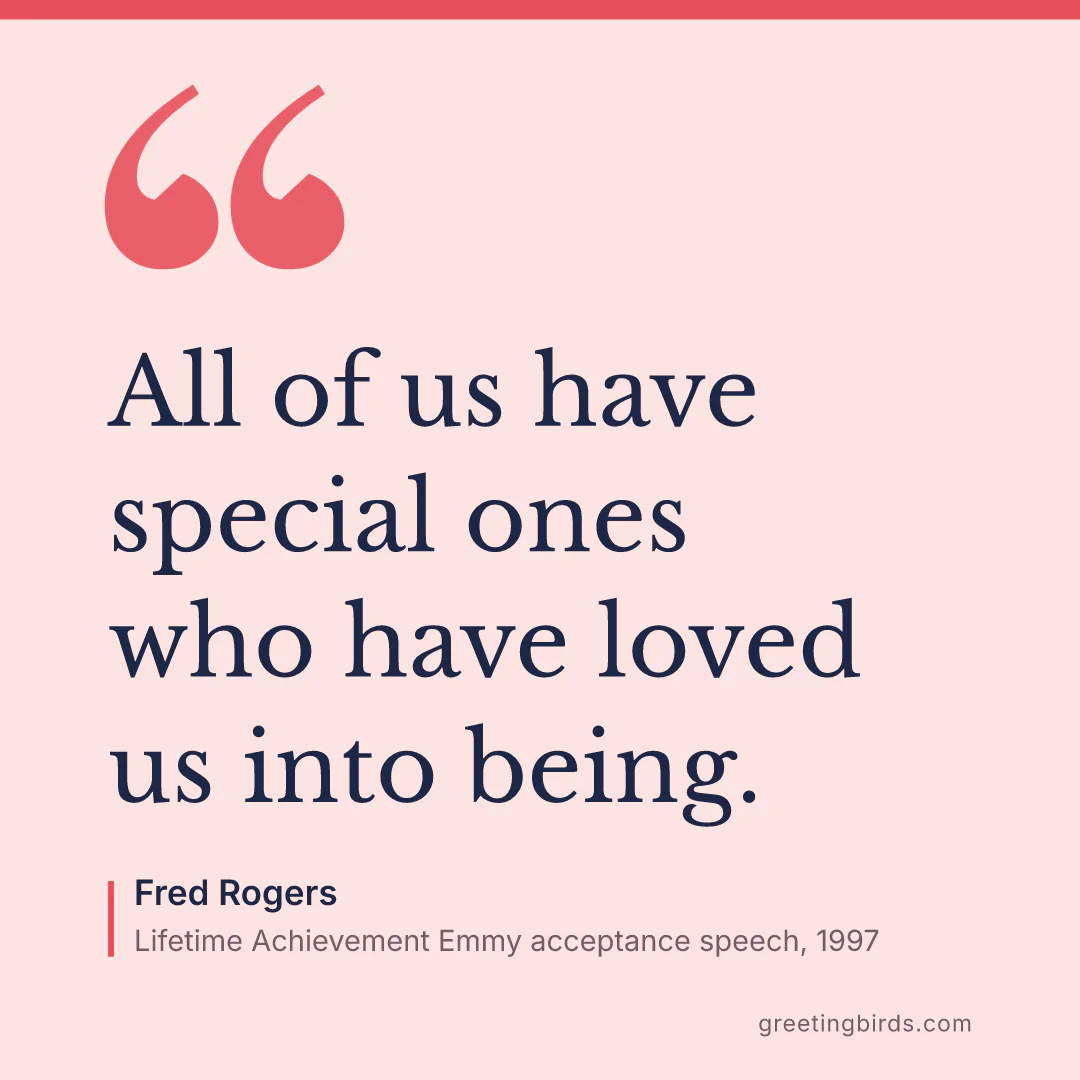
"All of us have special ones who have loved us into being."
— Fred Rogers, Lifetime Achievement acceptance speech, Emmy Awards (1997)
Fred Rogers said this at the 1997 Emmy Awards, accepting a Lifetime Achievement award. He then asked the room to take ten seconds of silence to think of the people who had helped them become who they are, and added that those people would be pleased to know the difference they had made (transcript on Speakola). It works on a card to a parent, a teacher or an old friend, and it gives you a ready-made exercise: before you write, spend your own ten seconds.
"I thank my God upon every remembrance of you."
— Paul, Philippians 1:3, King James Version (1611)
This is Philippians 1:3 in the King James Version (1611), the opening of the apostle Paul's letter to the church at Philippi. It is among the oldest "grateful for you" lines in English, and it suits a believer writing to a friend, a mentor or a congregation. Notice what it thanks for: not a gift, but remembering the person. If your reader is not religious, borrow the shape instead: "I think of you and I'm thankful."

For more traced lines on gratitude in general, see quotes about being thankful.
What to write depending on who you are thanking
| Who | Best length | Tone | Example opener |
|---|---|---|---|
| Partner | 2–3 sentences, card or note | Warm, specific | "Of all the things I'm grateful for this year…" |
| Close friend | 1–2 lines, text | Light, honest | "Random, but I'm grateful for you." |
| Parent | 3–4 sentences, handwritten | Sincere | "I understand now what you did." |
| Coworker or boss | 1–2 sentences, email or card | Professional but real | "Thank you for how you handled…" |
| Teacher or mentor | Short paragraph | Respectful | "You changed how I think about…" |
For your partner
Here, gratitude lands best when it names an ordinary habit instead of a grand gesture. Keep it to what is true; one real detail is worth more than three adjectives.
- I'm grateful for you every morning, usually before I'm awake enough to say it.
- Thank you for being steady when I'm not. I'm grateful for you more than I show.
- You make ordinary Tuesdays feel like something I'd choose again. Grateful for you.
- Of all the things I'm thankful for, the list starts and ends with you.
- I'm grateful you listen to the long version of my stories. And for laughing at the same parts.
- Thank you for loving me on the days I'm hard to love. I don't take it for granted.
- Whatever this year brings, I'm glad I get to face it with you. Grateful, always.
- You are my favorite person to be quiet with. Thank you for that gift.
For a close friend, by text
Friends rarely get a formal thank-you, which is why a short, slightly casual one stands out. Send it on a day that is not a birthday.
- No reason, I just wanted you to know I'm grateful for you.
- You answered when I called at a bad hour. I haven't forgotten. Thank you.
- Friends like you are the part of my life I'd never want to lose track of. Grateful.
- Thanks for being the one who tells me the truth kindly. Grateful for you.
- If you ever wonder whether you matter to me: you do. A lot.
- Grateful for you and for every dumb inside joke we've collected.
- I got lucky when we met. Still grateful.
- Thank you for staying friends through the busy years. It meant more than you know.
For a parent or grandparent
Many adults wait years to say this. A handwritten card is ideal; it can be short. Avoid turning it into a list of old grievances settled.
- Thank you for everything you did that I didn't notice until I was older. I'm grateful for you.
- You taught me how to show up, mostly by doing it. I see it now, and I'm thankful.
- I'm grateful for the way you made our house feel safe.
- Thank you for the sacrifices you never mentioned.
- Everything good in how I treat people started with you. Grateful, Mom.
- Dad, you didn't say much, but you were always there. Thank you.
- Grandma, I'm grateful for your patience, your cooking and your belief in me, in that order.
- I may not say it enough: I'm thankful you're my family.
For a coworker, boss or team
At work, be specific and brief, and say what the person's help allowed. A line like this is easy to forward to a manager, and people keep them. For Boss's Day specifically, see Boss's Day wishes.
- Thank you for making the handoff painless. I'm grateful to work with you.
- I'm grateful for how you explain things without making anyone feel behind.
- You made a hard quarter manageable. Thank you for being on this team.
- I appreciate that you assume good intent. It makes the whole department easier to work in.
- Thanks for sticking up for the plan when it was unpopular. I noticed.
- I'm grateful for the way you teach by example.
- Thank you for trusting me with that project. I'm grateful for the chance.
- This team is better because you're on it. Grateful for you.
For a teacher or mentor
The most welcome note tells them where the lesson ended up. Even a sentence about what you do now because of them is enough.
- You saw something in me before I did. I'm grateful for you.
- Years later, I still use what you taught me about writing a clear sentence. Thank you.
- Thank you for being patient with the questions I was afraid to ask.
- You made hard things feel possible. I'm grateful for the push.
- I'm grateful for the time you gave when you didn't have to.
- Because of you, I kept going. Thank you.
- Your encouragement is a thing I still carry. Grateful for you.
- A good teacher changes a life without announcing it. You did. Thank you.
Teachers get particularly little thanks; our teachers' day wishes have more lines for them.
Write your own in three steps
- Name the person. "Maria," not "you guys."
- Say the specific thing. "You drove an hour to pick me up."
- Say what it changed. "I stopped feeling stranded."
Then close with "I'm grateful for you." Example: "Maria, you drove an hour to get me from the airport and never mentioned it. I stopped feeling stranded. I'm grateful for you."
Keep away from three things: "grateful for everything" with nothing specific, thanks that ends with a favor to ask, and long lists of compliments you don't mean.
Does saying it actually matter?
Psychologists have tested it. In a 2005 study in American Psychologist (Seligman, Steen, Park and Peterson, "Positive Psychology Progress"), people who wrote a letter of gratitude and delivered it in person reported more happiness a month later than a control group. By six months the effect had faded, which is a fair argument for saying it more than once a year. Kumar and Epley's 2018 work on thank-you letters, covered on our thank you message page, found senders underestimated how much recipients would value them.
A line you will see attributed, and we could not confirm
The saying "Let us be grateful to people who make us happy; they are the charming gardeners who make our souls blossom" is widely shared and credited to Marcel Proust. We searched the C. K. Scott Moncrieff translation of Within a Budding Grove on Project Gutenberg and did not find it, so we left it out rather than guess its source.