
13 Wishes Ritual for the Winter Solstice: Steps, 2026 Dates and 53 Wish Ideas
How to do the 13 wishes ritual: both calendars with 2026 dates, step-by-step guide, where the custom comes from, 53 wish ideas and 24 solstice greetings.
By GreetingBirds EditorsPublished October 14, 202614 min read
The winter solstice of 2026 arrives on Monday, December 21, at 20:50 UTC, which is 3:50 p.m. Eastern and 12:50 p.m. Pacific, according to the U.S. Naval Observatory's season tables. That evening brings the longest night of the year in the Northern Hemisphere, and it is the night many people start the 13 wishes ritual.
The short answer: write 13 wishes for the coming year on 13 separate slips of paper, fold them so they all look the same, and keep them in a bowl. For 12 nights, draw one slip without reading it and burn it safely. When the 12 nights are over, one slip is left. Open it: that wish is the one you work on yourself in the new year. If you need a starting point tonight, here are five wishes in the form that works best on a slip:
- I sleep well most nights and wake up with energy.
- Our home feels calm, and we eat dinner together more often.
- I finish the project I keep putting off and share it with someone.
- I see my oldest friend in person at least twice this year.
- Money feels steady, and I stop checking my account in a panic.
Below you'll find both calendars people use (solstice start and Christmas start, with the exact 2026–27 dates), the steps, where the custom really comes from, a simple way to word your wishes, 48 more wish ideas grouped by life area (53 in all), 24 winter solstice greetings to send to friends, and how to burn the slips without burning anything else. Our editors wrote every wish and greeting here; copy and change them freely.
Solstice Start or Christmas Start: The Two Calendars
Most write-ups give only one set of dates, which is why people end up confused about when the "12 nights of Yule wishes" begin. Both versions are in use. The older German custom the ritual borrows from, the Raunächte (or Rauhnächte), is counted two ways too: German Wikipedia's article says they are usually the twelve days from Christmas Day, December 25, to Epiphany on January 6, while in some regions they run from St. Thomas's Night, December 21 (the solstice), to New Year.
| Version | 2026–27 dates |
|---|---|
| Solstice start | Write: Mon, Dec 21. Burn: Dec 21 to Fri, Jan 1. Open the last slip after the Jan 1 burning. |
| Christmas start (Raunächte) | Write: Thu, Dec 24 or Fri, Dec 25. Burn: nights of Dec 25 to Tue, Jan 5. Open the last slip on Wed, Jan 6. |
Pick the solstice start if the year's turning point means more to you than Christmas, or if your house is quiet before the holidays and loud after. Pick the Christmas start if December 21 lands in the middle of work deadlines and travel, or if you like ending on Epiphany. Neither is "the correct one"; just keep the count at 12 burning nights so one slip is left.
How to Do the 13 Wishes Ritual, Step by Step
- Get 13 identical slips. Cut them from the same sheet so no slip is thicker or a different color. If you can tell them apart by touch, you'll start choosing.
- Write one wish per slip. Short, in the present tense, and about your own life (more on wording below). Sign nothing; the slips are for you.
- Fold each slip the same way and drop them into a bowl, jar or envelope. Shake it.
- Each night of the 12, draw one slip without reading it. Burn it in a fireproof dish, or use one of the no-flame options below. The idea is that you hand that wish over to whatever you trust: luck, God, the universe, time, your own subconscious.
- Don't peek. Not knowing which wishes went into the fire is the whole trick. It stops you from ranking your hopes.
- After the 12th night, open the last slip. That wish is yours to carry. Put it somewhere you'll see it: a bathroom mirror, a planner's first page, your phone's lock screen.
Missed a night? Burn two the next evening. Started late? Write the slips anyway and burn two or three a night until you catch up; the custom has no rulebook, and an honest late start beats skipping the year.
Where the 13 Wishes Come From (and What the Sources Leave Out)
The setting is old. The ritual itself, as far as we can tell, is not. The Raunächte are the dark nights around the turn of the year in German and Alpine folk custom. German Wikipedia gives two explanations for the name that are both centuries old: Middle High German rûch, "hairy," for the furred spirits said to roam those nights, and Rauch, "smoke," for the incense farmers and priests burned in houses and stables. The customs it lists are smoking out the rooms, not hanging white laundry outside (the Wild Hunt might take it), and fortune-telling such as lead pouring.
What that long article does not mention is anything about 13 wishes. We found no historical source for the slips-in-a-bowl version; it reads as a modern practice built on top of the old nights, and the pages that explain it today are mostly coaching, wellness and parenting blogs in German and English. Mother.ly, for example, describes it as rooted in the Rauhnächte but moved to run from the solstice to New Year's. That doesn't make it any less worth doing. It just means you can adapt it without worrying about "doing it wrong."
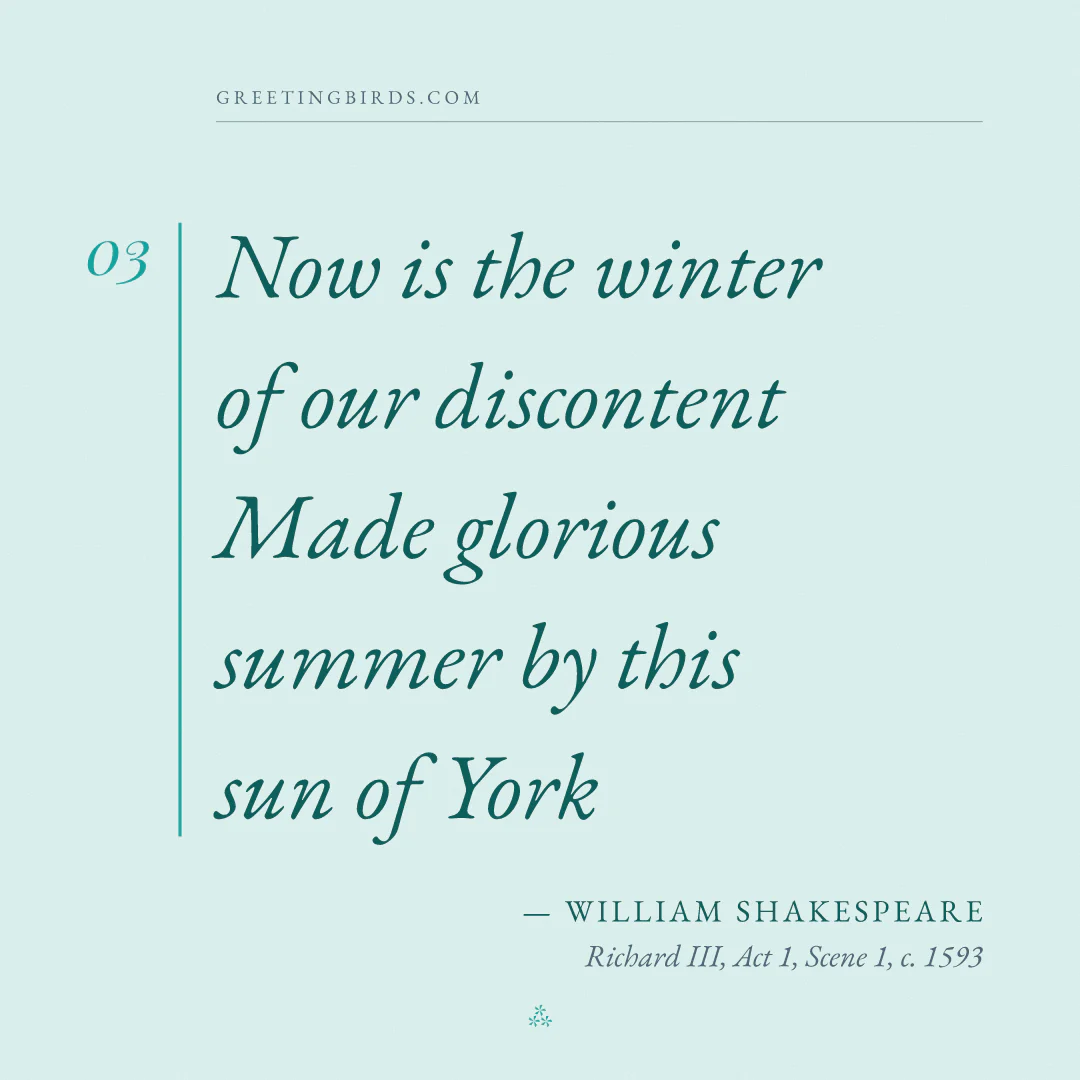
The solstice half of the story has a famous pun attached. Shakespeare opens Richard III with Richard describing his brother Edward IV's rise as winter turning to summer:
"Now is the winter of our discontent / Made glorious summer by this sun of York"
— Richard, Duke of Gloucester, Richard III, William Shakespeare (c. 1593)
In the 1623 First Folio the word is printed "Son of Yorke" (you can see it in the Project Gutenberg Folio text): Edward was the son of the Duke of York and wore a sun badge, so both readings work. It is the oldest well-known line about the light coming back after the darkest stretch, which is exactly what the longest night celebrates. The days start getting longer the morning after December 21.
How to Word a Wish So It Fits on a Slip
A wish that's too vague ("be happy") gives you nothing to work with if it turns out to be the 13th slip. A wish that's a to-do list ("go to the gym Monday, Wednesday, Friday at 6") feels like homework. Aim for the middle with this three-part formula:
Present tense + one concrete sign + how it feels.
Worked example. Start with the rough wish "I want to be less stressed about work." The concrete sign that it came true might be "I close the laptop by 6." The feeling is "and evenings feel like mine again." Put together: "I close the laptop by 6, and my evenings feel like mine again." That fits on a slip, you'd know if it happened, and if it's the one you keep, you know exactly what to do in January.
Things to avoid on the slips:
- Wishes about someone else's choices. "My sister apologizes" puts the wish in her hands. "I make peace with my sister, whatever she does" keeps it in yours.
- "Not" wishes. "I don't get sick" keeps the focus on sickness. "My body feels strong through the winter" says the same thing forward.
- Thirteen versions of one wish. Spread them over different parts of life. If 5 slips are about money, the bowl isn't really deciding anything.
- A secret you don't want found. Slips sit in a bowl for almost two weeks. If roommates or kids might read them, keep the wording private enough to survive that.
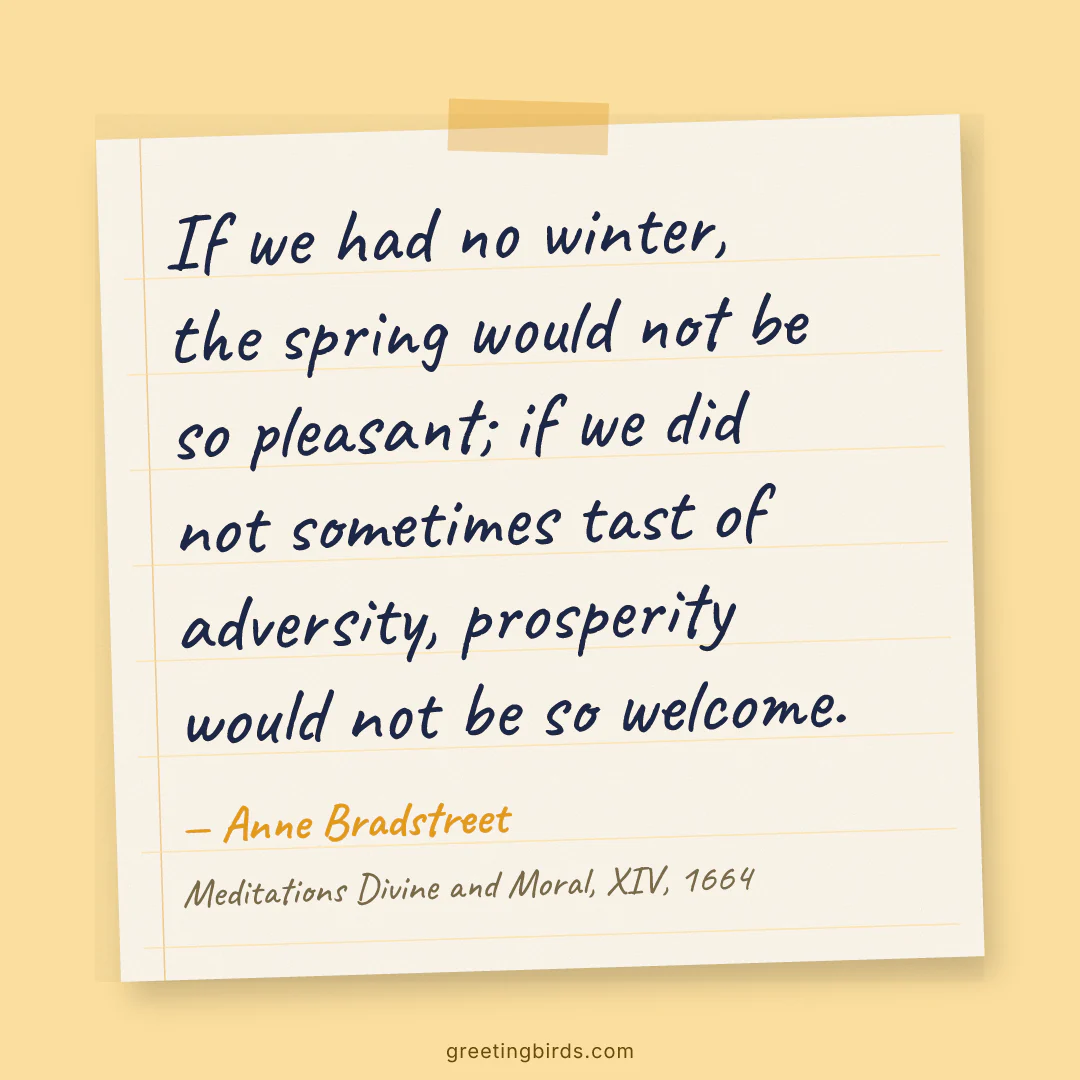
Anne Bradstreet, writing to her son Simon in a short book of sayings she dedicated to him on March 20, 1664, gave the reason the darkest part of the year is a good time to ask for things at all:
"If we had no winter, the spring would not be so pleasant; if we did not sometimes tast of adversity, prosperity would not be so welcome."
— Anne Bradstreet, Meditations Divine and Moral, XIV (1664)
The spelling "tast" is hers; the text is meditation 14 in the collection reprinted in Anne Bradstreet and Her Time. It's a useful test for your list: if a wish names something hard from this year, the slip can name what "welcome" would look like after it.
48 More Ideas for Your 13 Wishes, by Life Area
Borrow one or two from each group, then rewrite them with your own details: a name, a place, a number. A wish with your sister's name or your street in it is harder to forget than any line on this page.
Health and rest
- I sleep seven hours on most nights and stop scrolling in bed.
- My back feels good enough to carry the groceries without thinking about it.
- I walk outside every day, even for ten minutes in the cold.
- I finally book the checkup I keep postponing, and the news is good.
- I drink more water than coffee most days.
- I take a real day off every week, phone in a drawer.
Home
- Our kitchen table is clear enough to eat at every night.
- We move into a place with more light and a door that locks properly.
- The house feels peaceful when I walk in after work.
- I fix the things that have been broken so long we stopped noticing.
- Our home has room for friends to stay over.
- Something green grows on my windowsill all year.
Work and money
- I'm paid fairly for what I do, and I ask for it without apologizing.
- I have three months of expenses saved by next winter.
- My work uses what I'm good at, not just what I'm used to.
- I pay off the card with the highest interest.
- I leave work at work at least four days a week.
- A door opens that I didn't know to knock on.
Love and partnership
- We laugh together every day, even on the hard ones.
- I meet someone kind who is ready for the same things I am.
- We take the trip we've talked about for years.
- We argue less about chores and more about which movie to watch.
- I say "I love you" first, often, and mean it each time.
- Our long-distance year ends in the same city.
Family and friends
- My parents are healthy, and I call them because I want to, not because I should.
- Our family's group chat has more photos than arguments.
- I'm the friend who remembers birthdays this year.
- My kids feel safe telling me the truth.
- I make one new friend I'd call at 2 a.m.
- We host one big dinner where everyone stays too late.
Learning and creating
- I finish a book I start, and then another.
- I can hold a real conversation in Spanish by December.
- Something I made hangs on a wall, plays on a speaker or sits on a shelf.
- I take the class I keep bookmarking.
- I write every morning, even if it's one line.
- I learn to cook three dishes well enough to serve guests.
Inner life
- I forgive myself for last year faster than I did the year before.
- I feel calm in my own company.
- I say no without writing a paragraph to explain it.
- I notice good things while they're happening, not only afterward.
- My faith (or my sense of meaning) feels close and alive again.
- I worry less about what people think of me and more about how I treat them.
Wishes worth keeping if they're the 13th
Some wishes are good to put in the bowl precisely because you'd be glad to draw them as your own job:
- I'm brave enough to start the thing I've been afraid to start.
- I keep one promise to myself every single day.
- I spend this year on purpose, not on autopilot.
- I ask for help before I'm desperate.
- I end the year proud of how I treated people.
- Whatever happens, I'll be the kind of person I'd want next to me.
24 Winter Solstice Greetings to Send
The solstice is a quiet greeting occasion: no gift is expected, and a short text the evening of December 21 lands better than a long card. If you're also sending holiday cards, you'll find more card lines in our season's greetings messages and a full guide to the night before Christmas in Christmas Eve greetings.
Short texts for the longest night
- Happy winter solstice! From tomorrow, every day gets a little brighter.
- Longest night of the year. Light a candle and think of me lighting one too.
- Happy solstice. The dark is at its deepest and already on its way out.
- Wishing you a warm, slow, cozy longest night.
- The sun's coming back. So are our walks. Happy solstice!
- Happy shortest day! See you on the bright side.
For close friends
- Happy winter solstice to the friend who always brings the light into a room. The year turns tonight; I hope yours turns toward everything you're wishing for.
- On the longest night, I'm grateful for the people who make dark evenings feel short. You're at the top of that list.
- Doing the 13 wishes this year? I put "more dinners with you" on one of my slips. Happy solstice.
- Happy solstice, friend. May the returning light find you rested, loved and a little bit lucky.
- Tonight is the turning point. Here's to the friends who stayed through the dark months.
- Wishing you candlelight, good soup and a long night's sleep. Happy winter solstice.
Blessed Yule and pagan greetings
- Blessed Yule! May the reborn sun bring warmth to your hearth and light to your path.
- Merry Yule to you and yours. May the darkest night bring the brightest beginning.
- Blessings of the winter solstice to you. As the wheel turns, may you turn toward what you love.
- Bright Yule! Wishing you a full table, a warm fire and a heart that feels new.
- May the light that returns tonight stay with you all year. Blessed solstice.
- Happy Yule! Rest deep now; the growing season is coming.
For a card or a gentle note to someone having a hard winter
- Thinking of you on the longest night. It won't stay this dark, and you won't be alone in it.
- Happy solstice. Every day from here gets a little lighter, and I hope your days feel lighter too.
- Sending warmth for the darkest day of the year and every brighter one after it.
- On the solstice we remember that light always comes back. So will you. Love you.
- Wishing you a quiet, kind winter solstice and a new year that's gentler than this one.
- The longest night is also the turning point. I'm cheering for your turn.
Shelley ends one of his best-known poems on the same turn, and the last line works on its own in a solstice card:
"If Winter comes, can Spring be far behind?"
— Percy Bysshe Shelley, Ode to the West Wind (1820)
The poem was published in the 1820 volume with Prometheus Unbound; Shelley's own note says he wrote most of it in a wood by the Arno near Florence on a stormy autumn day. Written under one of the greetings above, the line gives a short card a closing that doesn't sound like a holiday slogan. Planning ahead for December 1 as well? Our welcome December wishes cover the start of the month.

Burning the Slips Safely (or Not Burning Them at All)
Small slips of paper flare up fast and drop burning bits, so treat this like any open flame in the house:
- Use a metal or ceramic dish, a cast-iron pan, or burn the slip over the kitchen sink. Keep a glass of water next to you.
- Hold the slip with tongs, not fingers, and keep it away from curtains, Christmas trees, wreaths and paper decorations.
- Do it standing up, not in bed by a candle, and never leave a candle burning after the slip is gone.
- Kids can draw the slip and say "goodbye" to it while an adult does the burning.
No flame allowed where you live (dorms, many apartments, a house with a toddler)? These keep the same idea:
- Tear the slip into small pieces without reading it and drop it into the recycling.
- Write the wishes in washable marker and dissolve each slip in a bowl of water.
- Bury the slips in a pot of soil and plant seeds in it in spring.
- Drop each one into a sealed "sent" envelope that you never open.
Bringing Kids or Friends Into It
The ritual works well as a small group thing on the solstice evening. Everyone writes their own 13 slips at the table; each person keeps their own bowl. Children under about eight do better with fewer wishes (say, six slips burned over five nights, so one is left) and wishes they can picture: "We go sledding," "Grandma visits," "I learn to ride without training wheels." Older kids may like keeping their last slip secret until the morning after the final night, then telling everyone at breakfast.
If you're adding cards or messages to the evening, keep them short and warm; a wish slip and a candle say most of it. For New Year's cards after the 12 nights, see our New Year wishes for cards.
Quick Questions
What are the 12 nights of Yule wishes?
It's another name for the same ritual: 13 wishes, one burned each of 12 nights, starting either on the winter solstice (December 21, 2026) or on Christmas night. The 13th wish is the one you keep and work on yourself.
What are the 13 days of Yule?
There's no single historical list. People who use the phrase usually mean the 12 burning nights plus the day you open the last slip: December 21 through New Year's Day in the solstice version, or Christmas through Epiphany (January 6) in the Christmas version.
What happens if I accidentally read a slip before burning it?
Nothing bad. Burn it anyway and keep going. The point of not reading is to stop yourself from choosing; one glance doesn't undo that.
Do the burned wishes "come true"?
The ritual doesn't promise that, and we won't either. What it does well is make you write down 13 specific hopes at the turn of the year, then hand you one clear goal for January.
Can I do the 13 wishes ritual on the summer solstice?
Some people do a June version, but the custom belongs to the long winter nights around the turn of the year, which is what gives the 12 nights their meaning.