Famous Christmas Quotes: 32 Lines From Books, Films and Speeches, With Sources
32 famous Christmas quotes from Dickens, Dr. Seuss, Elf, Charlie Brown and Coolidge, each checked against its source, plus card tips and saying origins.
By GreetingBirds EditorsPublished October 13, 202619 min read
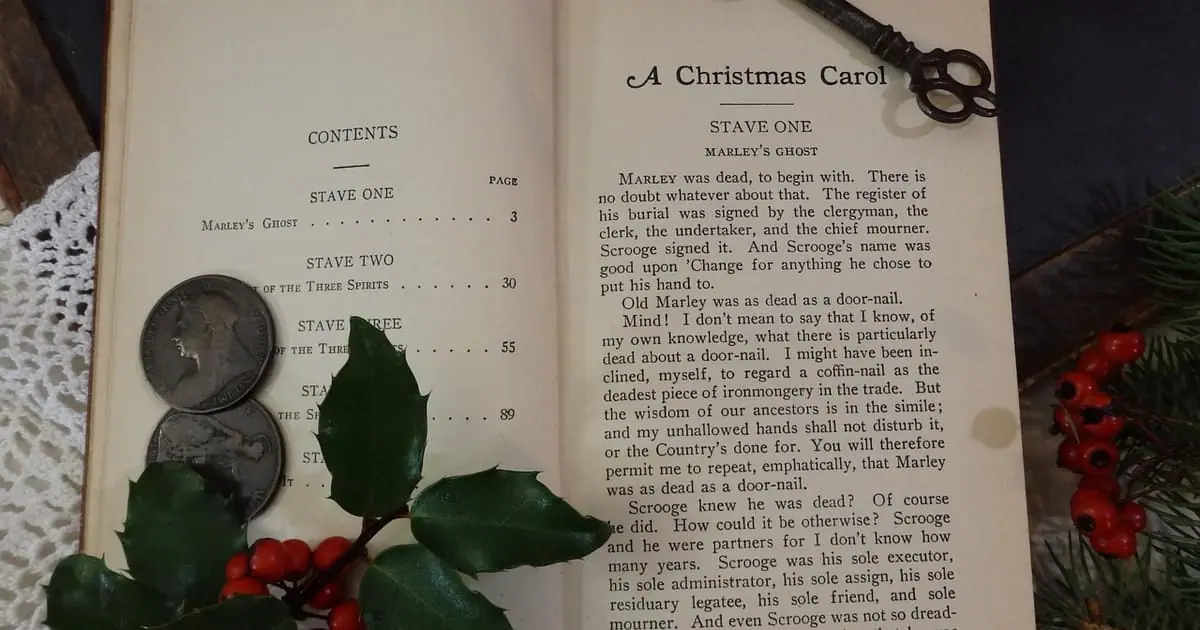
Charles Dickens published A Christmas Carol in December 1843, and more than 180 years later people still copy its sentences into Christmas cards. Most famous Christmas quotes come from a short list of sources like that: a few books, a few films, two or three speeches and the Gospel of Luke. A surprising number of them are quoted wrong.
The short answer: if you need one famous Christmas quote right now, these five are among the best known. Each one is checked against its original source.
- "I will honour Christmas in my heart, and try to keep it all the year." (Charles Dickens, A Christmas Carol, 1843)
- "Maybe Christmas," he thought, "doesn't come from a store." (Dr. Seuss, How the Grinch Stole Christmas!, 1957)
- "That's what Christmas is all about, Charlie Brown." (Linus, A Charlie Brown Christmas, 1965)
- "Christmas is not a time or a season, but a state of mind." (Calvin Coolidge, 1927)
- "The best way to spread Christmas cheer is singing loud for all to hear." (Buddy, Elf, 2003)
Below are 32 famous Christmas quotes in all, grouped by where they come from: classic books, children's stories, films, and speeches and scripture. Each one comes with the scene or situation it belongs to. After that you'll find where the short sayings on cards come from, five popular lines that are misquoted or hard to source, and a quick guide to putting a quote in a card without it sounding borrowed.
The Books That Wrote Christmas
Many of the phrases English speakers still use at Christmas were written in the 50 years between Washington Irving's essays and Little Women. These are the ones people still put in cards.
"...a good time; a kind, forgiving, charitable, pleasant time; the only time I know of, in the long calendar of the year, when men and women seem by one consent to open their shut-up hearts freely..."
— Charles Dickens, A Christmas Carol, Stave One (1843)
This is Scrooge's nephew Fred, answering his uncle's "Humbug!" in the cold counting-house on Christmas Eve. The full speech ends with Fred admitting that Christmas "has never put a scrap of gold or silver in my pocket" and blessing it anyway. "Open their shut-up hearts" is the phrase to borrow if you're writing to someone who has had a guarded, difficult year.
"I will honour Christmas in my heart, and try to keep it all the year."
— Charles Dickens, A Christmas Carol, Stave Four (1843)
Scrooge says this on his knees beside his own neglected grave, begging the last spirit for a second chance. It's often placed in the final chapter, but it belongs to Stave Four, and the original has "try to," which many versions drop. Dickens used the British spelling "honour." Keep it if you're quoting him exactly; "honor" is fine in a casual American card.

"...it was always said of him, that he knew how to keep Christmas well, if any man alive possessed the knowledge."
— Charles Dickens, A Christmas Carol, Stave Five (1843)
This comes from the book's last paragraph, after the reformed Scrooge has become "a second father" to Tiny Tim. "He knew how to keep Christmas well" is one of the best compliments you can write in a card to the person who hosts every year, or in a sympathy note for someone who loved the season.
"God bless Us, Every One!"
— Tiny Tim, quoted in the closing line of A Christmas Carol (1843)
Tiny Tim first says it at the Cratchits' small dinner in Stave Three, and Dickens ends the whole book with it. The capitals on "Us" and "Every One" are in the original. It's the safest quote on this page for a family card, because almost every generation knows it.
"It is, indeed, the season of regenerated feeling—the season for kindling, not merely the fire of hospitality in the hall, but the genial flame of charity in the heart."
— Washington Irving, "Christmas," The Sketch Book (1819–20)
Irving wrote five Christmas essays about old English customs, and this sentence opens the first of them. The popular version shortens this to "the season for kindling the fire of hospitality in the hall, the genial flame of charity in the heart," which drops "not merely" and "but" and so loses his point: hospitality is the easy part, and charity is what he's really after. Quote the full sentence, or say that you're quoting part of it.
"Happy Christmas to all, and to all a good night."
— Clement Clarke Moore (attributed), "A Visit from St. Nicholas," Troy Sentinel, December 23, 1823
The poem first ran anonymously in a New York newspaper, and Moore claimed it in his 1844 Poems, where the last line still says "Happy." The "Merry Christmas to all" ending most people recite is a later change. If you write the original on a card, someone may correct you. You can tell them it's the 1823 wording.
"Christmas won't be Christmas without any presents," grumbled Jo, lying on the rug.
— Louisa May Alcott, Little Women, Chapter One (1868)
It's the first line of the novel. The four March sisters face a poor Christmas while their father is away in the Civil War, and on Christmas morning, in the next chapter, they give their breakfast to a hungry family. On a gift tag it's a good joke between sisters, and the story behind it is about the opposite of presents.
"Then pealed the bells more loud and deep: / 'God is not dead; nor doth he sleep! / The Wrong shall fail, / The Right prevail, / With peace on earth, good-will to men!'"
— Henry Wadsworth Longfellow, "Christmas Bells," written 1864, first published in Our Young Folks, 1865
Longfellow wrote this after his wife died in a fire in 1861 and his son was badly wounded in the Civil War in 1863. That's why the poem admits despair before it gets to hope. The National Park Service's Longfellow House dates it to 1864, not the often-quoted 1863. It's the best-known Christmas poem for someone going through a hard December.
Quotes for Kids and From Children's Classics
These lines work in a child's card, a classroom display or a note tucked into a stocking. Most of them come from books written for children that adults reread every year.
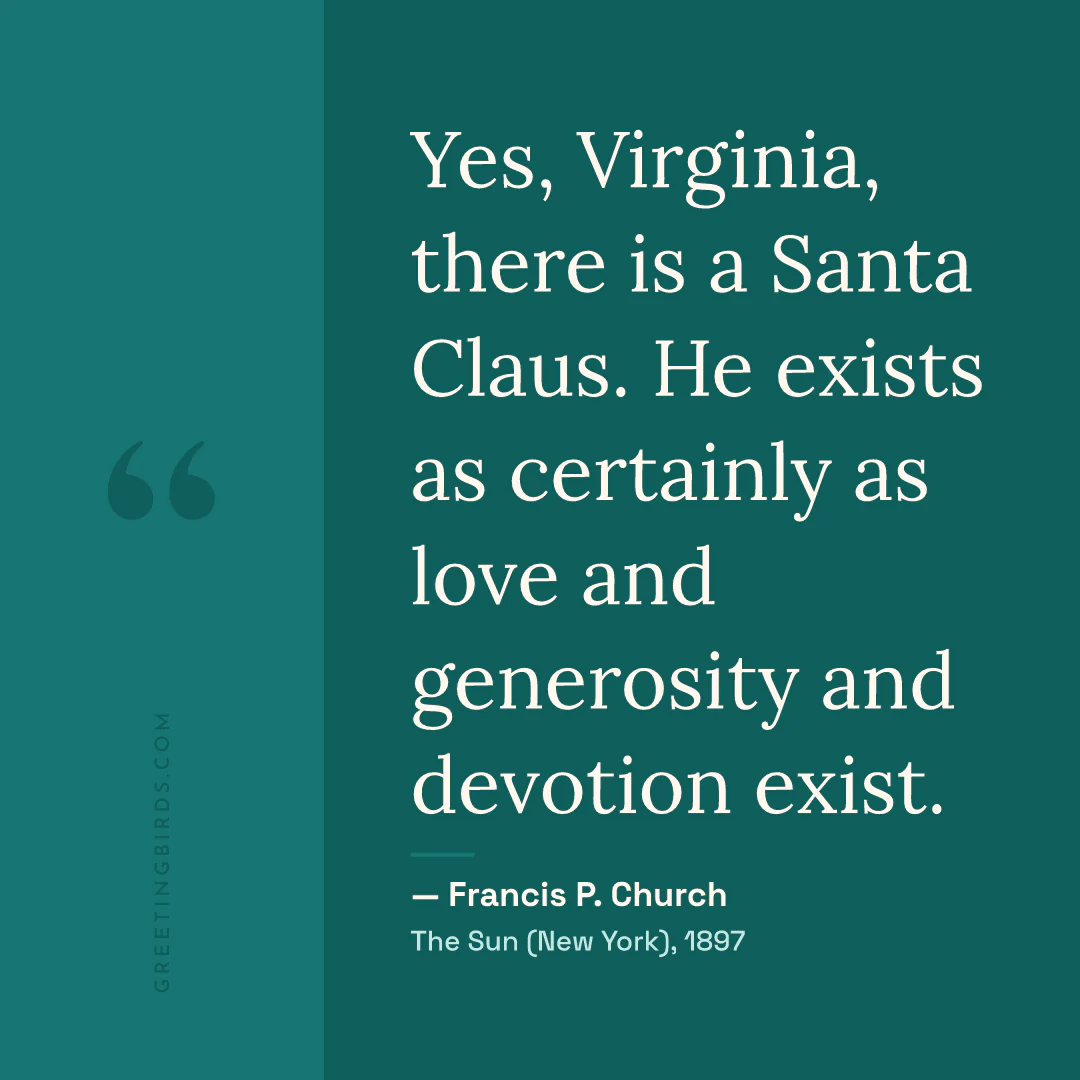
"Yes, Virginia, there is a Santa Claus. He exists as certainly as love and generosity and devotion exist, and you know that they abound and give to your life its highest beauty and joy."
— Francis P. Church, "Is There a Santa Claus?", The Sun (New York), September 21, 1897
Eight-year-old Virginia O'Hanlon wrote to the newspaper after her friends told her Santa wasn't real. Church's reply ran unsigned, and his name wasn't revealed until after he died in 1906. Notice what he actually argues: Santa is as real as love and generosity. That makes it a good answer for a child who has started to ask.
"A thousand years from now, Virginia, nay, ten times ten thousand years from now, he will continue to make glad the heart of childhood."
— Francis P. Church, The Sun (New York), September 21, 1897
The editorial ends with this sentence. It suits a card from grandparents, who can read it aloud and mean it.
"Maybe Christmas," he thought, "doesn't come from a store. Maybe Christmas ... perhaps ... means a little bit more!"
— Dr. Seuss, How the Grinch Stole Christmas! (1957)
The Grinch thinks this after stealing every present in Who-ville, when he hears the Whos singing anyway. It comes from the 1957 book, not the 1966 TV special. It fits a card that comes with a small gift or no gift at all, and children recognize it at once.
"Though I've grown old, the bell still rings for me as it does for all who truly believe."
— Chris Van Allsburg, The Polar Express (Houghton Mifflin, 1985)
This is the book's last sentence. The narrator explains that his friends, and even his sister Sarah, eventually stopped hearing the sleigh bell Santa gave him, but he never did. The book won the Caldecott Medal in 1986. Tie a small bell to the gift and write this line on the tag.
"Oh! how I wish I were as tall as the other trees, then I would spread out my branches on every side..."
— Hans Christian Andersen, "The Fir-Tree" (1844), translated by Mrs. H. B. Paull (1888)
This is the best-known Christmas tree quote from the old fairy tales. The little fir is always impatient for the next thing, and it only learns, too late, to enjoy the moment it's in. Andersen's story is sadder than most parents remember, so the line works better on a tree-decorating card than as a bedtime story for a four-year-old.
"We elves try to stick to the four main food groups: candy, candy canes, candy corn, and syrup."
— Buddy (Will Ferrell), Elf (2003)
Buddy explains his diet at his new family's dinner table before pouring syrup on his spaghetti. It's a natural fit for a cookie-plate tag or a card that comes with candy.
Christmas Movie Quotes, and the Scenes Behind Them
Film lines are the most-searched Christmas quotes, and they're also the easiest to get slightly wrong, because most people remember the line from hearing it rather than reading it. The wording below follows the film transcripts collected on Wikiquote, with variants noted.
"Look, Daddy. Teacher says, every time a bell rings an angel gets his wings."
— Zuzu Bailey, It's a Wonderful Life (1946)
A bell on the tree rings in the final scene and George's youngest daughter says this, so George knows Clarence got his wings. People usually leave out "Teacher says," but it's part of the line.
"Remember no man is a failure who has friends."
— Clarence's inscription in The Adventures of Tom Sawyer, It's a Wonderful Life (1946)
Clarence leaves George a copy of Tom Sawyer with this note inside, which George reads while the whole town fills his living room to cover the missing money. It's one of the warmest lines you can send to a friend who helped you this year.
"I think there must be something wrong with me, Linus. Christmas is coming, but I'm not happy. I don't feel the way I'm supposed to feel."
— Charlie Brown, A Charlie Brown Christmas (1965)
These are nearly the first words of the special. Sixty years later they still sound honest to anyone who finds December harder than it looks on TV. You can send it to a friend who's struggling, with a promise to call.
"I never thought it was such a bad little tree. It's not bad at all, really. Maybe it just needs a little love."
— Linus, A Charlie Brown Christmas (1965)
The other kids mock Charlie Brown's drooping little tree, then decorate it together while Linus says this. If you searched for a Christmas tree quote, this is the most loved one. It suits a card for a first apartment, a small tree, or a year that didn't go to plan.
"That's what Christmas is all about, Charlie Brown."
— Linus, A Charlie Brown Christmas (1965)
Linus says this alone on a stage after reciting the angel's announcement from Luke 2:8–14. Use this line with the verse for a faith-based card, or alone for a light one.
"Oh, Christmas isn't just a day, it's a frame of mind... and that's what's been changing."
— Kris Kringle, Miracle on 34th Street (1947)
Kris tells Doris Walker he's worried about how commercial Christmas has become. That was a complaint in 1947, too. Most people quote only the first half, which works on a card. Add the second half if you want to make his point about a busy season.
"Faith is believing in something when common sense tells you not to."
— Fred Gailey, Miracle on 34th Street (1947)
This line belongs to Fred, the lawyer who defends Kris in court, not to Doris, as many lists say. You'll also see "believing in things." The transcript has "something." It's a good line for a card to someone starting over.
"The best way to spread Christmas cheer is singing loud for all to hear."
— Buddy, Elf (2003)
Buddy says it to Jovie in the department store, and it's also part of the "Code of the Elves" shown earlier in the film. It's the go-to caption for a caroling photo or an office party invitation.
"I just like to smile! Smiling's my favorite."
— Buddy, Elf (2003)
Buddy says this to his manager at Gimbels, who has just told him to make work his favorite thing. It suits a coworker card, or a photo of a child in a Santa hat.
"Would you please tell him that instead of presents this year, I just want my family back. No toys, no nothing."
— Kevin McCallister, Home Alone (1990)
Kevin, alone in the house, says this to a street-corner Santa's helper. It's a good line for a card to family you won't see this year. The famous "Keep the change, ya filthy animal" isn't Kevin's line. It comes from the gangster film he watches.
"...we're gonna have the hap-hap happiest Christmas since Bing Crosby tap-danced with Danny ... Kaye."
— Clark Griswold, National Lampoon's Christmas Vacation (1989)
The film version has a swear word where the ellipsis is. Clark delivers it to stop his family walking out on a holiday that's already falling apart. Keep it to friends who know the film. For a host who's frazzled this year, it's the funniest quote on this page.
Scripture, Hymns and Speeches
These lines carry the most weight, which makes them right for a religious card, a toast at a family dinner or a work message that needs to sound serious without being stiff.
"Fear not: for, behold, I bring you good tidings of great joy, which shall be to all people. For unto you is born this day in the city of David a Saviour, which is Christ the Lord."
— Luke 2:10–11, King James Version (1611)
The angel says this to the shepherds near Bethlehem. Linus recites the same passage in the Charlie Brown special. For a church family or a religious grandparent, the second sentence on its own is a complete Christmas card.
"Glory to God in the highest, and on earth peace, good will toward men."
— Luke 2:14, King James Version (1611)
This is the angels' song, and it's where the saying "peace on earth" comes from. In the King James wording it's "on earth peace," not "peace on earth." Quote the verse exactly when you cite it, and use the familiar order when you're simply wishing it.
"Joy to the world! the Lord is come!"
— Isaac Watts, The Psalms of David Imitated (1719)
Watts wrote this as a version of Psalm 98, not as a Christmas carol. It became one because the words fit the season. It's a strong opening line for a church newsletter or a religious card.
"Christmas is not a time or a season, but a state of mind. To cherish peace and good will, to be plenteous in mercy, is to have the real spirit of Christmas."
— Calvin Coolidge, Christmas message to the nation (1927)
Coolidge wrote the first presidential Christmas message to the American people by hand on White House paper. The text kept by the Coolidge Foundation says "a time or a season." The "nor a season" you'll see on most quote sites is a misquote. It's a good choice for a business card, because it's warm without being religious until its last sentence.
"Let the children have their night of fun and laughter. Let the gifts of Father Christmas delight their play."
— Winston Churchill, Christmas Eve address at the White House, December 24, 1941
Churchill spoke at the national tree lighting beside Franklin Roosevelt, less than three weeks after Pearl Harbor. The speech goes on to "the stern task and the formidable years that lie before us." That's why this line moves people: he's asking adults to protect one happy night in a terrible year. It's a strong toast for a family that's been through a lot (full text at the International Churchill Society).
"Christmas waves a magic wand over this world, and behold, everything is softer and more beautiful."
— Norman Vincent Peale, newspaper column, December 1954
This one is often dismissed as an internet quote, but it's real. Researcher Barry Popik traced it to Peale's column in The Daily Herald of Circleville, Ohio, on December 21, 1954. The column continues: "If only for one short day, ill will is set aside." If someone asks you for a "magical" Christmas quote, this is the one.
"Christmas is doing a little something extra for someone."
— Charles M. Schulz, Peanuts (December 1965)
This also turns out to be real. It's from a Peanuts strip printed in newspapers that December, in which Snoopy finds his bowl filled with extra bones (earliest printing found: the Seguin Gazette, Texas, December 22, 1965). It's a perfect line for a thank-you card to a neighbor, a mail carrier or a coworker who covered a shift.
Where the Short Christmas Sayings Come From
Most "Christmas sayings" on cards and mugs are lines from carols and old poems that have drifted loose from their source. Knowing where one comes from can give you something to write next to it. Every origin below was checked on hymnary.org, Wikisource, Bible Gateway, the Library of Congress or a news report.
| Saying | Where it comes from |
|---|---|
| "On earth peace, good will toward men" | Luke 2:14, King James Version (1611). "Peace on earth" is the later, familiar word order. |
| "Joy to the world" | Isaac Watts, 1719, a version of Psalm 98 that was never written as a carol. |
| "All is calm, all is bright" | "Silent Night," German text by Joseph Mohr, first sung December 24, 1818, in Oberndorf, Austria, with a guitar because the organ was broken. John Freeman Young's English translation was published in 1863. |
| "Tidings of comfort and joy" | "God Rest Ye Merry, Gentlemen," an English carol from the 1700s, author unknown. |
| "Deck the halls with boughs of holly" | English words by Thomas Oliphant (1862), set to the Welsh New Year's tune "Nos Galan." |
| "O Christmas tree" | "O Tannenbaum," lyric by Leipzig organist Ernst Anschütz (1824), built on a much older folk song. |
| "Jingle bells" | James Lord Pierpont's "One Horse Open Sleigh" (1857), first performed in Boston. The popular story that it was written for Thanksgiving has no evidence behind it, according to Boston University researcher Kyna Hamill. |
| "Happy Christmas to all, and to all a good night" | "A Visit from St. Nicholas," Troy Sentinel, December 23, 1823. "Merry Christmas to all" came later. |
| "Bah! Humbug!" | A Christmas Carol (1843). In the book it's "Bah!" said Scrooge, "Humbug!" The two words were never printed side by side. |
| "Yes, Virginia, there is a Santa Claus" | The Sun, New York, September 21, 1897. |
| "Have yourself a merry little Christmas" | Hugh Martin and Ralph Blane, Meet Me in St. Louis (1944). Judy Garland refused the first, gloomier lyric, so Martin rewrote it. |
| "Let it snow! Let it snow! Let it snow!" | Sammy Cahn and Jule Styne, written during a Hollywood heat wave in July 1945. The song never mentions Christmas. |
| "Rockin' around the Christmas tree" | Johnny Marks, recorded by Brenda Lee in Nashville in July 1958, when she was 13. |
Five Popular Lines to Handle With Care
These turn up on nearly every Christmas quote list. Two are misquoted, and three have no primary source we could find. That's no reason to avoid them, but write "attributed to" rather than presenting them as certain.
- "Christmas is not a time nor a season, but a state of mind." This is the Coolidge line above with one word changed. His 1927 text says "or."
- "Merry Christmas to all, and to all a good night!" Moore's poem ends "Happy Christmas" in both the 1823 printing and his own 1844 collection.
- "Christmas, children, is not a date. It is a state of mind." Usually credited to the writer Mary Ellen Chase. Newspapers in 1947 and 1948 credited the columnist Heywood Broun instead, and neither original has been found. Write "attributed to Mary Ellen Chase."
- "My idea of Christmas, whether old-fashioned or modern, is very simple: loving others." Credited to Bob Hope and sometimes linked to his 1964 USO show in Vietnam, but no recording or transcript we could find contains it. Treat it as attributed.
- "Peace on earth will come to stay, when we live Christmas every day." Credited to the greeting-card poet Helen Steiner Rice, and said to close her poem "Live Christmas Every Day." We couldn't check the poem itself, so write "attributed to Helen Steiner Rice."
Short Christmas Quotes for Photos, Tags and Captions
For a photo, a gift tag or a social caption, keep it under about 12 words so it can be read at a glance. These short lines all come from the sources above:
- "God bless Us, Every One!" (Dickens, 1843)
- "Happy Christmas to all, and to all a good night." (Moore poem, 1823)
- "Christmas isn't just a day, it's a frame of mind." (Miracle on 34th Street, 1947)
- "Maybe it just needs a little love." (Linus, 1965)
- "Christmas is doing a little something extra for someone." (Schulz, 1965)
- "Smiling's my favorite." (Elf, 2003)
- "Joy to the world! the Lord is come!" (Watts, 1719)
- "No man is a failure who has friends." (It's a Wonderful Life, 1946)
- "The bell still rings for me." (Van Allsburg, 1985)
Christmas images with quotes get shared widely, so add the source in small type. "— Dickens" takes up almost no room, and it stops the line from being passed around later as "unknown."
How to Put a Famous Quote in a Card Without It Sounding Borrowed
A quote on its own can read as if you couldn't think of anything to say. A quote followed by one sentence of your own reads as if you chose it for that person. The simplest pattern is:
- The quote, with the name under it.
- One bridge sentence connecting it to the person: why you thought of them.
- Your wish and your name.
Worked example (for an aunt who hosts every year):
"It was always said of him, that he knew how to keep Christmas well." — Charles Dickens
Every time I read that I think of your kitchen on Christmas Eve. Thank you for keeping it so well, for all of us, all these years. Merry Christmas, love, Sam.
A few choices make the difference:
| Who the card is for | A quote that fits |
|---|---|
| Young children | Seuss's Grinch, the Polar Express bell, Buddy's food groups |
| A child starting to doubt Santa | "Yes, Virginia," with the love and generosity line |
| Grandparents and older relatives | "God bless Us, Every One!" or the "keep Christmas well" line |
| Coworkers and clients | Coolidge's "state of mind," Kris Kringle's "frame of mind" |
| A religious friend or church family | Luke 2:11, Watts's "Joy to the world" |
| Someone grieving or having a hard year | Longfellow's "Christmas Bells," Charlie Brown's "I'm not happy" |
| Friends who love the films | Elf, Christmas Vacation, Zuzu's bell |
What to avoid:
- Scrooge's "Humbug" on its own. Without a joke around it, it can read as a complaint about the person you're writing to.
- Bible verses for people you don't know well. At work, Coolidge or Kris Kringle carry the same warmth without assuming anyone's faith.
- "Unknown" when you could check. If a line isn't on this page, search it in quotation marks with the word "source." If no book, film or speech turns up, say "attributed to."
- Long passages in small cards. A 4×6 card has room for a short quote and two lines of your own. Trim with "..." if you have to, and keep the part that makes the point.
If you'd rather write the whole message yourself, our guide to what to write in a Christmas card has 80 lines sorted by who the card is for. For a manager or team lead, see Christmas wishes for your boss. For the weeks before Christmas, the Advent quotes page goes week by week. And for ready-to-send greetings, our Merry Christmas wishes are free to copy.
Questions People Ask About Christmas Quotes
What is the most famous Christmas quote?
Probably Tiny Tim's "God bless Us, Every One!" from A Christmas Carol (1843), with "I will honour Christmas in my heart, and try to keep it all the year" close behind. Among film lines, "Every time a bell rings an angel gets his wings" from It's a Wonderful Life (1946) is the best known.
Is "Merry Christmas to all, and to all a good night" the original line?
No. The poem's first printing in the Troy Sentinel on December 23, 1823, and Clement Clarke Moore's own 1844 collection both end "Happy Christmas to all, and to all a good night." "Merry" came later.
Who said "Christmas is not a time or a season, but a state of mind"?
President Calvin Coolidge, in his 1927 Christmas message, the first a president sent to the nation. The original says "or a season." The common "nor a season" is a misquote.
What are some short and funny Grinch quotes?
The best-known Grinch line is the one that turns the story: "Maybe Christmas," he thought, "doesn't come from a store." It comes from Dr. Seuss's 1957 book. For a funny card, film lines usually work better: Buddy's "four main food groups" from Elf, or Clark Griswold's "hap-hap happiest Christmas" from Christmas Vacation.
Christmas quotes last because the people who wrote them were writing about a real winter: Dickens about the London poor, Longfellow about his own grief, Churchill about a war just begun, and Charlie Brown about feeling flat when everyone expects you to be happy. Choose the line whose story fits the person you're writing to, and they'll feel that you chose it for them.