
Advent Quotes for Each Week: 19 Traced to Their Sources, Plus Sunday Blessings
19 Advent quotes for each candle, from Isaiah to Bonhoeffer, with the real source and story, plus 34 Sunday blessings and 12 Advent calendar notes.
By GreetingBirds EditorsPublished October 12, 202617 min read

Advent comes from the Latin adventus, "coming" or "arrival." It's the four Sundays of waiting before Christmas, and in 2026 it starts on Sunday, November 29. The best Advent quotes are about that waiting: light in the dark, a door that only opens from the outside, a promise that hasn't arrived yet. Below are 19 Advent quotes we traced to their source, sorted by the week they suit, with the story behind each one.
Need one right now? Five short ones that fit on a card or a church slide:
- "The people that walked in darkness have seen a great light." (Isaiah 9:2, KJV)
- "The night is far spent, the day is at hand." (Romans 13:12, KJV)
- "Rejoice in the Lord always: and again I say, Rejoice." (Philippians 4:4, KJV)
- "Celebrating Advent means being able to wait." (Dietrich Bonhoeffer, sermon, 1928)
- "Love came down at Christmas." (Christina Rossetti, 1885)
After the quotes there are 34 blessings our editors wrote for each Sunday, a few popular "Advent quotes" that don't say what people think, a guide to writing your own Advent note, and 12 notes for a family Advent calendar.
Advent 2026 at a glance: four Sundays, four candles
| Sunday (2026) | Candle and theme |
|---|---|
| Nov 29: First Sunday of Advent | Purple. Hope. "I wait for the Lord, my soul doth wait." |
| Dec 6: Second Sunday | Purple. Peace. "Prepare ye the way of the Lord." |
| Dec 13: Third Sunday (Gaudete) | Rose or pink. Joy. "Rejoice in the Lord always." |
| Dec 20: Fourth Sunday | Purple. Love. "Love came down at Christmas." |
| Dec 24/25: Christmas Eve and Day | White center candle, if your wreath has one. |
Not every church uses the same four words. Hope, peace, joy and love is the most common scheme in American churches. Others name the candles Prophecy, Bethlehem, Shepherds and Angels, and some order peace and love differently. The one fixed point is the third Sunday. It's called Gaudete, Latin for "rejoice," after the opening words of that day's Mass, and its candle is rose-colored because it's a lighter break in an otherwise quiet, penitential season.
The wreath itself is younger than most people guess. In Advent 1839, the Lutheran pastor Johann Hinrich Wichern was running a home for poor boys, the Rauhes Haus near Hamburg. To count down the days to Christmas with the children, he mounted candles on an old wooden cartwheel: a small red one for every weekday and a large white one for each Sunday. The fir branches came about twenty years later. Today's four-candle wreath is the Sundays-only version of his countdown.
First week: waiting in the dark (hope)
The first Sunday's readings aren't cozy. They're about night, watching and not knowing when. That's why the best first-week quotes have some darkness in them. They work for people who aren't feeling festive yet.
"The people that walked in darkness have seen a great light: they that dwell in the land of the shadow of death, upon them hath the light shined."
— Isaiah 9:2, King James Version (1611)
Isaiah wrote this to a kingdom under threat from Assyria, and Christians have read it as a promise of the Messiah ever since. Handel set it in Messiah, and it's read in many churches at Christmas. For an Advent card, the first half is enough. The full verse, with "the shadow of death," is the stronger choice for someone grieving this December.
"The night is far spent, the day is at hand: let us therefore cast off the works of darkness, and let us put on the armour of light."
— Romans 13:12, King James Version (1611)
Paul's line is part of the traditional epistle reading for the first Sunday of Advent, which is why it shows up in Advent collects and old prayer books. "The night is far spent, the day is at hand" is short enough for a text on November 29 and says exactly what the season is about: it's still dark, but morning is close.
"I wait for the Lord, my soul doth wait, and in his word do I hope. My soul waiteth for the Lord more than they that watch for the morning: I say, more than they that watch for the morning."
— Psalm 130:5–6, King James Version (1611)
The repeated line is the point: the psalmist is like a night watchman checking the horizon again and again. Psalm 130 opens "Out of the depths," so it's honest about trouble before it gets to hope. It suits a prayer group, a hospital chaplain, or anyone keeping a long vigil this season.
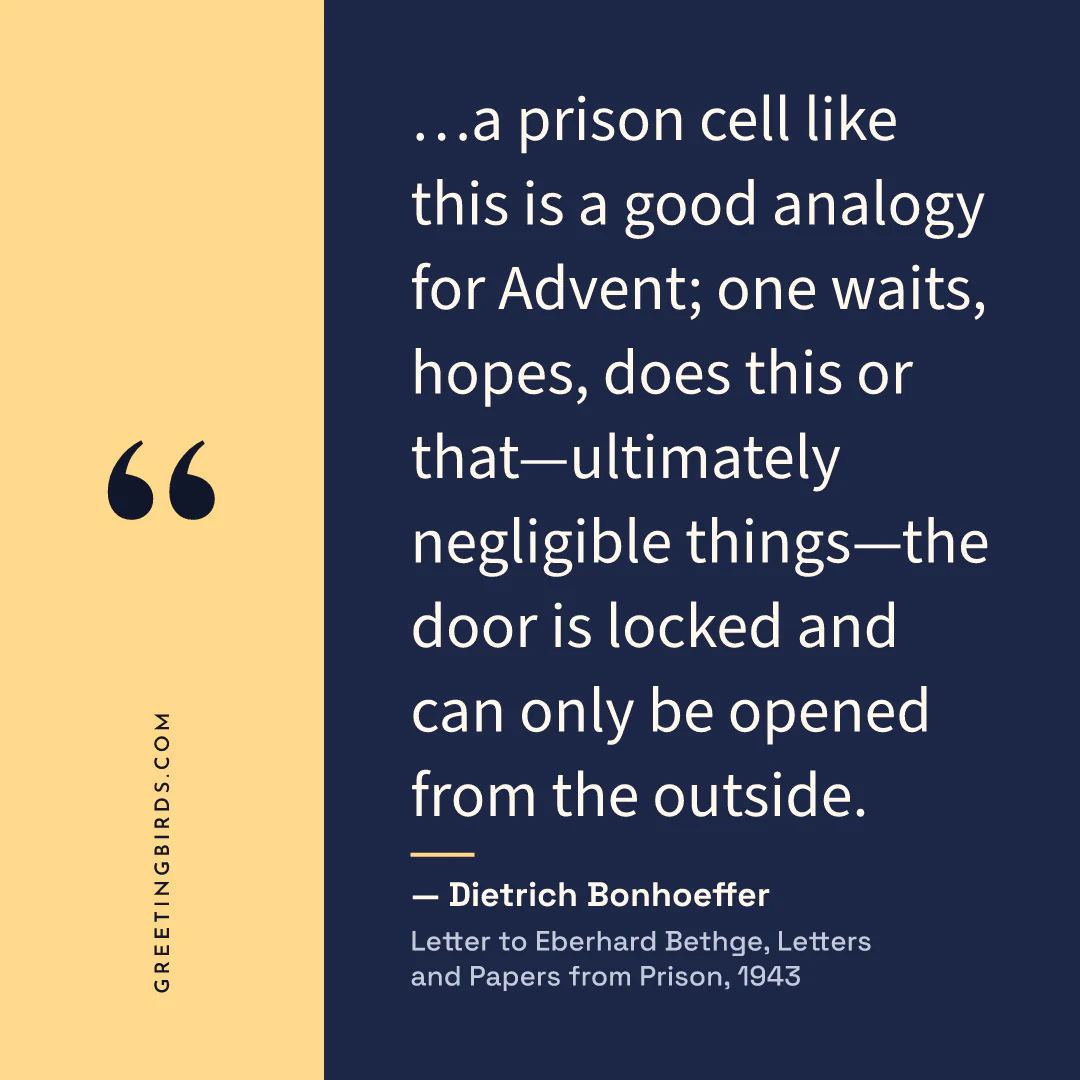
"By the way, a prison cell like this is a good analogy for Advent; one waits, hopes, does this or that—ultimately negligible things—the door is locked and can only be opened from the outside."
— Dietrich Bonhoeffer, letter to Eberhard Bethge, November 21, 1943, Letters and Papers from Prison (Dietrich Bonhoeffer Works vol. 8, 2010)
Bonhoeffer wrote this from Tegel prison in Berlin, about seven months after his arrest in April 1943. He was executed in April 1945, weeks before the war in Europe ended. You'll see a smoother version online ("the door of freedom has to be opened from the outside"), but we couldn't find that wording in any translation. The older English edition has "the door is shut and can be opened only from the outside." It's the most honest Advent line there is about helplessness, so use it with care, for someone in a situation they can't fix themselves.
"This Advent moon shines cold and clear,
These Advent nights are long;
Our lamps have burned year after year
And still their flame is strong."
— Christina Rossetti, "Advent," Goblin Market and Other Poems (1862)
Rossetti builds the poem on Jesus's parable of the wise virgins, who kept oil in their lamps through the night, and she keeps returning to the line "Watchman, what of the night?" from Isaiah. The four opening lines make a lovely card verse for a congregation or a long marriage: people who have kept the lamp burning "year after year."
First Sunday of Advent blessings (10 to copy)
These are original lines by our editors. The first nine are for churchgoing friends and family; the last is for someone having a hard year.
- May the first candle remind you that a small light still counts. Blessed first Sunday of Advent.
- Wishing you a quiet start to Advent this weekend. One candle, one prayer, one less thing on the list.
- The waiting starts today. May it be gentle with you.
- Lighting the first candle and thinking of you. May this season bring you hope you can actually feel.
- Happy first Sunday of Advent! Four weeks to slow down, make room, and get ready. We're glad to share them with you.
- May the hope of this first week of Advent find you even on the busy days.
- Praying that this Advent gives you room to breathe before the rush. Blessings to you and the whole family.
- First candle's lit at our house. Sending a little of its light your way.
- To my Bible study friends: here's to four weeks of waiting well together. See you Sunday.
- I know this season is hard this year. You don't have to feel festive. I'm lighting a candle for you tonight.
Second week: make ready (peace)
Week two belongs to John the Baptist and the prophet's call to clear a road. The quotes here are about getting ready, which is a more active kind of waiting, and about the peace that comes at the end of it.
"The voice of him that crieth in the wilderness, Prepare ye the way of the Lord, make straight in the desert a highway for our God."
— Isaiah 40:3, King James Version (1611)
All four Gospels apply this verse to John the Baptist, which is why it's read on the second Sunday in most Advent lectionaries. Handel used the same chapter for the opening of Messiah ("Comfort ye my people"). "Prepare ye the way" makes a strong one-line banner for a church bulletin or a choir card.
"Through the tender mercy of our God; whereby the dayspring from on high hath visited us, To give light to them that sit in darkness and in the shadow of death, to guide our feet into the way of peace."
— Luke 1:78–79, King James Version (1611)
These are the closing words of the Benedictus, the song Zechariah sings when his son John is born, and many churches pray it every morning. "Dayspring" is an old word for dawn. "To guide our feet into the way of peace" is the line to lift for a peace-candle message, and it reads well under a family photo.
"We know that there are three comings of the Lord. The third lies between the other two. It is invisible, while the other two are visible."
— Bernard of Clairvaux, Sermon 5 on Advent (12th century), read in the Liturgy of the Hours
Bernard, a Cistercian abbot in twelfth-century France, is explaining something Advent sermons still return to: Christ came once at Bethlehem, will come again at the end, and comes in between, quietly, to anyone who makes room. Catholics hear this passage in the Office of Readings on the Wednesday of the first Advent week. It suits a reflection for a small group or a thoughtful note to a pastor.
"Advent is the time for rousing. Man is shaken to the very depths, so that he may wake up to the truth of himself."
— Alfred Delp, SJ, The Prison Meditations of Father Delp, written in Advent 1944
Delp was a German Jesuit arrested after the failed July 1944 plot against Hitler. He wrote his Advent meditations in Tegel, the same Berlin prison that held Bonhoeffer, and he was executed on February 2, 1945. We took this wording from the older English translation as quoted by secondary sources; the 2006 collection Advent of the Heart translates the idea as "being shaken awake." It's a bracing line, better for a sermon or a study group than a greeting card.
"We always have little time; especially for the Lord... Well, God has time for us!"
— Pope Benedict XVI, Angelus, First Sunday of Advent, November 30, 2008
Benedict was speaking from the window above St. Peter's Square and presented Advent as a gift of time in a month when nobody has any. The full address is on the Vatican's website. "God has time for us" is a gentle line for an overworked friend, a nurse on holiday shifts, or a parent juggling school concerts.
Second Sunday of Advent messages (8)
- Second candle, second week. May you find one peaceful hour in it, and keep it.
- Wishing you peace this week of Advent: in your home, in your inbox, and in your heart.
- May the peace of this second Sunday sit with you at the kitchen table, in traffic, and at bedtime.
- Make straight the path, the old prophet said. My prayer for you this week is just a little less clutter in the way.
- Blessed second Sunday of Advent. May the noise of December stay outside your door.
- Thinking of you as we light the peace candle. If there's something heavy you need to set down, I'm here.
- Peace to you, your family, and every relative arriving for the holidays. (Especially the relatives.)
- A wish for week two: fewer shoulds, more stillness.
Third week: the rose candle (joy)
Gaudete Sunday is the pause in the middle. Priests who wear vestments can switch from purple to rose for one day, and the readings turn bright. These quotes are about the joy of waiting itself, not just the arrival.
"Rejoice in the Lord always: and again I say, Rejoice."
— Philippians 4:4, King James Version (1611)
This is where the day's name comes from: in Latin, the verse begins "Gaudete in Domino semper." Paul wrote it while he was in prison himself, which gives the cheerfulness some weight. It's the obvious, and best, line for a third-Sunday card or a pink-candle photo caption.
"Celebrating Advent means being able to wait. Waiting, however, is an art that our impatient age has forgotten."
— Dietrich Bonhoeffer, sermon for the First Sunday of Advent, Barcelona, December 2, 1928
Bonhoeffer was 22 and an assistant pastor to a German congregation in Barcelona when he preached this, fifteen years before the prison letter above. The sermon goes on to criticize people who "break open the ripe fruit" too early. The text is reprinted in the anthology God Is in the Manger; we confirmed the wording through secondary sources, and most posts quietly drop the word "however." It's a fun one to send to a child, or an adult, who has already opened every calendar door.
"So waiting is never a movement from nothing to something. It is always a movement from something to something more."
— Henri Nouwen, "A Spirituality of Waiting," Weavings (January/February 1987)
Nouwen, a Dutch priest who taught at Yale and Harvard and then lived in a community for people with intellectual disabilities, wrote this essay about Zechariah, Elizabeth and Mary. People who wait well, he argues, have already received a promise, "like a seed that has started to grow." The line fits a pregnancy announcement in December, a couple waiting on an adoption, or anyone partway through something good.
"The season of Advent, which we begin again today, restores this horizon of hope, a hope which does not disappoint for it is founded on God's Word."
— Pope Francis, Angelus, December 1, 2013
This was Francis's first Advent as pope, and the same talk includes the shorter, livelier line "The horizon of hope! This is the horizon that makes for a good journey." Either works for a parish newsletter. The short one is easier to fit in a text.
Gaudete Sunday messages (8)
- The pink candle is lit! Rejoice, friend: we're more than halfway there.
- Happy Gaudete Sunday. May joy surprise you this week in small, ordinary places.
- Wishing you the kind of joy that doesn't depend on the to-do list being finished.
- Third week of Advent, and the house smells like pine. Hope yours is full of something good, too.
- Rejoicing with you this Sunday and thanking God for your friendship.
- May the joy candle remind you that even a long wait has bright moments.
- For a child's card: Three candles lit, one to go. Christmas is almost here!
- Joy to you this week, and a little extra patience for the last days of waiting.
Fourth week: love comes close
On the last Sunday the readings turn to Mary, Joseph and Bethlehem, and the hymns get louder. Many of the best fourth-week lines are carols, so people already know the tune when they read them on a card.
"Therefore the Lord himself shall give you a sign; Behold, a virgin shall conceive, and bear a son, and shall call his name Immanuel."
— Isaiah 7:14, King James Version (1611)
"Immanuel" means "God with us," and Matthew's Gospel quotes this verse in the Christmas story. It's a natural choice for the fourth Sunday, when many churches read the announcement to Joseph. For a card, "God with us" alone carries the meaning.
"Come, thou long expected Jesus,
born to set thy people free;
from our fears and sins release us,
let us find our rest in thee."
— Charles Wesley, Hymns for the Nativity of Our Lord (1744)
Charles Wesley, brother of Methodism's founder John, wrote thousands of hymns. This one is sung across denominations every Advent. "Let us find our rest in thee" is a quietly good line for someone worn out by December.
"O come, O come, Emmanuel,
And ransom captive Israel."
— Latin "O Antiphons," translated by John Mason Neale (1851, revised 1861)
The hymn paraphrases seven ancient antiphons sung at evening prayer in the last week before Christmas. Neale's first version in 1851 actually began "Draw nigh, draw nigh, Emmanuel." The familiar "O come, O come" opening comes from the 1861 revision in Hymns Ancient and Modern. Quote it for a choir, a church musician or anyone who says Advent doesn't feel like Advent until this hymn is sung.
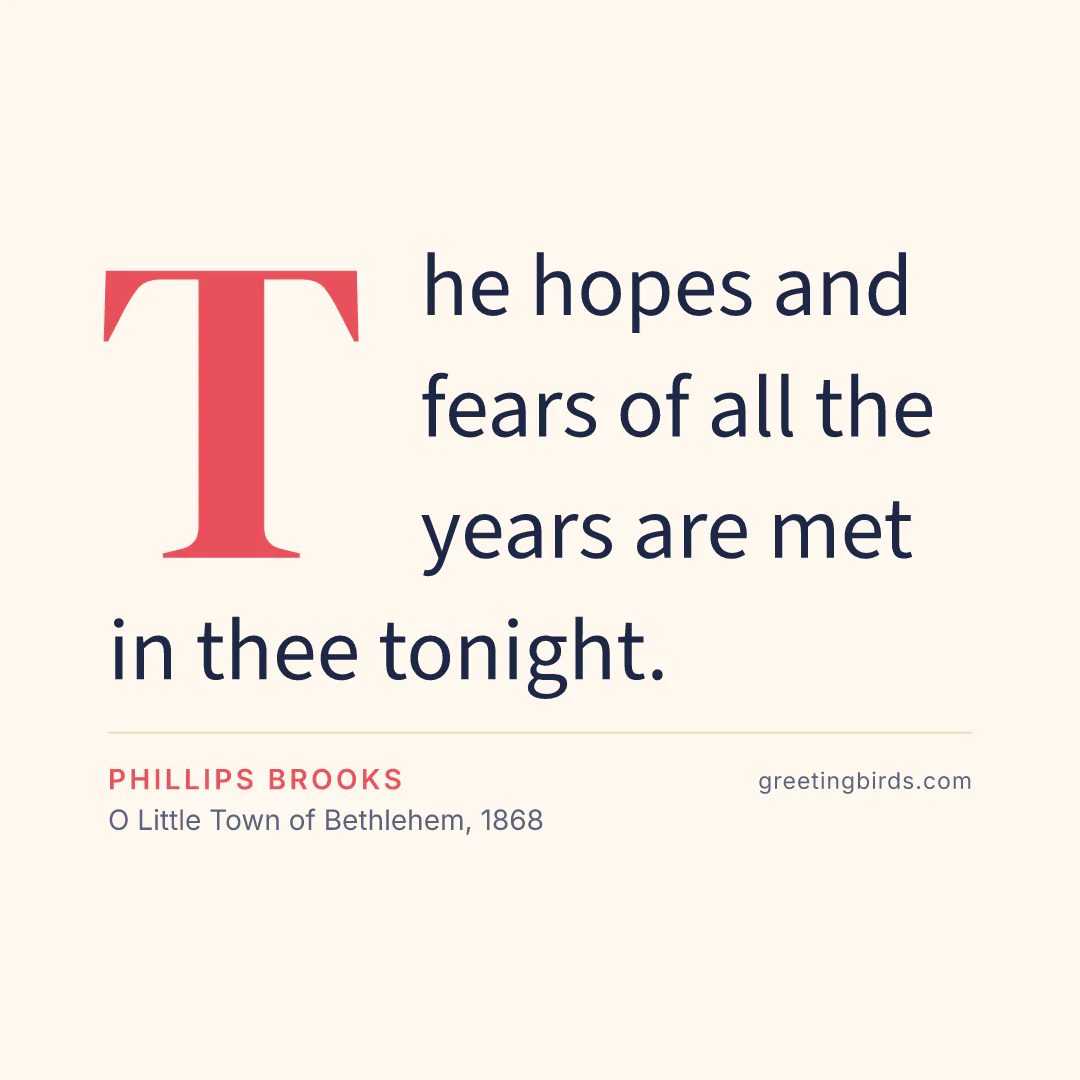
"The hopes and fears of all the years
Are met in thee tonight."
— Phillips Brooks, "O Little Town of Bethlehem" (1868)
Brooks, an Episcopal rector in Philadelphia, visited Bethlehem on Christmas Eve 1865 and wrote the words a few years later for his Sunday school. His organist, Lewis Redner, wrote the tune. These two lines are one of the best things to write to someone whose year held both: a new baby and a loss, a move and a homesickness.
"Love came down at Christmas,
Love all lovely, Love divine;"
— Christina Rossetti, Time Flies: A Reading Diary (1885)
Rossetti first published this short poem without a title, as the December 29 entry in a daily devotional book. It was later called "Christmastide," and today it's sung as a carol. Pair it with the love candle on December 20, or use it to sign off a family Christmas letter.
Fourth Sunday of Advent messages (8)
- All four candles are burning. May the love that came down at Christmas fill your home this week.
- Fourth Sunday of Advent: the waiting is almost over. Sending you love and a quiet moment before the big day.
- May the love candle remind you how loved you are, by God and by all of us.
- Almost there. Wishing you a last week of Advent full of the people you love most.
- The wreath is fully lit, and so is our gratitude for you. Blessed fourth Sunday of Advent.
- Love is the last candle and the reason for the other three. Merry almost-Christmas.
- Praying that the love of this season reaches every empty chair at your table this year.
- From our family to yours: love, light, and a peaceful Christmas Eve when it comes.
Three "Advent quotes" that aren't quite what you've been told
These are all over Advent graphics. None is a fake exactly, but each has been changed or detached from its context.
- "It is Christmas every time you let God love others through you" (Mother Teresa). We found no text by Mother Teresa that says this. The closest documented version comes from Pope Benedict XVI, who said on January 4, 2008: "Mother Teresa used to like to say: it is Christmas every time we allow Jesus to love others through us." If you use it, credit it "as recalled by Benedict XVI."
- "Advent is the beginning of the end of all in us that is not yet Christ" (Thomas Merton). Merton's wording begins "The Advent mystery is..." and the line is usually traced to his essay "Advent: Hope or Delusion?" in Seasons of Celebration (1965). We couldn't confirm the page, so we left it out of the list above.
- "A stable once had something inside it that was bigger than our whole world" (C. S. Lewis). Lewis did write this, in The Last Battle (1956), but as dialogue for the character Lucy in a Narnia novel. It isn't Lewis speaking about Advent. It's fine on a card if you say where it's from.
How to write an Advent note that isn't just an early Christmas card
An Advent message is about the waiting, not the arrival. That's the one thing that sets it apart. "Merry Christmas" in the first week of December skips ahead; an Advent note meets the person where they are, in the middle of the countdown.
A simple way to build one:
- Name the week. "First Sunday of Advent," "the pink candle," "one week to go."
- Add the week's word. Hope, peace, joy or love, or whatever your church uses.
- Bring it down to their life. One specific thing: the new baby, the long commute, the first Christmas without their dad.
- Close with a small wish or a prayer, not a big one.
Worked example, for a friend who just started chemo: "Second Sunday of Advent, and we lit the peace candle tonight. I thought of you and all those waiting rooms. Praying for an hour of real rest for you this week." It's four lines, and most of them are about your friend, not the holiday.
A few things to skip:
- Don't send "Happy Advent" to everyone on your Christmas list. Plenty of Christians outside liturgical churches don't mark Advent, and to most non-Christians the word means nothing. Save Advent notes for people who share the tradition, and send them a Christmas card later as usual.
- Don't pile on Bible verses. One verse plus your own sentence reads as care. Four verses reads as a sermon.
- Don't promise a cheerful season to someone grieving. Advent is one of the few times in the church year that makes room for darkness and longing. Lean on that. "You don't have to feel festive" is a kind thing to write.
- Watch the date. Advent 2026 starts on November 29, only three days after Thanksgiving. A first-Sunday text that arrives on the Monday still works; one that arrives after Christmas doesn't.
Who usually gets one: a small group or Bible study, a godchild, a pastor or choir director, a friend having a hard December, and grandchildren who are counting down with a calendar. For a pastor, keep it short and specific ("Thank you for Sunday's sermon on waiting"); clergy get a lot of generic Christmas cards in December.
Notes for a family Advent calendar
If you fill a calendar with little notes instead of chocolate, kids under ten do best with one small job or one fact per day. Here are a dozen to start from:
- Day 1: Advent means "coming." Something good is on its way!
- Hug someone before breakfast today.
- Write one thing you're thankful for and put it by the wreath.
- Tonight, you get to light the candle.
- Make a card for someone who lives alone.
- Find the brightest star you can see tonight.
- Pick a canned food to give to the food drive.
- Sing one carol in the car, as loud as you like.
- Say something kind to your brother or sister. (Yes, really.)
- Today's job: hang one ornament wherever you want.
- Read the Christmas story from Luke 2 together at bedtime.
- Last door: tomorrow is Christmas Eve. Thank you for waiting so well.
Quick answers about Advent greetings
Is it OK to say "Happy Advent"?
Yes. "Happy Advent," "Blessed Advent" and "Happy first Sunday of Advent" are all normal among churchgoers. "Blessed" sounds a little more reverent and suits a pastor or an older relative; "Happy" is fine for friends. For people who don't observe Advent, just wait and send Christmas wishes.
When does Advent start in 2026?
On Sunday, November 29, 2026, the fourth Sunday before Christmas. The other Sundays are December 6, December 13 (Gaudete) and December 20. Because Christmas 2026 falls on a Friday, the season runs almost four full weeks. In Western churches Advent always begins on the Sunday between November 27 and December 3.
What do the four Advent candles mean?
In the most common American scheme: hope, peace, joy and love, lit one more each Sunday. The third candle is rose-colored for Gaudete ("rejoice") Sunday. Some churches use Prophecy, Bethlehem, Shepherds and Angels instead, so check what your own congregation uses before you write "the peace candle" in a card.
Advent leads straight into the card-writing season. When you're ready for that, our Merry Christmas wishes and Christmas messages for family and friends pick up where this page stops. If someone you're writing to is facing the holidays after a loss, the messages for someone grieving cover Christmas and New Year too, and the Thanksgiving prayers and table graces work for the Sunday after the holiday, which is the first Sunday of Advent this year.