Thanksgiving Prayer Before the Meal: 57 Short Graces, Family Blessings and the Traditional Words Behind Them
57 Thanksgiving prayers for the meal: short graces, family and kids' prayers, blessed wishes, plus the classic graces and where each one really comes from.
By GreetingBirds EditorsPublished October 11, 202616 min read
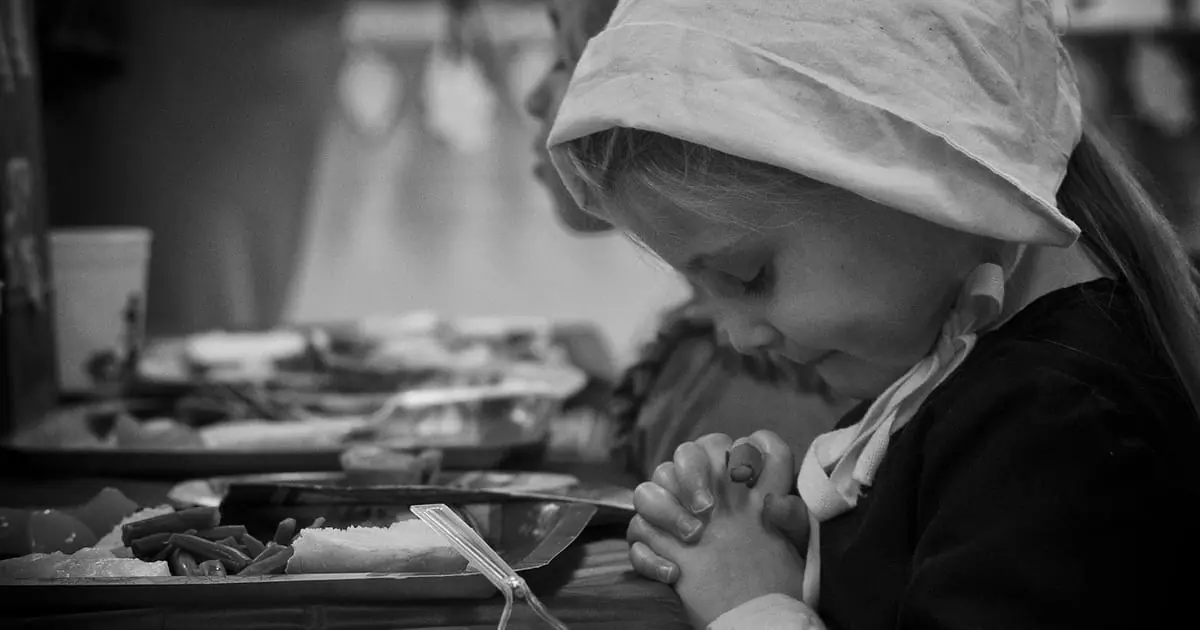
A Thanksgiving prayer before the meal can be one sentence long. Here is one anyone at the table can say: "Lord, thank you for this food, for the hands that made it and for every person at this table. Bless our time together. Amen." You'd be in good company. In a Pew Research Center survey from November 2024, 65% of U.S. adults said someone at their Thanksgiving dinner typically says a prayer or blessing. Three more short graces, if you want a choice:
- For the meal in front of us, the people beside us and the year behind us, we give thanks. Amen.
- God, we're grateful. Bless this food, bless this family, and make us mindful of those who have less today. Amen.
- Thank you for bringing us together again. May we never take this table, or each other, for granted. Amen.
Thanksgiving 2026 falls on Thursday, November 26. Below you'll find the traditional graces many families already know, with where each one actually comes from. After them come prayers and blessings for specific tables: a big family, a child leading grace, a year with an empty chair, a table of mixed faiths. All 57 listed prayers and messages on this page, including the four above, were written by our editors. The page ends with blessed Thanksgiving wishes for cards and a simple way to write a grace of your own.
The Graces Many Families Already Know
Most American table prayers come from a handful of old sources. Knowing where yours comes from is a nice thing to share before the meal, and it helps you pick one that fits the people at your table.
| Grace | Where it comes from |
|---|---|
| "Bless us, O Lord…" | Catholic; English form of the Latin Benedic, Domine |
| "Come, Lord Jesus, be our guest…" | Lutheran and other Protestant families; German, first printed 1698 |
| "Praise God, from whom all blessings flow…" | The Doxology, by Bishop Thomas Ken, c. 1674 |
| "God is great, God is good…" | A children's grace; author unknown |
| Hamotzi | Jewish blessing over bread |
| "Some hae meat…" | The Selkirk Grace, Scotland, 17th century or earlier |
The Catholic grace. This is the form printed in the U.S. bishops' United States Catholic Catechism for Adults:
"Bless us, O Lord, and these thy gifts, which we are about to receive from thy bounty through Christ our Lord. Amen."
— Traditional Catholic grace, United States Catholic Catechism for Adults (English form of the Latin "Benedic, Domine")
It is a translation of the Latin Benedic, Domine, nos et haec tua dona, and it was among the basic prayers in the Baltimore Catechism of 1885, which is why generations of American Catholics learned it by heart. Many families add the sign of the cross before and after.
"Come, Lord Jesus." The short rhyming grace "Come, Lord Jesus, be our guest, and let these gifts to us be blessed. Amen." is the favorite in many Lutheran homes. It is often credited to Martin Luther, but the German original ("Komm, Herr Jesu, sei unser Gast") was first printed in 1698, more than 150 years after Luther's death, in a schoolbook by Johann Conrad Quensen, who probably wrote it.
The Doxology. Many Protestant families sing rather than say grace, and this is the verse they sing:
"Praise God, from whom all blessings flow; / Praise Him, all creatures here below; / Praise Him above, ye heav'nly host; / Praise Father, Son, and Holy Ghost."
— Thomas Ken, closing verse of his morning and evening hymns for Winchester College, c. 1674
Ken, an English bishop, wrote it as the last stanza of hymns for the boys of Winchester College (Hymnary.org). Sung to the tune "Old Hundredth," it takes about twenty seconds, and everyone at the table usually knows it already, which makes it a good choice when nobody wants to pray solo.
"God is great, God is good." The rhyme most children learn first: "God is great, God is good, let us thank Him for our food. Amen." Some families add "By His hands we all are fed; give us, Lord, our daily bread." Nobody knows who wrote it; it has been passed along by families and Sunday schools.
Hamotzi. At a Jewish table, the meal begins with the blessing over bread: Barukh ata Adonai Eloheinu melekh ha'olam hamotzi lehem min ha'aretz, "Blessed are You, Lord our God, Ruler of the universe, who brings forth bread from the earth" (translation from My Jewish Learning). Many Jewish families say it over a challah or dinner roll on Thanksgiving too.
The Selkirk Grace. "Some hae meat an canna eat, / And some wad eat that want it; / But we hae meat, and we can eat, / And sae the Lord be thankit." It is named for Robert Burns, who is said to have recited it at the Earl of Selkirk's table, but it was already known in the 17th century as the Galloway Grace or Covenanters' Grace. For a Thanksgiving table it has a fitting point: be grateful you have food and an appetite.
The "Johnny Appleseed" grace. Families who sing "Oh, the Lord is good to me…" are singing "The Lord Is Good to Me," a song from the Johnny Appleseed segment of Disney's 1948 film Melody Time. It's a lovely grace for kids, but it comes from the movie, not from John Chapman, the real orchard planter the film is about.
Short Prayers Before the Thanksgiving Meal
These are for the moment when the food is on the table, everyone is hungry and someone says, "Who wants to say grace?" Each one takes less than fifteen seconds to say out loud.
- Bless this food, Lord, and the people who share it. Amen.
- Thank you, God, for full plates and full chairs. Amen.
- For turkey and talk, for pie and patience, we thank you. Amen.
- Lord, you have been good to us all year. Make us good to one another tonight. Amen.
- We give thanks for this harvest, for the farmers who grew it and the cooks who made it. Amen.
- Gracious God, thank you for another year together. Bless this meal and this home. Amen.
- Thank you for what is on this table and for who is around it. Amen.
- Father, our thanks today is bigger than our words. Please bless this food. Amen.
- Lord, let this meal strengthen our bodies and this company warm our hearts. Amen.
- For every blessing we noticed this year, and the many we didn't, thank you. Amen.
Prayers for the Family Around the Table
A family prayer can be a little longer and a lot more personal. Name what this particular year held: a new baby, a new job, a move, a recovery. The details are what make people at the table look up.
- Lord, thank you for this family: for the ones who traveled far, the ones who have been cooking since dawn, and the little ones who can't wait for pie. Keep us kind to each other today and in the year ahead. Amen.
- God, you know every story at this table, the hard ones and the happy ones. Thank you for carrying us through all of them, and for letting us be together again. Amen.
- Bless our parents and grandparents, who taught us to say thank you. Bless our children, who are teaching us to see the world new. And bless this meal we share. Amen.
- Thank you for the new faces at our table this year. [Name], welcome. May every guest here feel like family. Amen.
- Father, we haven't always agreed this year, but we are here, together. Thank you for that. Help us listen more than we talk, and laugh more than we argue. Amen.
- Lord, thank you for the work that paid for this food, the health that let us gather and the love that made the effort worth it. Amen.
- Gracious God, bless this home and the work of our hands. Where we have plenty, make us generous. Where we are struggling, make us brave. Amen.
- Thank you for the cousins, the in-laws, the old friends who count as family and the dog under the table hoping for scraps. Bless us all. Amen.
Bible Verses to Read Before the Meal
If you'd rather read than pray in your own words, one verse is enough. These are from the King James Version (checked on Bible Gateway), the translation many families still read aloud at holidays.
| Verse | Text (KJV) |
|---|---|
| Psalm 136:1 | "O give thanks unto the LORD; for he is good: for his mercy endureth for ever." |
| 1 Chronicles 16:34 | "O give thanks unto the LORD; for he is good; for his mercy endureth for ever." |
| Psalm 118:24 | "This is the day which the LORD hath made; we will rejoice and be glad in it." |
| Philippians 4:6 | "Be careful for nothing; but in every thing by prayer and supplication with thanksgiving let your requests be made known unto God." |
The psalm people most often call "the" Thanksgiving psalm is Psalm 100. Its fourth verse is the one most often read before a meal:
"Enter into his gates with thanksgiving, and into his courts with praise: be thankful unto him, and bless his name."
— Psalm 100:4, King James Version, 1611
It works well as an opening line: read it, pause, then add one sentence of your own about this year. In Philippians, "be careful for nothing" means "don't be anxious about anything," a good verse for a year that held a lot of worry. For more lines on gratitude with their sources checked, see our quotes about being thankful.
When Someone Is Missing From the Table
The first Thanksgiving after a death, a divorce or a deployment is when a prayer matters most, and when people most want to skip it. Saying the person's name out loud usually helps more than it hurts. Keep it short, and let whoever is closest to the loss decide whether to mention it at all. If you're writing to a friend who is grieving rather than praying at the table, our condolence messages may help.
- Lord, there is an empty chair at our table this year. Thank you for [name] and for every Thanksgiving we shared. Hold them, and hold us, close today. Amen.
- God, some of the people we love are serving far from home tonight. Keep them safe, let them feel how grateful we are, and bring them back to this table soon. Amen.
- We remember the people who can't be with us: the ones in the hospital, the ones too far away to travel and the ones we have lost. We are thankful for each of them. Amen.
- Thank you for the years we had with [name]. Today we miss them, and today we give thanks for them. Both are true. Amen.
- Lord, grief and gratitude are sitting together at this table. Help us make room for both. Amen.
- For everyone who is alone today, Lord, send company and comfort, and show each of us who we can call this weekend. Amen.
Graces a Child Can Lead
Asking a child to say grace is a sweet tradition, but put them on the spot gently: ask them before dinner, not in front of twenty relatives. Rhymes are easiest to remember. Let them add one thing they're thankful for at the end; it's often the best part of the meal.
- Thank you for the turkey, thank you for the pie, thank you for my family sitting side by side. Amen.
- Thank you, God, for this big meal, and for the happy way I feel. Amen.
- For my mom and dad and all my friends, for love and food that never ends, thank you, God. Amen.
- Dear God, thank you for Grandma's pie, for the cousins coming over and for everyone here. Amen.
- Thank you for the sun that grew the corn, the rain that grew the beans and the people who cooked it all. Amen.
- God, I'm thankful for this food, my home and my family. Help me share. Amen.
A Blessing for a Table of Mixed Faiths (or None)
Plenty of Thanksgiving tables include a devout grandmother, an agnostic son-in-law and a friend from a different faith. A blessing that names no god lets everyone take part honestly, and believers can add their own silent prayer to it.
- Before we eat, let's take a moment to be thankful for this food, for the people who made it and for the people sharing it.
- We're grateful for this meal, this home and this company. May everyone at this table feel welcome, and may everyone who is hungry tonight find a full plate.
- Let's each think of one person who made this year better. (Pause.) Thank you to all of them. Now let's eat.
- For the earth that grew this food, the hands that brought it here and the friendships that brought us here, we give thanks.
- Whatever words each of us uses, tonight we share one: thanks.
- May this meal nourish us, this conversation connect us and this gratitude stay with us long after the dishes are done.
One old example of a thanksgiving that names everything before asking for anything is the Haudenosaunee Thanksgiving Address, the "Words That Come Before All Else," spoken at gatherings of the Six Nations. It thanks the people, the earth, the waters, the plants and more in turn, and closes each section with the refrain "Now our minds are one" (English version by John Stokes and Kanawahienton, via The American Yawp). It's a reminder that giving thanks together is older than any one faith's grace.
Hymns and Prayers With a Long History
Some families end the meal, or start it, with a hymn. Two are tied closely to the American holiday.
"We Gather Together" ("We gather together to ask the Lord's blessing") began as a Dutch song by Adrianus Valerius in 1597, celebrating a military victory, and was translated into English by Theodore Baker in 1894. According to Wikipedia's history of the hymn, it entered the Methodist hymnal in 1935 and became a fixture of services on the Sunday before Thanksgiving.
"Now thank we all our God / with heart and hands and voices, / who wondrous things hath done, / in whom his world rejoices;"
— Martin Rinkart, tr. Catherine Winkworth, "Now Thank We All Our God," Lyra Germanica (second series), 1858
Rinkart was a Lutheran pastor in Eilenburg, Saxony; his German text was published in 1636, during the Thirty Years' War (Hymnology Archive). Eilenburg was a crowded walled refuge during that war and was hit by a great epidemic in 1637 and a famine after it. That backstory is why the hymn means so much in a hard year: it was written by a pastor giving thanks in the middle of a long war, not after it.
The General Thanksgiving. Episcopal and Anglican families may know this prayer from the 1662 Book of Common Prayer, written by Edward Reynolds, Bishop of Norwich. It opens: "Almighty God, Father of all mercies, we thine unworthy servants do give thee most humble and hearty thanks for all thy goodness and loving-kindness to us, and to all men" (text of the General Thanksgiving). Its full text is long for a dinner table, but the opening line alone makes a fine grace.
Blessed Thanksgiving Wishes for Cards and Texts
If you're writing to someone rather than praying with them, a faith-based wish works best when you know they share it: church friends, a pastor, family who pray. For everyone else, the warm but secular lines in our Thanksgiving wishes guide are the safer choice.
- Happy Thanksgiving! Praying God's blessings over your table and your family today.
- Wishing you a blessed Thanksgiving full of good food, good people and the kind of peace only God can give.
- Grateful to God for you this Thanksgiving, and praying your home is full of joy.
- May the Lord bless you and your family this Thanksgiving with health, laughter and everything you need for the year ahead.
- Counting my blessings today, and you are one of them. Have a blessed Thanksgiving.
- Happy Thanksgiving to our church family. Thank you for praying with us, cooking for us and showing up for us all year.
- Praying for safe travels, a full table and a rested heart for you this Thanksgiving.
- God has been faithful again this year. I hope you can see it in every corner of your life this Thanksgiving.
- Pastor [Name], thank you for shepherding us through this year. May your own table be blessed today.
- I know this year has been hard. I'm praying that Thanksgiving brings you a moment of rest and a reason to hope.
Short Thanksgiving Blessings for a Photo or Post
These are short enough to sit on top of a photo of your table or under a family picture. Keep the image your own (your table, your people) and let the line do the rest.
- Grateful, thankful, blessed, and about to eat.
- Full table, full heart, faithful God. Happy Thanksgiving.
- Counting blessings, not calories, today.
- Thankful for every chair filled at this table.
- Bless the cooks. Bless the food. Bless the nap that follows.
- Gathered, grateful and blessed beyond measure.
- Every good thing on this table started as a gift. Happy Thanksgiving.
- Today's plan: give thanks, pass the rolls, repeat.
Write Your Own Grace in Four Lines
A homemade grace doesn't need special language. Most good ones follow the same four steps, and each step is one sentence:
- Address. Who you're speaking to: "Lord," "Dear God," "Father," or, at a mixed table, "Before we eat,".
- Thank, specifically. One real thing from this year, not a list of everything.
- Remember. Someone who isn't here, or someone who has less.
- Bless and close. Ask a blessing on the food or the people, then "Amen" (or "Let's eat").
Worked example. Say your family moved this year and your brother drove six hours to help:
"Lord, thank you for bringing us together in our new home. Thank you for Dan, who gave up a whole weekend and his back to carry our boxes up three flights of stairs. We remember Grandpa, who would have loved this view, and everyone who is hungry tonight. Bless this food and every person at this table. Amen."
That is about 25 seconds out loud. What to leave out: long lists of names (someone always gets missed), anything that sounds like a dig at a relative ("help those who need to change their ways"), politics, and the word "finally."
Who Says Grace, and How Long Should It Be?
Who leads. By custom it's the host, or someone the host asks: the oldest person at the table, a pastor or priest if one is there, or a child. If you want a guest to lead, ask them privately before dinner, never by surprise.
How long. Under a minute. The food is getting cold and the kids are watching the rolls. Fifteen to forty-five seconds is the sweet spot.
Holding hands. Common in many families, never required. A guest who doesn't want to can simply rest their hands in their lap; nobody should comment.
Guests of another faith, or none. They're not expected to pray, just to wait quietly. If you know the table is mixed, choose one of the inclusive blessings above, or invite a moment of silence so each person can give thanks in their own way.
Going around the table. Some families skip a formal prayer and have each person name one thing they're thankful for. With more than ten people, set a limit of one sentence each, or the gravy will set.
Visiting someone else's home. Follow their custom. If they don't say grace and you want to, bow your head for a few silent seconds before you start eating. No announcement needed.
Lines Credited to the Wrong Person
If you print a grace on place cards, check the name under it. These four are almost always credited wrongly:
"For each new morning with its light, / For rest and shelter of the night, / For health and food, for love and friends, / For everything Thy goodness sends." Shared everywhere as Ralph Waldo Emerson's. We found it credited to him only on quote sites with no source, and not in his published works. A related hymn, "We Thank Thee" ("For flowers that bloom about our feet"), is listed by Hymnary.org as anonymous, c. 1904. Print it without a name.
"Come, Lord Jesus, be our guest" is not by Martin Luther; it first appeared in 1698 (see above).
The Selkirk Grace is not by Robert Burns; it is older than he is.
"The Lord is good to me" is not by Johnny Appleseed; it is a 1948 Disney song.
Common Questions About Thanksgiving Grace
What is a good short prayer before Thanksgiving dinner?
"Lord, thank you for this food, for the hands that made it and for every person at this table. Bless our time together. Amen." It takes about ten seconds and works for almost any Christian family. For a mixed table, try: "For the meal in front of us, the people beside us and the year behind us, we give thanks."
What psalm is a prayer of thanksgiving?
Psalm 100 is the best-known psalm of thanksgiving ("Enter into his gates with thanksgiving"). Psalm 136, which repeats "for his mercy endureth for ever," and Psalm 107 are also often read on Thanksgiving.
What is the simplest way to say thanks to God?
Name one specific thing and say thank you for it: "God, thank you for bringing Mom home from the hospital this year. Amen." A short, specific prayer is often more meaningful than a long general one.
Do you have to hold hands during grace?
No. Holding hands is a family custom, not a rule. Guests who would rather not can rest their hands in their lap and bow their heads or simply wait quietly.
If you're leading grace for the first time this year, pick one prayer from this page, add one sentence about your own family's year, and say it slowly. Nobody at the table will remember whether the wording was perfect. They'll remember that someone stopped to say thank you.