
Inspirational and Motivational Quotes: 8 Sourced Lines and 36 Short Ones to Use
Eight inspirational and motivational quotes with exact wording, source and story, plus 36 short lines of our own for cards, captions and texts.
By GreetingBirds EditorsUpdated October 15, 20268 min read

Inspiration tells you why something is worth doing; motivation tells you what to do in the next ten minutes. Most people searching for "inspirational and motivational quotes" want one of each: a line that lifts the mood, and a line that gets them moving. This page gives you both. First come eight quotes with a verified source, each with the story behind it, and then 36 short lines of our own for cards, captions and texts. Our own lines carry no author, and we don't pretend otherwise.
Which line fits the moment
| What you need | Reach for |
|---|---|
| To start something you keep putting off | Roosevelt, or "Starting lines" below |
| To stop comparing yourself | Thoreau and Emerson |
| To get through something unfair | Douglass and Washington |
| To feel less afraid of the news or the week | Franklin Roosevelt |
| To encourage someone else | Dickens (Our Mutual Friend) |
| To do a small job well | Dickens (David Copperfield) |
Eight quotes with a source, and what they were really about
Thoreau on keeping your own pace
"If a man does not keep pace with his companions, perhaps it is because he hears a different drummer."
Henry David Thoreau, Walden (1854), "Conclusion"
Thoreau wrote this after two years in a cabin at Walden Pond, as a reply to people who thought a life like his had to be a mistake. The sentence is an alibi for anyone who is behind their friends at something: a career change at forty, a late degree, a slow recovery. It works well on a card for a person who has just changed direction. It is not an excuse to ignore feedback; the line says the other person may be hearing something different, not that you are always right.
Emerson on being misunderstood
"To be great is to be misunderstood."
Ralph Waldo Emerson, "Self-Reliance," Essays: First Series (1841)
Emerson is arguing that consistency for its own sake is a trap: if you only do what will be understood at once, you will never do anything new. He follows it with a list of people who were misread in their own time, from Socrates to Newton. Use it when someone you care about is being doubted over a choice that makes sense to them. As a caption it is short enough for any image.
Douglass on how a person changes
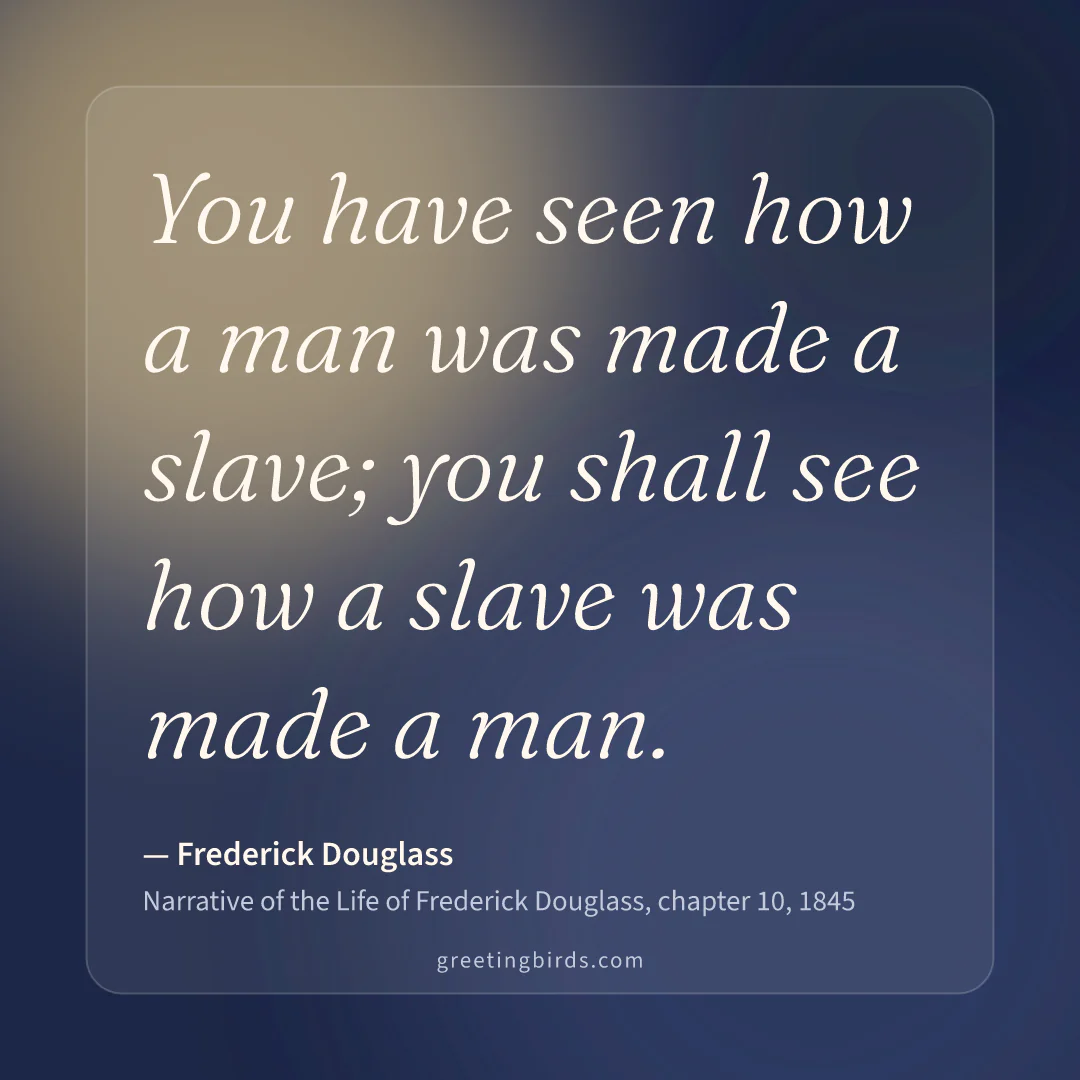
"You have seen how a man was made a slave; you shall see how a slave was made a man."
Frederick Douglass, Narrative of the Life of Frederick Douglass, an American Slave (1845), chapter 10
Douglass introduces his fight with the slave-breaker Edward Covey in August 1833 with this sentence. He writes that the victory "rekindled the few expiring embers of freedom, and revived within me a sense of my own manhood." The quote is not a slogan about "hustle." It is about the moment a person decides that the way they have been treated will stop, and that decision is where all later effort starts. It belongs in a section on resilience, not on a Monday coffee mug.
Booker T. Washington on how to measure success
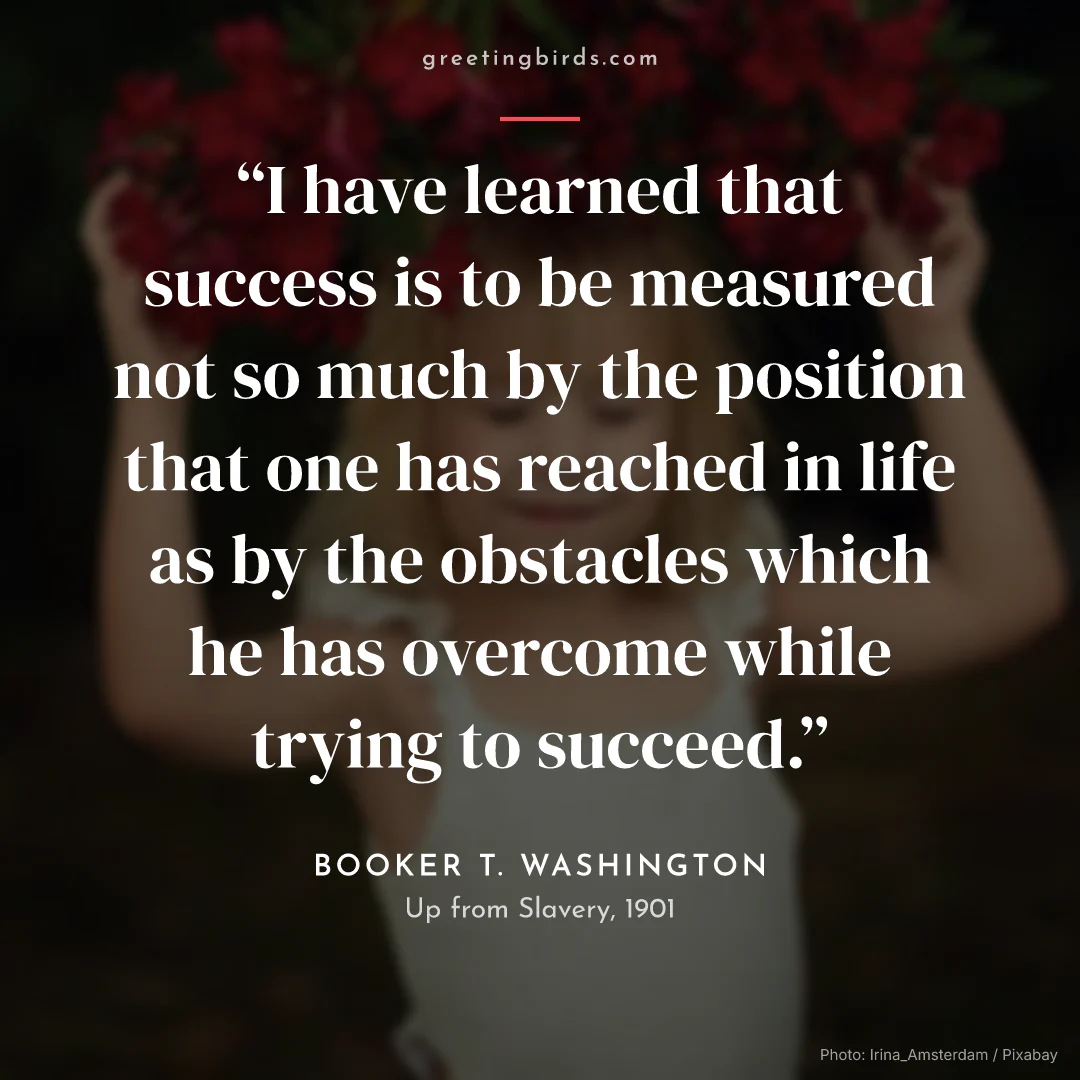
"I have learned that success is to be measured not so much by the position that one has reached in life as by the obstacles which he has overcome while trying to succeed."
Booker T. Washington, Up from Slavery (1901), chapter 2
Washington, born into slavery, wrote this while looking back on the days when he envied the white boy who had no obstacles in the way of his ambitions; later in life, he says, he no longer did. The useful idea is the yardstick: a modest job reached against heavy odds counts for more than a grand one that came easily. It is a good line for a graduation card for a first-generation student, or for anyone who feels they started late.
Theodore Roosevelt on daring
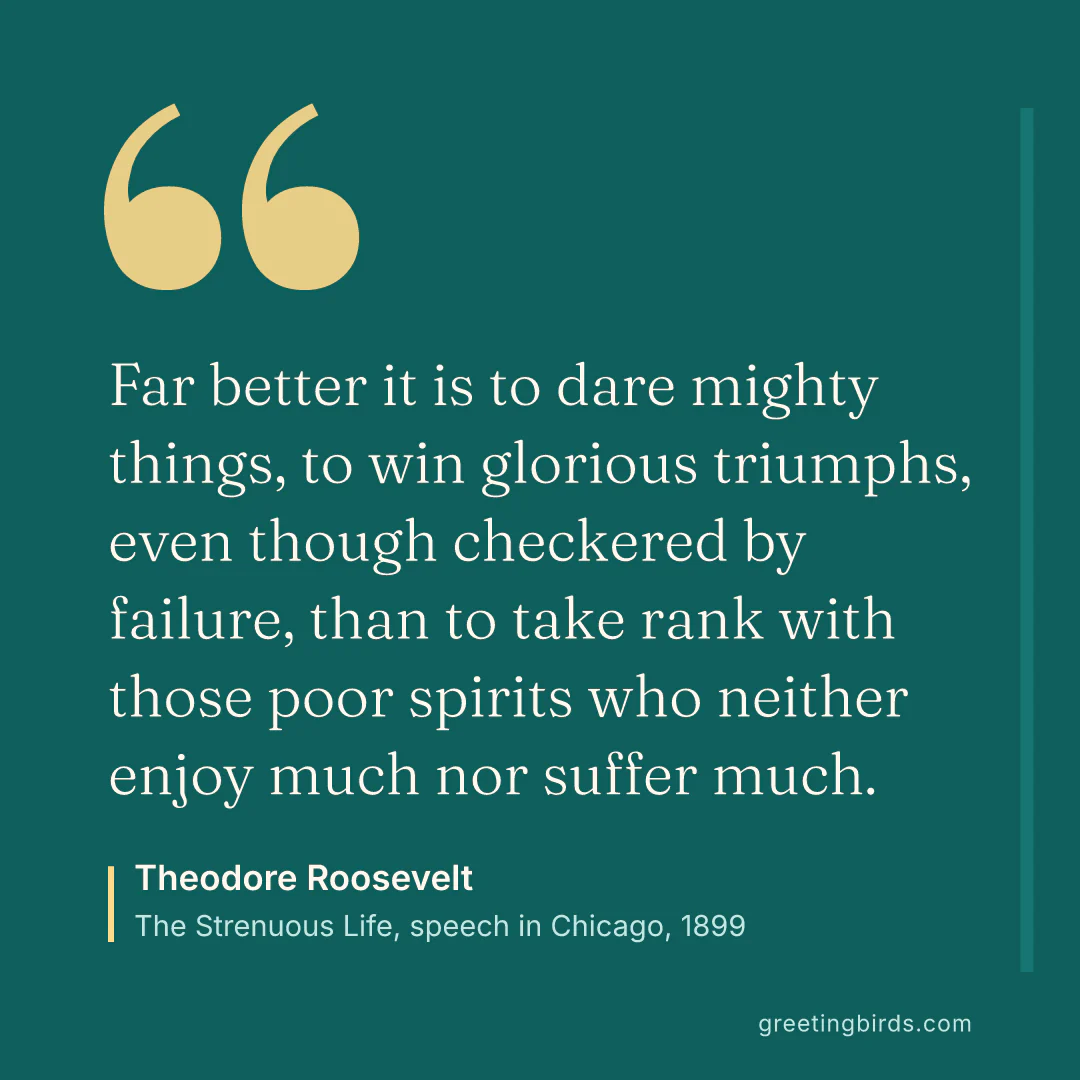
"Far better it is to dare mighty things, to win glorious triumphs, even though checkered by failure, than to take rank with those poor spirits who neither enjoy much nor suffer much."
Theodore Roosevelt, "The Strenuous Life," speech before the Hamilton Club, Chicago, April 10, 1899
This is the long, complete sentence behind many shortened versions online. Roosevelt was speaking to businessmen about national ambition, so the original is partly about the country, not only about personal goals. Read slowly, it makes a modest claim: a life with failures in it is better than one kept safe in what he calls "the gray twilight." It suits a send-off card for someone starting a business or moving abroad.
Franklin D. Roosevelt on fear
"So, first of all, let me assert my firm belief that the only thing we have to fear is fear itself—nameless, unreasoning, unjustified terror which paralyzes needed efforts to convert retreat into advance."
Franklin D. Roosevelt, First Inaugural Address, March 4, 1933
Most people know only the first half. The full sentence says what fear does: it paralyzes the efforts that would turn a retreat into an advance. FDR spoke in the fourth year of the Great Depression, with banks closing across the country. The practical takeaway for a card or a pep talk is the second half, which shifts the focus from "don't be afraid" to "fear is what stops you from acting."
Dickens on lightening a burden
"No one is useless in this world who lightens the burden of it for any one else."
Charles Dickens, Our Mutual Friend (1865)
In the novel, the Secretary, Mr. Rokesmith, answers Bella Wilfer when she says she is useless in this world. It's one of the kindest answers to someone who feels they have nothing to offer, and it makes a good line for a thank-you note to a volunteer, a caregiver or a colleague who quietly keeps a team going.
Dickens on doing the small thing well
"Whatever I have tried to do in life, I have tried with all my heart to do well; that whatever I have devoted myself to, I have devoted myself to completely; that in great aims and in small, I have always been thoroughly in earnest."
Charles Dickens, David Copperfield (1850), chapter 42
David, now a working writer, is describing how he got on. The point to borrow is the last clause: earnestness, in great things and small. It is a good motivational line for the days when the task is boring, such as the report, the repair or the lesson plan.
36 short lines of our own
These have no author because we wrote them. Use them as they are, shorten them, or use them as a starting point for your own wording. Each group fits a different moment.
Starting lines
- Do the first ten minutes. The rest gets easier to argue for once it is started.
- You don't need the whole plan, only the next clear step.
- A rough draft beats a perfect idea that never leaves your head.
- Today's small effort is next month's habit.
- Waiting until you feel ready is how most good things get postponed.
- Start badly, then improve. It beats not starting.
For a tired week
- Slow progress is still progress. Keep walking.
- Rest is part of the work, not a break from it.
- You've handled hard weeks before, and this one will end too.
- Lower the goal for today, not the standard for the month.
- Being tired doesn't mean you chose wrong.
- One finished thing today is enough.
To send to someone else
- I've watched you do harder things than this. I'm still betting on you.
- No pressure, just a reminder that you're doing better than you think.
- Whatever happens with the interview, I'm proud you went in.
- You don't have to be fearless, only willing. You are.
- Thinking of you today. Go and do the thing.
- Your effort has not gone unnoticed, even when it feels that way.
- Take the afternoon off if you need to, and start again tomorrow.
- You've got this, and if you don't, you've got me.
Short captions and desk notes
- Begin anyway.
- Small steps, every day.
- Keep going. You're closer than you think.
- Progress, not perfection.
- Today counts.
- Make it a good one.
- Courage is a habit.
- Do it tired. Do it scared. Do it anyway.
End of the day
- You did what you could today. That is a full day.
- Whatever didn't get done can be picked up in the morning.
- Finish by noticing one thing that went well.
- Rest well. Tomorrow starts clean.
- You showed up. That counts for more than the list.
- Close the laptop. The work will still be there, and so will you.
- One good day at a time adds up faster than it feels.
- Tonight, give yourself credit.
How to choose a line and use it
- Name the moment first. Is the person starting, stuck, tired or celebrating? A starting line sent to a tired person reads as pressure.
- Match the length to the medium. Captions and desk notes: five words or fewer. Cards: one sentence plus your own line. Speeches: a full quotation, with the name.
- Add one personal sentence. "This reminded me of how you handled the move" turns a borrowed line into a message. A quote alone is a poster; a quote plus a specific detail is a card.
- Credit the author. If it's a sourced quote, write the name and the work. If it is one of ours, there's no need to credit us.
- Don't stack quotes. One line per card. Two lines compete.
For lines linked to a day of the week, see Monday greetings and Saturday motivational quotes for work. For longer sourced lists grouped by season and mood, try motivational quotes for 2026 and motivational quote for today. If you need to encourage a team, inspirational quotes for employees has lines for that.
How to check a quote before you share it
Many motivational quotes online are shortened, reworded or credited to the wrong person. A two-minute check helps. Copy the exact words into a search engine and look for a page that shows the book, speech or letter, not just a quote site. Check whether the full sentence is longer than the version you've seen (the Roosevelt and FDR lines above both are). Search Project Gutenberg or Wikisource for the text itself when the author lived before 1930. If you can't find a primary source, either skip the line or write "attributed to" and say that you couldn't confirm it.
Common questions
What is the difference between inspirational and motivational quotes?
Inspirational quotes widen your view of what is possible or meaningful. Motivational quotes push you toward an action. The two overlap, and the best lines (like Douglass's or Roosevelt's) do both.
What are some short inspirational quotes?
From the list above, Emerson's "To be great is to be misunderstood" is one of the shortest sourced lines. From our own, "Begin anyway" and "Today counts" fit on a sticky note.
Can I use these quotes on a card or social post?
Yes. The sourced quotes are from works long in the public domain, so you can quote and share them with the author's name. The short lines we wrote are free to use and need no credit.
How many quotes should I put in one message?
One. A single line with a personal sentence beside it is more convincing than a list.