
Pet Sympathy Messages: 71 Things to Write When a Dog or Cat Dies
71 original pet sympathy messages for a lost dog or cat, for cards, texts, coworkers and vets, plus what not to say and the true Rainbow Bridge story.
By GreetingBirds EditorsPublished October 24, 202615 min read
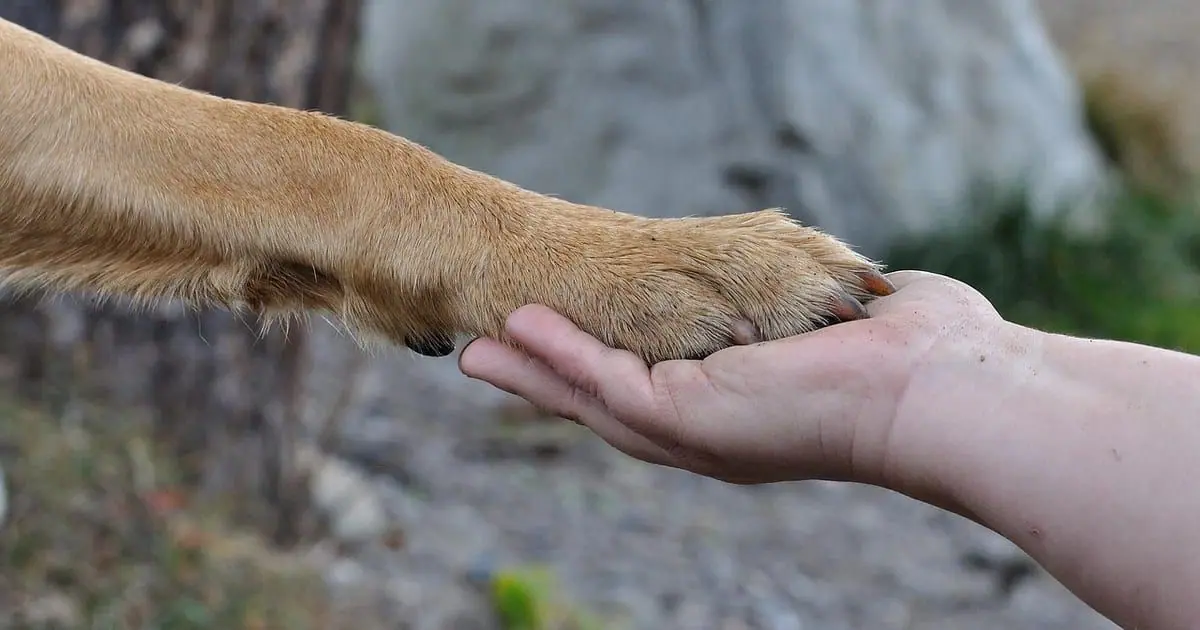
The best pet sympathy messages do three things: use the animal's name, say one true thing about them, and treat the loss as the real grief it is. A dog who met someone at the door for twelve years, or a cat who slept on the same chair every afternoon, leaves a gap that shows up in the daily routine, and people who have lost a pet often say the hardest part is that others expect them to be over it by Monday. The 71 messages below are original lines you can copy or adapt for a card, a text or a note from the vet clinic, sorted by the questions people actually ask when someone's pet dies.
If you need something right now, start here:
- I'm so sorry about [name]. They were lucky to be loved by you, and you were lucky to have them.
- Thinking of you and missing [name] with you. The house must feel so quiet.
- There's no "just" about losing a pet. [Name] was family, and I'm so sorry.
- Sending love. I'll always remember [name] [one small detail, like "stealing socks"].
- So sorry for your loss. Grieve as long as you need to. They were worth every tear.
What Do You Write in a Pet Sympathy Card?
Write two or three sentences: the pet's name, one memory or trait, and a line that gives the person permission to grieve. You don't need poetry. The name alone does most of the work, because it tells the reader you saw their animal as an individual and not as a category.
A simple formula works for almost any card:
- Name the loss. "I was so sorry to hear about Biscuit."
- Add one true detail. "I'll never forget how she waited at the window for the school bus."
- Close with care, not advice. "Thinking of you this week, and I'm here if you want to talk about her."
Worked example (a sample, not a real card): a coworker's old beagle, Rufus, was put to sleep on Friday. You only knew him from photos on her desk. "I'm so sorry about Rufus. Every photo of him on your desk had that same proud-of-himself face, and I could tell how much you loved him. Take whatever time you need. I'm thinking of you."
If you don't know the name, ask someone who does, or write "your sweet girl" or "your faithful boy" rather than "your pet." "It" reads cold in a sympathy card.
What Is a Good Condolence Message for the Loss of a Pet Dog?
For a dog, speak to the routine they filled: walks, the greeting at the door, the spot by the bed. Dog owners often describe the silence at home as the first thing that hits them, so lines that admit the house feels different tend to land.
- I'm so sorry about [name]. The best greeter in the neighborhood, and the most loyal friend you could ask for.
- Thinking of you on all the walks that will feel too quiet now. [Name] was such a good dog.
- [Name] spent [number] years making sure you never came home to an empty house. I'm so sorry he's gone.
- She knew every one of your moods and loved you through all of them. Sending you so much love.
- No more muddy paws by the door, and I know you'd give anything for one more set. I'm so sorry.
- He was a very good boy, and he had the very best person. Thinking of you.
- I'll miss [name]'s whole-body tail wag. Thank you for letting us all borrow a little of his joy.
- Rest easy, [name]. You were loved every single day, and you gave it all back twice over.
Where "man's best friend" comes from
The phrase people reach for in dog sympathy cards traces back to a Missouri courtroom. On September 23, 1870, the lawyer George Graham Vest (later a U.S. senator) gave the closing argument in Burden v. Hornsby, a suit over a foxhound named Old Drum who had been shot by a neighboring sheep farmer. Vest barely mentioned the evidence. He spoke about dogs instead, and only part of the speech survives:
"The one absolutely unselfish friend that a man can have in this selfish world, the one that never deserts him and the one that never proves ungrateful or treacherous is his dog."
— George Graham Vest, closing argument in Burden v. Hornsby, Warrensburg, Missouri (1870)
The jury awarded the dog's owner $50, and a statue of Old Drum now stands outside the Johnson County Courthouse in Warrensburg. The full passage ends with a dog keeping watch at its master's grave, so in a card it works best as a short excerpt: the sentence above, or just "the one absolutely unselfish friend," followed by your own line about their dog.

What Do You Say When Someone's Cat Dies?
Cats tend to be loved for their particular habits, so lean on those: the chair they claimed, the 5 a.m. wake-up call, the way they chose one person. Cat owners sometimes feel their grief gets taken less seriously than a dog owner's, so a message that treats the bond as real means a lot.
- I'm so sorry about [name]. She chose you, and cats don't do that lightly.
- Thinking of you and the empty spot on the windowsill. [Name] was one of a kind.
- I know how much [name] was part of your everyday life. Sending love while you adjust to the quiet.
- Eighteen years of purring, judging and keeping your lap warm. [Name] had a wonderful life with you. (Change the number to fit.)
- He ran the house and everyone knew it. I'm so sorry he's gone.
- No one will ever knock things off your desk with quite as much style. I'm so sorry about [name].
- She may have pretended not to care, but she always came to find you. That kind of love doesn't leave quickly.
- Holding you in my thoughts. Losing a cat is losing a whole daily rhythm, and I'm sorry you're going through it.
Short Messages for a Text or a Small Card
The first day or two, a short text is often kinder than a phone call: the person can read it without having to hold it together on the line. Keep it to one or two lines and make clear no reply is needed.
- So sorry about [name]. No need to reply, just sending love.
- Thinking of you and [name] today.
- Heartbroken for you. [Name] was the best.
- I'm so sorry. Here if you want to talk about her, or not talk at all.
- Sending a big hug. He was so loved.
- Gone from the house, never from your heart. So sorry, friend.
- [Name] was lucky to have you. I'm so sorry.
- Thinking of you tonight. I know the first evenings are the hardest.
How Do You Comfort a Friend or Coworker Who Lost a Pet?
For a close friend, add an offer with a date attached. For a coworker, keep it warm and brief, and add the practical relief a team can give, like covering a meeting. Both groups benefit from one simple step: ask about the pet later, by name, when the cards have stopped.
- I'm bringing dinner Thursday so you don't have to think about cooking. I'm so sorry about [name].
- Want to walk [name]'s old route together this weekend? I'll go wherever you want to go.
- You gave [name] the kind of life every animal deserves. I'm here, friend.
- The team is so sorry about [name]. Please take the time you need; we've got things covered here.
- We were so sorry to hear about your dog. Thinking of you this week. (From all of us at [team].)
- I know [name] was family. If you'd like to step out today or work from home, just say the word.
- I still have the photo you sent of [name] in the Halloween costume. I'm keeping it. So sorry, friend.
Grief after a pet often overlaps with other hard seasons. If your friend is also dealing with a move, an illness or a breakup, our encouragement messages for someone going through a hard time are written for that longer stretch.
What If They Had to Put Their Pet to Sleep?
Choosing euthanasia often leaves people with guilt layered on top of grief: was it too soon, too late, the right call? Your message can quietly answer that worry. Say that the decision was an act of love, and don't ask questions about how or why.
- Letting [name] go peacefully was the last kind thing you could do for him, and you did it. I'm so sorry.
- You carried the hardest part so she wouldn't have to hurt anymore. That is love.
- I know this was the decision no one wants to make. You made it with so much care.
- [Name] was safe and with you at the end. That matters more than anything.
- Thinking of you after such a hard day. You gave her a gentle goodbye.
- Second-guessing is part of loving them. Please be kind to yourself; you did right by [name].
What About a Sudden or Accidental Loss?
When a pet dies suddenly, after an accident, a short illness or a surgery that didn't go as hoped, the person had no time to say goodbye. Skip anything that sounds like a review of what happened ("Was the gate open?"). Focus on the shock and on the pet's life, not the last day.
- I'm so sorry. There was no time to prepare, and that makes it even harder.
- I can't believe [name] is gone. I'm thinking of you through the shock of it.
- Please don't carry blame for this. [Name] knew a lifetime of love from you, not one bad day.
- I'm so sorry. You didn't get to say goodbye, but [name] heard "I love you" from you every single day.
- Sending love while this sinks in. I'm here at any hour.
Lines for a Long, Full Life
An old dog or a twenty-year-old cat is still a deep loss, but the person may also want to celebrate the years. Here you can be a little lighter and lean on gratitude.
- What a life [name] had: [number] years of being spoiled by you. I'm so sorry it's over.
- From a tiny puppy to the gray-muzzled king of the couch, you loved him every step of the way.
- Old pets are the best pets. She had a long, well-loved life, and you gave her every day of it.
- Thank you for sharing [name] with all of us for so long. The neighborhood won't be the same.
- So many good years. I hope the memories start to feel warm sooner than you expect.
Is It Okay to Mention the Rainbow Bridge?
Yes, if you know the person finds comfort in it; otherwise a simpler line is safer. The "Rainbow Bridge" is the meadow where, in a widely shared prose poem, pets wait in good health until their people join them. It soothes many readers, but someone who doesn't believe in an afterlife can find it hollow, and a few find it painful in the first days.
The story's authorship was unknown for decades. It circulated in typed copies without a name, and the "Dear Abby" advice column printed it unattributed in 1994. In February 2023, researcher Paul Koudounaris, followed by National Geographic, traced it to Edna Clyne-Rekhy, who wrote it as a teenager in Scotland in 1959 after her dog Major died. Because the text is still her work, we haven't reprinted it here; if you include it, credit her by name.
- I hope [name] is running free at the Rainbow Bridge, young and well again, keeping an eye out for you.
- Somewhere there's a meadow with a very happy [dog/cat] in it. Thinking of you.
- Until you meet again at the Rainbow Bridge, may your memories of [name] keep you company.
- Praying for comfort for you, and grateful to God for every year you had with [name].
- May God's peace hold you while you miss your faithful friend.
Is "Beauty Without Vanity" by Lord Byron?
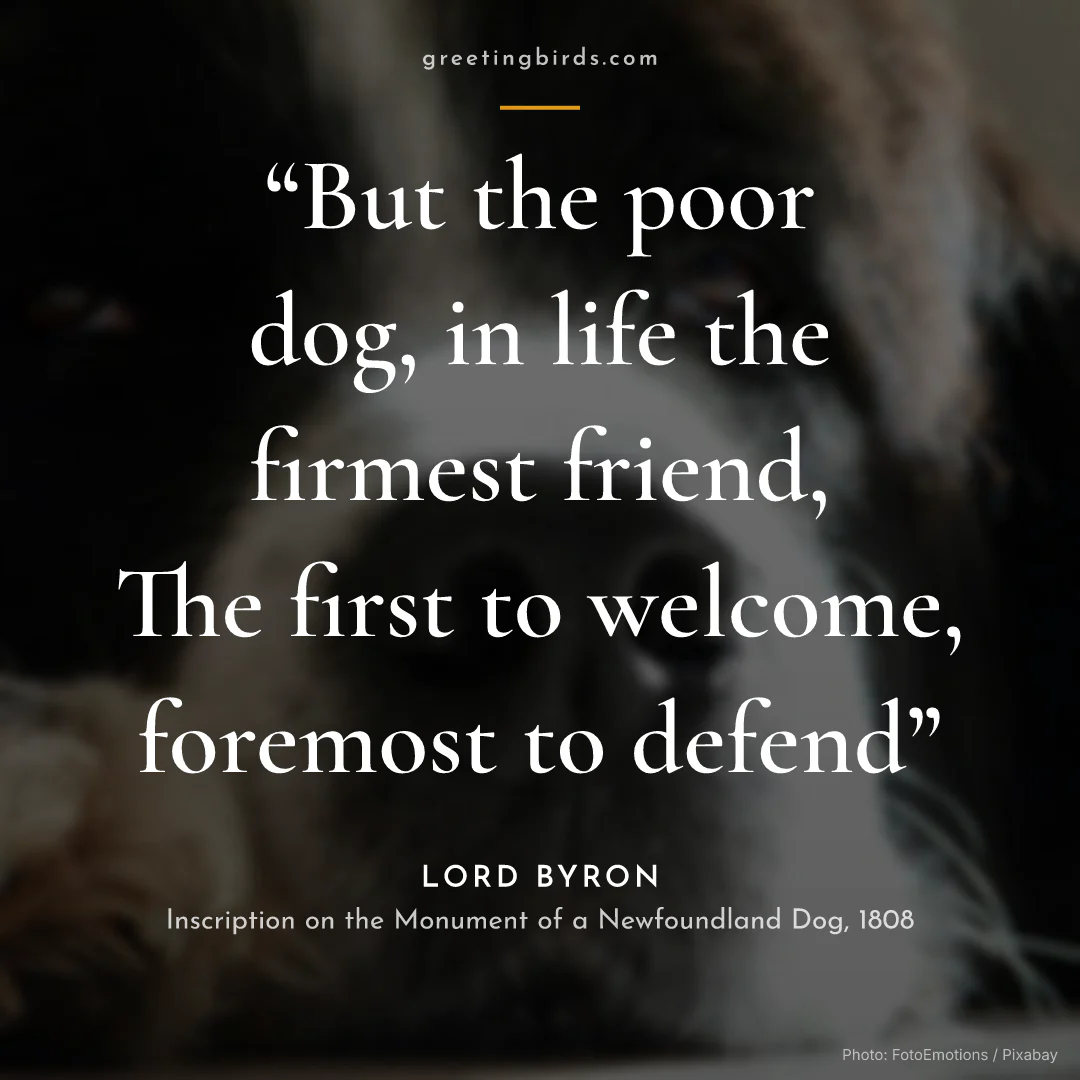
Only partly. The lines most often quoted on pet sympathy cards ("Beauty without Vanity, Strength without Insolence, Courage without Ferocity, and all the Virtues of Man without his Vices") come from the stone monument Byron built in 1808 at Newstead Abbey for his Newfoundland dog, Boatswain, who died of rabies that November. The prose inscription sits above Byron's poem on the monument, and research published in The Byron Journal (1998) credits it to his friend John Cam Hobhouse, not Byron. Byron's own verse below it says this:
"But the poor dog, in life the firmest friend, / The first to welcome, foremost to defend"
— Lord Byron, "Inscription on the Monument of a Newfoundland Dog" (1808)
If you quote the prose lines, the honest credit is "inscription on Boatswain's monument, Newstead Abbey (1808)." If you want Byron's own words, use the couplet above, which fits a card for any dog who met their person at the door. Skip the rest of the poem: it turns into a bitter attack on humankind that won't comfort anyone.
What Can a Vet Clinic Write in a Sympathy Card?
Clinics often send a card a few days after a pet dies. The staff knew the animal, so a line about the visit or the pet's personality is better than a printed sentiment. Sign it with the names of the people who cared for the pet.
- Everyone at [clinic] is so sorry about [name]. It was a privilege to care for her.
- We'll miss [name]'s visits, and the way he tried to charm us out of extra treats. Thinking of you.
- You gave [name] wonderful care to the very end. Our thoughts are with your family.
- Thank you for trusting us with [name] all these years. We're so sorry for your loss.
- With deepest sympathy from Dr. [name] and the whole team. [Name] was loved here too.
How Do You Help a Child Who Lost a Pet?
For a family with young children, you can write to the parents and add a line the kids can hear. Keep it concrete and honest; avoid "went to sleep" or "ran away," which can confuse or frighten small children.
- (To the parents) Thinking of all of you. I know [name] was the kids' best friend, and that's a big loss at any age.
- (For the child) [Name] was lucky to have a friend like you. It's okay to be sad, and it's okay to tell stories about him too.
- (For the child) You took such good care of [name]. That's something to be proud of forever.
- (For the child) Would you draw me a picture of [name]? I'd love to have one.
- (To the family) So sorry about [name]. Sending hugs to every member of the house, including the ones with paws.
Is It Too Late to Send a Card Weeks Later?
No. A note that arrives after the first week often means more, because by then most people have stopped asking. Acknowledge the delay once and move on.
- I've been thinking of you and [name] since I heard, and I'm sorry I'm only writing now.
- I know it's been a few weeks, but I wanted you to know [name] isn't forgotten.
- Checking in. I know the quiet stretches after the first weeks can be the hardest.
- It's been a month since [name] died, and I still think of her every time I pass your house. Sending love.
Which Message Fits the Situation?
Use this table to choose a tone quickly, then pick a line from the matching section above.
| Situation | What helps | What to skip |
|---|---|---|
| Euthanasia after an illness | Calling the decision an act of love | Questions about timing or cost |
| Sudden death or accident | Naming the shock; "they knew a lifetime of love" | Anything that reviews how it happened |
| Very old pet | Gratitude for the long life; lighter memories | "At least they were old" |
| Coworker | Two warm lines plus practical relief | Long stories about your own pets |
| Family with young kids | A line the child can hear; honest words | "Went to sleep," "ran away" |
| Person who isn't religious | Memories and the bond itself | Rainbow Bridge or heaven lines |
What Should You Not Say When a Pet Dies?
Most hurtful lines are meant to help but end up shrinking the loss. Leave these out:
- "It was just a dog / just a cat." Nothing makes a grieving person feel more alone.
- "When are you getting another one?" A new pet is not a replacement, and the question can feel like being rushed.
- "At least it wasn't a person." Comparisons tell people their grief is the wrong size.
- "Everything happens for a reason." Few people want a reason in the first week.
- "I know exactly how you feel." Better: "I remember how hard it was when I lost my dog," then turn the focus back to them.
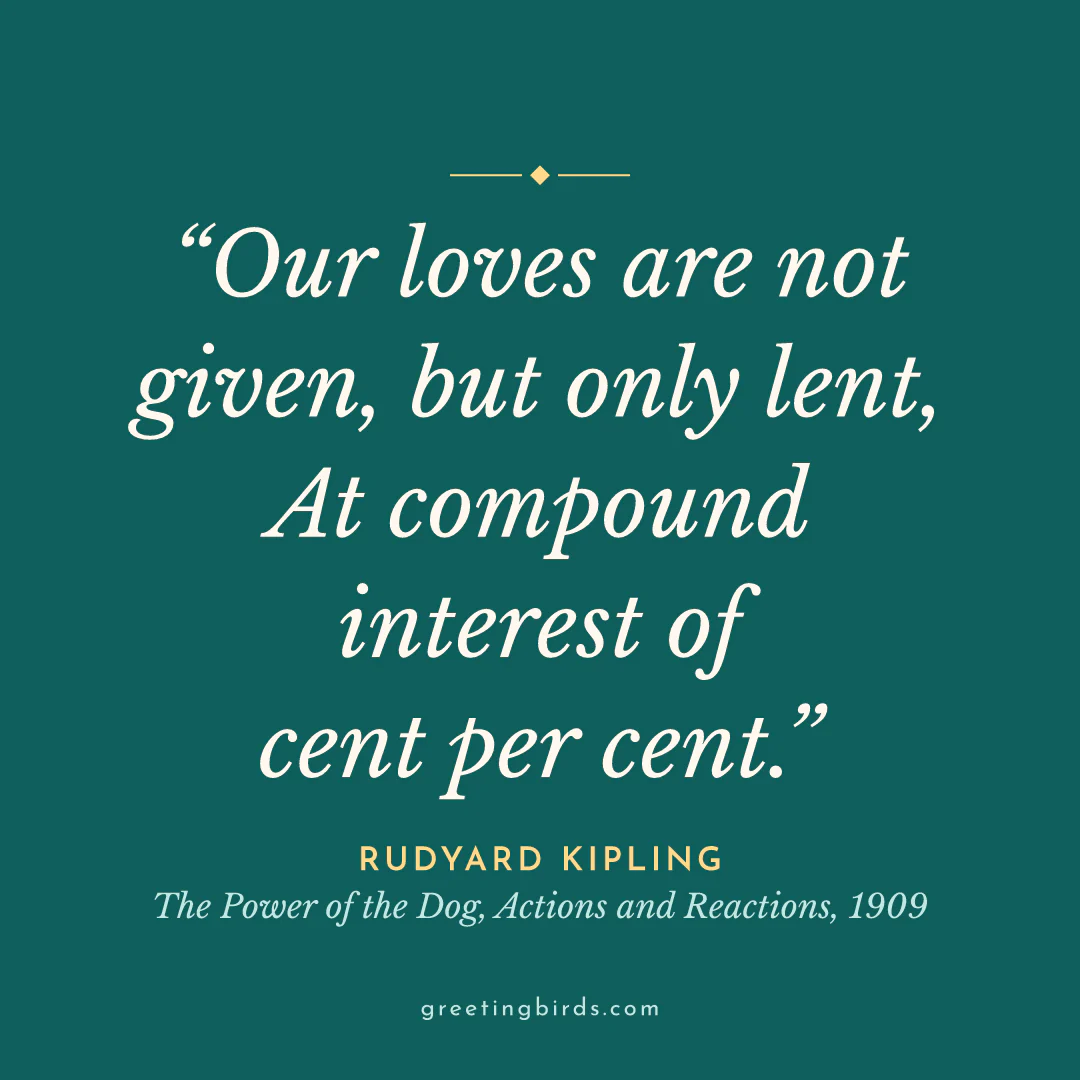
Rudyard Kipling wrote about the cost of loving a dog in "The Power of the Dog," a poem published with his 1909 collection Actions and Reactions. The poem's refrain warns readers against "giving your heart to a dog to tear," but its last stanza holds the line many owners recognize:
"Our loves are not given, but only lent, / At compound interest of cent per cent."
— Rudyard Kipling, "The Power of the Dog," Actions and Reactions (1909)
"Cent per cent" means a hundred percent: the grief comes back with full interest on the love. It suits a card for someone who will understand the wry tone, usually a fellow dog person, and pairs well with a plain closing like "And every bit of it was worth it."
Card Etiquette, Gifts and Where to Find Support
- Timing: a text the same day or the next; a card within a week or two; a check-in note around a month later.
- Sign-off: "Thinking of you," "With love and sympathy," or "Missing [name] with you." Avoid "Cheers" or "Best regards," which feel flat here.
- Group cards: for a coworker, one card with short notes from the team is better than a dozen separate emails.
- Small gifts: a framed photo of the pet, a plant, a donation to a local shelter in the pet's name, or a meal. Ask before ordering a custom portrait, since some people aren't ready to see one yet.
- Support: Cornell University's Pet Loss Support Hotline (607-218-7457) is free and staffed by trained veterinary student volunteers on weekday evenings (6 to 9 p.m. ET) and weekends (noon to 9 p.m. ET). It is not a crisis line; for mental health emergencies in the U.S., call or text 988.
When someone is grieving a person, the words shift; see our condolence messages and, for a parent, sympathy messages for the loss of a mother.
Pet Sympathy FAQ
What is a good condolence message for the loss of a pet dog?
Use the dog's name and one detail from daily life, then give permission to grieve. For example: "I'm so sorry about Max. I'll miss his welcome at the door. He was a very good dog, and he had the very best person."
What do I say when someone's pet dies?
Say you're sorry, use the pet's name, and treat the loss as real: "I'm so sorry about Luna. I know how much she meant to you." Then listen. Asking them to tell you a favorite story is often more comforting than anything you could say.
Is it appropriate to send a sympathy card for a pet?
Yes. Pet sympathy cards are common and almost always welcome, especially from friends, coworkers and the vet clinic. A handwritten line with the pet's name shows the person their grief is taken seriously.
What is a good short sympathy quote for a pet?
Two well-documented options: Byron's "in life the firmest friend, / The first to welcome, foremost to defend" (1808), and George Graham Vest's "the one absolutely unselfish friend" (1870). Credit the "Beauty without Vanity" lines to Boatswain's monument rather than to Byron himself.