
Quote of the Day: 31 Sourced Quotes, One for Every Date of the Month
A quote of the day for every date from 1 to 31, each checked against its book, letter or speech, with context and tips for sharing at work or school.
By GreetingBirds EditorsUpdated October 11, 202619 min read

A quote of the day is one short line, credited to the real person who said or wrote it, that you read once in the morning and carry around until night. This page is a calendar: find today's date in the table below and that's your quote. All 31 were checked against the book, letter, speech or poem they come from. Each has a few lines on who said it and when it fits, so you can share it without passing on a fake.
Months with 30 days simply skip the 31st. In February, days 29 to 31 make a good "end of month" set to read together.
The calendar at a glance
| Date | Quote of the day |
|---|---|
| 1 | "if one advances confidently in the direction of his dreams..." (Thoreau, 1854) |
| 2 | "Dost thou love Life, then do not squander Time" (Franklin, 1758) |
| 3 | "So teach us to number our days" (Psalm 90:12) |
| 4 | "six impossible things before breakfast" (Lewis Carroll, 1871) |
| 5 | "nobody need wait a single moment before beginning to improve the world" (Anne Frank, 1944) |
| 6 | "Procrastination is the thief of time" (Edward Young, 1742) |
| 7 | "Forever – is composed of Nows –" (Emily Dickinson) |
| 8 | "standing on the shoulders of Giants" (Isaac Newton, 1676) |
| 9 | "1 per cent inspiration and 99 per cent perspiration" (Thomas Edison, 1901) |
| 10 | "not because they are easy, but because they are hard" (John F. Kennedy, 1962) |
| 11 | "then you must write it" (Toni Morrison, 1981) |
| 12 | "Stay Hungry. Stay Foolish." (Steve Jobs, 2005) |
| 13 | "when you do not know a thing, to allow that you do not know it" (Confucius) |
| 14 | "The dogmas of the quiet past, are inadequate to the stormy present." (Abraham Lincoln, 1862) |
| 15 | "to choose one's attitude in any given set of circumstances" (Viktor Frankl) |
| 16 | "I'm not afraid of storms, for I'm learning how to sail my ship." (Louisa May Alcott, 1869) |
| 17 | "Darkness cannot put out darkness; only light can do that." (Martin Luther King Jr., 1967) |
| 18 | "Hope springs eternal in the human breast" (Alexander Pope, 1734) |
| 19 | "Life is either a daring adventure or nothing." (Helen Keller, 1940) |
| 20 | "The universe is transformation: life is opinion." (Marcus Aurelius) |
| 21 | "It goes on." (Robert Frost, 1954) |
| 22 | "To every thing there is a season" (Ecclesiastes 3:1) |
| 23 | "to thine own self be true" (Shakespeare, Hamlet) |
| 24 | "Trust thyself: every heart vibrates to that iron string." (Emerson, 1841) |
| 25 | "Think only of the past as its remembrance gives you pleasure." (Jane Austen, 1813) |
| 26 | "I am large, I contain multitudes." (Walt Whitman) |
| 27 | "Hold fast to dreams" (Langston Hughes, 1923) |
| 28 | "even the undertaker will be sorry" (Mark Twain, 1894) |
| 29 | "your one wild and precious life" (Mary Oliver, 1990) |
| 30 | "reserves of strength that will endure as long as life lasts" (Rachel Carson, 1965) |
| 31 | "life, if you know how to use it, is long" (Seneca) |
The calendar runs in four themed weeks plus a short end-of-month set. The first week is about starting, the second about work, the third is for heavy days and the fourth is about people. If the quote for today's date doesn't suit the day you're actually having, borrow one from the week that does. If you'd rather pick by mood than by date, our motivational quote for today guide matches quotes to the kind of day someone is having.
Days 1 to 7: for starting something
The first week of a month is when plans are still fresh, so these seven lines are about beginning, using time well and not waiting for a perfect moment.
"I learned this, at least, by my experiment: that if one advances confidently in the direction of his dreams, and endeavors to live the life which he has imagined, he will meet with a success unexpected in common hours."
— Henry David Thoreau, Walden, "Conclusion" (1854)
Day 1. Thoreau wrote this as the lesson of his two years in a cabin at Walden Pond. Notice the word "experiment": he's reporting a result, not giving a pep talk. The short poster version ("Go confidently in the direction of your dreams") is a paraphrase, so quote the real sentence when you can. Good for the first day of a new job, a new month or a new plan.
"Dost thou love Life, then do not squander Time, for that's the Stuff Life is made of."
— Benjamin Franklin, The Way to Wealth (1758), quoting his own Poor Richard almanac
Day 2. The Way to Wealth is a speech by an old man called Father Abraham, made up almost entirely of sayings from Franklin's almanacs. This one had appeared in an earlier edition of the almanac. The old capital letters are Franklin's own, and keeping them makes the line look as old as it is. It's a gentle nudge to send someone who keeps putting off something they love.
"So teach us to number our days, that we may apply our hearts unto wisdom."
— Psalm 90:12, King James Version (1611)
Day 3. Psalm 90 is a meditation on how short a human life is next to God's, and this verse turns that thought into a request: help us count our days so we use them well. It suits a church bulletin, a family chat or a birthday card for someone who takes their faith seriously.
"Why, sometimes I've believed as many as six impossible things before breakfast."
— The White Queen, in Lewis Carroll's Through the Looking-Glass, ch. 5 (1871)
Day 4. The Queen says it right after telling Alice that she used to practise believing impossible things for half an hour a day. It's a joke, but a useful one for a morning when the to-do list looks absurd. Kids like it, so it's a good pick for a classroom board.
"How wonderful it is that nobody need wait a single moment before beginning to improve the world!"
— Anne Frank, essay "Give!" (26 March 1944), in Tales from the Secret Annex
Day 5. This line isn't from the diary entries, although it's often credited that way. It comes from a short essay Anne wrote in hiding about how people treat the poor, urging readers to give, even if all they can give is kindness. She was fourteen. Use it for a volunteer team, a fundraiser kickoff or anyone who thinks they have to wait to make a difference.
"Procrastination is the thief of time."
— Edward Young, Night-Thoughts, Night I (1742)
Day 6. It sounds like an anonymous proverb, but it was written by Edward Young, an English clergyman, in a very long poem about life, death and immortality. The next line, "Year after year it steals, till all are fled," is darker. For a whiteboard, the first line on its own is enough.
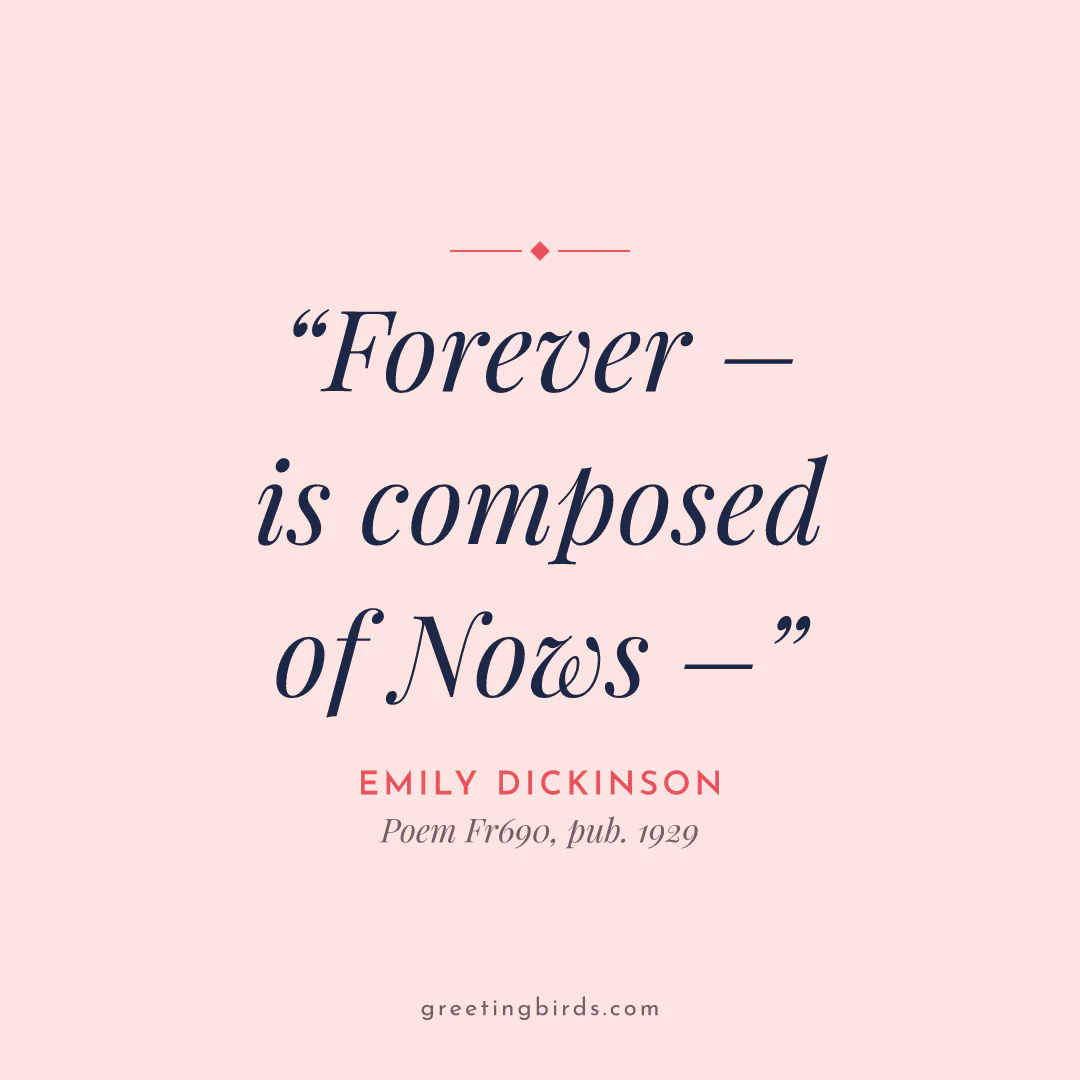
"Forever – is composed of Nows –"
— Emily Dickinson, poem Fr690 (first published 1929)
Day 7. Dickinson's poems were mostly published after her death, and this one only reached print in 1929. In six words it makes the case that the present moment is all eternity is made of. The dashes are hers, so keep them. It's the shortest line on this page and fits a sticky note perfectly.
Days 8 to 14: for work and doing things well
The second week is when the month's work actually happens. These are the lines people most often post on an office board or in a team channel: about effort, craft, learning and not pretending to know everything.
"If I have seen further it is by standing on the shoulders of Giants."
— Isaac Newton, letter to Robert Hooke, 5 February 1675/6 (spelling modernized; the letter reads "ye sholders")
Day 8. Newton wrote this in a letter to a scientific rival, and the image of standing on giants' shoulders was already centuries old. That makes it a fitting quote about giving credit. Use it on a day you want to thank the people whose earlier work made yours possible.
"Genius is 1 per cent inspiration and 99 per cent perspiration."
— Thomas Edison, as reported in the Idaho Daily Statesman (1901); Edison confirmed the saying in Harper's Monthly in 1932
Day 9. This is one of the few famous work quotes that really does trace back to the person it's credited to. Quote Investigator found it in print in 1901. Earlier versions gave the split as 2 and 98. It's a good one for a team in the middle of the dull, sweaty part of a project.
"We choose to go to the moon in this decade and do the other things, not because they are easy, but because they are hard..."
— John F. Kennedy, address at Rice University, Houston, 12 September 1962
Day 10. Kennedy said it in Rice Stadium, seven years before the landing. The full sentence goes on to say that the goal "will serve to organize and measure the best of our energies and skills," which is exactly why teams still quote it at the start of a hard project.
"If you find a book you really want to read but it hasn't been written yet, then you must write it."
— Toni Morrison, talk to the Ohio Arts Council, 1981 (reported in The Cincinnati Enquirer, 27 September 1981)
Day 11. The version that usually circulates ("If there's a book that you want to read...") is a later rewording. Morrison's point goes well beyond books: if the thing you need doesn't exist, make it. It suits makers, founders, students starting a project and anyone frustrated that "someone should" do something.
"Stay Hungry. Stay Foolish."
— Steve Jobs, Stanford commencement address, 12 June 2005
Day 12. Jobs ended his speech with this line and said it wasn't his. It was printed on the back cover of the final issue of the Whole Earth Catalog as the magazine's farewell message. Credit both if you have room. It works for graduations and new starts.
"When you know a thing, to hold that you know it; and when you do not know a thing, to allow that you do not know it;—this is knowledge."
— Confucius, Analects 2.17, trans. James Legge
Day 13. Confucius says this to his student Zilu, and it opens with a question: "Yu, shall I teach you what knowledge is?" It's the best answer on this page to "fake it till you make it", and a good pick for a team that is trying to make "I don't know yet" a normal thing to say.
"The dogmas of the quiet past, are inadequate to the stormy present."
— Abraham Lincoln, Annual Message to Congress, 1 December 1862
Day 14. Lincoln wrote this a month before the Emancipation Proclamation took effect, in the middle of the Civil War. The comma after "past" is in his original text. The next sentence is just as quotable: "The occasion is piled high with difficulty, and we must rise with the occasion." Use it on a day when the old way of doing something has stopped working.
Days 15 to 21: for heavy days
By mid-month somebody you know is having a hard week. These quotes don't tell anyone to cheer up. They come from people who went through real trouble and said something true about it.
"Everything can be taken from a man but one thing: the last of the human freedoms—to choose one's attitude in any given set of circumstances, to choose one's own way."
— Viktor Frankl, Man's Search for Meaning (first published in German, 1946)
Day 15. Frankl, a psychiatrist, survived Nazi concentration camps. He wrote this after describing prisoners who walked through the huts comforting others and giving away their last piece of bread. The line is about the one freedom no one could take from them, so don't send it as a breezy "just choose to be positive."
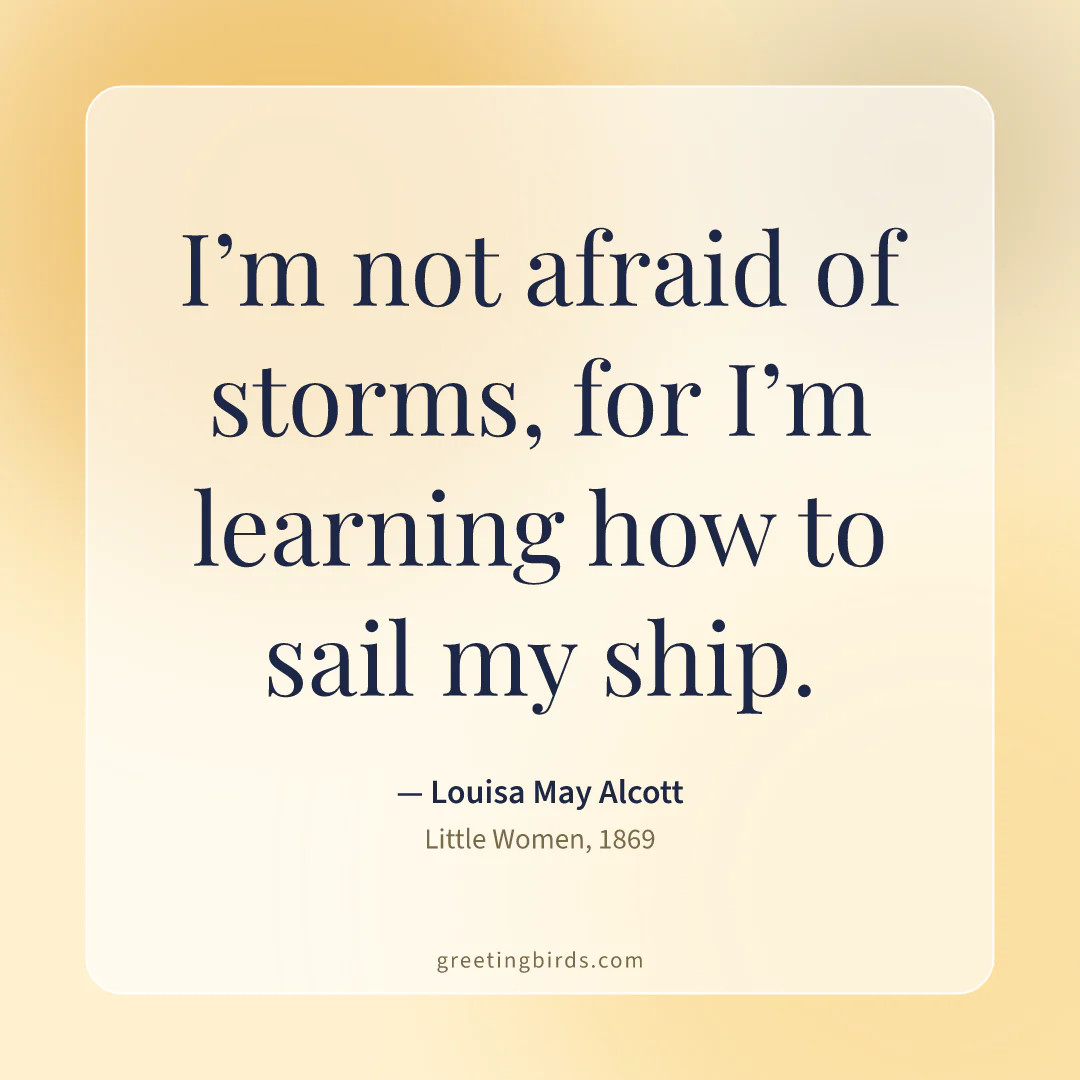
"I don't know how long it will last, but I'm not afraid of storms, for I'm learning how to sail my ship."
— Amy March, in Louisa May Alcott's Little Women, ch. 44 (1869)
Day 16. Amy says this to Laurie early in their marriage, and the "I don't know how long it will last" at the start keeps it honest. Most posters cut those words, but they're what make the line kind to someone in the middle of a rough stretch.
"Darkness cannot put out darkness; only light can do that."
— Martin Luther King Jr., "Where Do We Go From Here?", Atlanta, 16 August 1967
Day 17. King gave this address to the Southern Christian Leadership Conference in Atlanta, in a passage arguing that violence can't end hatred. A longer version with "drive out" and a second half about hate and love is widely shared too. We've printed the wording from the King Institute's text of the 1967 speech.
"Hope springs eternal in the human breast: / Man never is, but always to be blest."
— Alexander Pope, An Essay on Man, Epistle I (1733–34)
Day 18. Almost everyone knows the first line. The second line shows Pope was half teasing: people are never happy right now, only about to be. Use only the first line for encouragement. Use both if the person you're sending it to has a dry sense of humor.
"Life is either a daring adventure or nothing."
— Helen Keller, Let Us Have Faith (1940)
Day 19. Keller, who was deaf and blind from early childhood, wrote this in a chapter arguing that security is mostly a superstition. Quote Investigator notes that the popular version adds "at all" at the end, but her text doesn't have those words. It suits someone about to take a risk they're scared of.
"The universe is transformation: life is opinion."
— Marcus Aurelius, Meditations 4.3, trans. George Long (1862)
Day 20. The emperor's point is that things keep changing and much of what hurts is our judgment of them. You'll often see this as "Our life is what our thoughts make it." That's a looser translation, so don't put Long's name under it. Good for a friend stuck replaying a bad conversation.
"In three words I can sum up everything I've learned about life: it goes on."
— Robert Frost, as quoted by Ray Josephs in This Week magazine, 1954
Day 21. Frost was close to his 80th birthday when a journalist asked him what he had learned. The only source is that interview, so it's fair to say "Frost told an interviewer." It is the gentlest line here for a week after a loss or a breakup. For more words to send after a death, see our condolence messages.
Days 22 to 28: about people and character
The fourth week turns outward, to how we treat each other and ourselves. Several of these are older than the rest of the page, and two are funny on purpose.
"To every thing there is a season, and a time to every purpose under the heaven:"
— Ecclesiastes 3:1, King James Version (1611)
Day 22. This verse opens the famous list of times ("a time to be born, and a time to die... a time to weep, and a time to laugh"), which Pete Seeger later set to music in "Turn! Turn! Turn!". It fits retirements, moves and other goodbyes, and any week when someone needs permission to rest.
"This above all: to thine own self be true, / And it must follow, as the night the day, / Thou canst not then be false to any man."
— Polonius, in William Shakespeare's Hamlet, Act 1, Scene 3
Day 23. Polonius says this to his son Laertes, who is leaving for France, at the end of a long and rather pompous list of advice. Most people quote only the first line. The full three lines are better, because they say why being true to yourself matters: it's how you stay honest with everyone else.
"Trust thyself: every heart vibrates to that iron string."
— Ralph Waldo Emerson, "Self-Reliance," Essays: First Series (1841)
Day 24. "Self-Reliance" is Emerson's case for listening to your own judgment rather than to custom. This sentence compares the confidence everyone has deep down to a string that hums when it's plucked. Send it to someone second-guessing a decision they already know is right.
"You must learn some of my philosophy. Think only of the past as its remembrance gives you pleasure."
— Elizabeth Bennet, in Jane Austen's Pride and Prejudice, ch. 58 (1813)
Day 25. Elizabeth says it to Darcy when he is still embarrassed about the harsh letter he once wrote her. It's a lovely line for anniversaries and reunions, and for anyone who keeps apologizing for something long forgiven.
"Do I contradict myself? / Very well then I contradict myself, / (I am large, I contain multitudes.)"
— Walt Whitman, "Song of Myself," section 51 (wording of the later editions; first version 1855)
Day 26. Whitman kept revising Leaves of Grass for his whole life. The parentheses and section numbers come from later editions. It's a cheerful line for anyone who has changed their mind and been teased for it.
"Hold fast to dreams, my son, / For if dreams die / Life is a broken-winged bird / That cannot fly."
— Langston Hughes, "Dreams," The World Tomorrow (May 1923)
Day 27. This is the poem as Hughes first published it, in a magazine, early in his career. The better-known version leaves out "my son," and that change came later. Either one works in a graduation card. If you print the familiar version, don't date it 1923.
"Let us endeavor so to live that when we come to die even the undertaker will be sorry."
— Mark Twain, Pudd'nhead Wilson, ch. 6 (1894)
Day 28. Twain opened each chapter of the novel with a mock-wise entry from "Pudd'nhead Wilson's Calendar", so this is a calendar quote in the most literal sense. It's a joke with a real point, and it gets more smiles on a team board than anything solemn.
Days 29 to 31: to close the month
The last few days are a natural time to look back and ahead. These three are about what the time was for.
"Tell me, what is it you plan to do / with your one wild and precious life?"
— Mary Oliver, "The Summer Day," House of Light (1990)
Day 29. The poem spends most of its lines watching a grasshopper eat sugar from someone's hand and only asks its question at the very end. Quote these two lines exactly, because they're often paraphrased. They're perfect for a birthday or a big decision. For lines to go with a card, see our birthday messages.
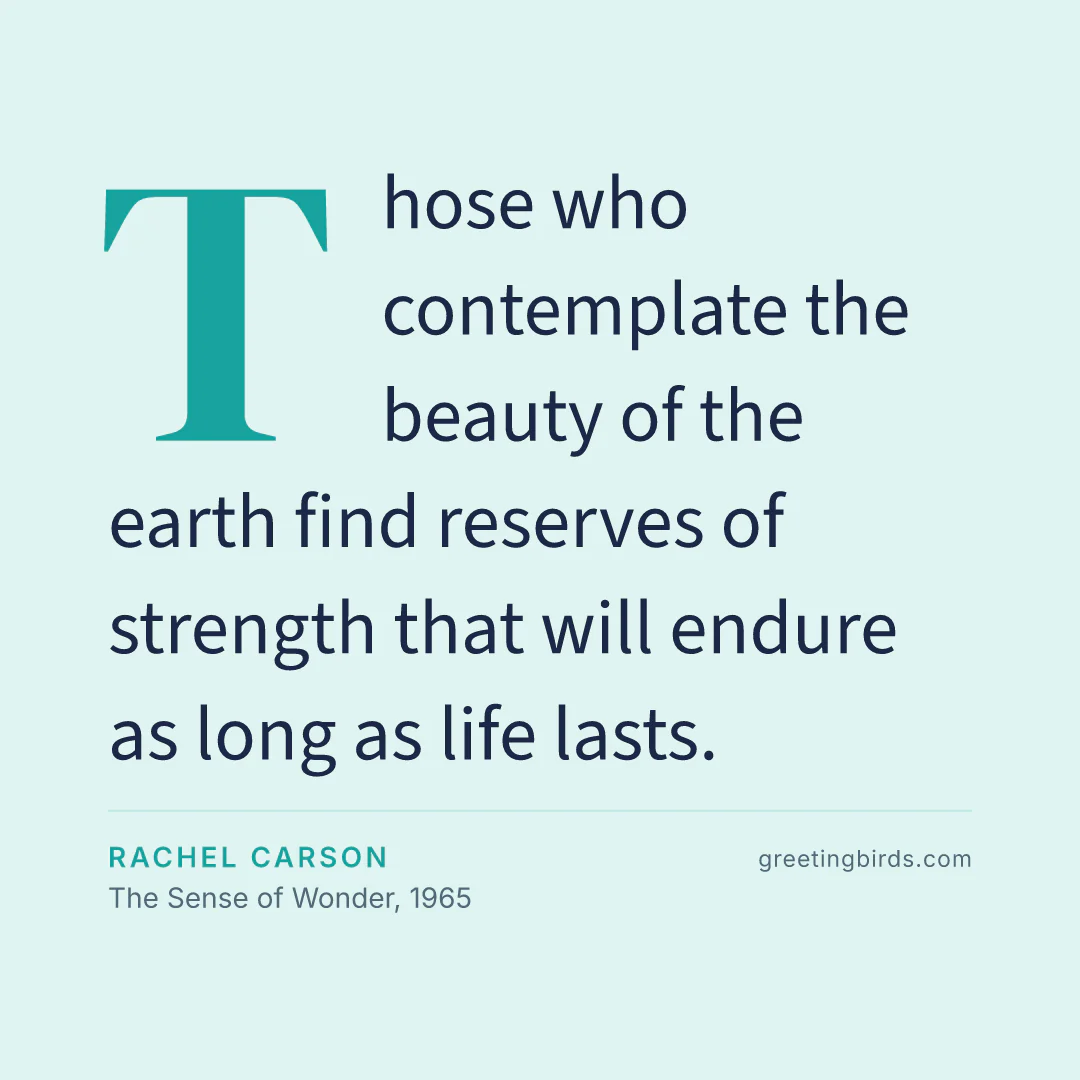
"Those who contemplate the beauty of the earth find reserves of strength that will endure as long as life lasts."
— Rachel Carson, The Sense of Wonder (1965)
Day 30. Carson, author of Silent Spring, wrote this in an essay about sharing the natural world with a child. It was published as a book in 1965, a year after her death. Good to send with a photo from a walk, or to anyone who needs a reason to go outside.
"Why do we complain of Nature? She has shown herself kindly; life, if you know how to use it, is long."
— Seneca, On the Shortness of Life, ch. 2, trans. John W. Basore (1932)
Day 31. Despite the essay's title, Seneca's argument is that life isn't short. We just waste a lot of it. "Life is long if you know how to use it" is a paraphrase of this sentence. It makes a good last-day-of-the-month line and leads neatly back to Franklin on day 2.
Running a quote of the day at work, in class or in a family chat
A quote of the day only works if people actually read it. The ones that last tend to be short, they always name the person who said it, and they're posted at the same time every day so people know where to look. Here's what suits each setting.
| Where it goes | What works there |
|---|---|
| Office whiteboard or break room | One line, big letters, name underneath. Change it before people arrive, not halfway through the morning. |
| Slack or Teams channel | Post at the same time daily, add one sentence on why you picked it, and leave reactions on. Skip the @channel ping. |
| Morning meeting or huddle | Read it in under ten seconds, then move on. Use it as an opener, not a speech. |
| Classroom board | Add one question underneath ("What's one thing you don't know yet?") and leave space for answers. |
| Family group chat or fridge | Shorter and lighter: Carroll, Twain and Alcott go over better here than Lincoln. |
| Newsletter or email signature | Credit it in full (name, work, year) because people forward it. |
For any of these, three parts are enough:
- The quote, word for word.
- The credit: name, plus the book, speech or year if you have room.
- One line of your own that ties it to today: a question, a nudge, or why you picked it.
Worked example for a team channel on the 8th:
- Quote: "If I have seen further it is by standing on the shoulders of Giants."
- Credit: Isaac Newton, letter to Robert Hooke, 1676
- Your line: Today's shout-out goes to whoever wrote the onboarding doc everyone keeps using. Who else should we thank this week?
That third line is where the warmth comes from. Here are some that work with almost any quote on this page:
- "Saw this and thought of your week."
- "Today's quote, picked for the person who's been holding the project together."
- "Not advice, just something to carry around today."
- "Read this on the train and it stuck with me. Passing it on."
- "Question for the room: does this one ring true for you?"
- "Short one today, because it's that kind of week."
- "For anyone starting something new this month."
- "Sending this with coffee, in spirit."
What to leave out
- Lines with no name, or the wrong name. Someone always checks. See the misattribution list below.
- Quotes that lecture staff. "Hard work beats talent" on the day overtime is announced reads as a memo, not inspiration.
- Politics and religion at work, unless that's clearly the norm in your group. On this page the Bible verses suit a family chat or church newsletter better than a company Slack.
- The same author every day. Mix centuries, genders and kinds of writing. A novelist one day and a scientist the next keeps people reading.
- Long passages. If it doesn't fit on one sticky note, trim it to the sentence that matters and keep the wording exact.
Five famous "quotes of the day" with the wrong name on them
These turn up on daily-quote sites and office posters all the time. The sayings are fine. The names under them aren't.
| Shared as | Where it really comes from |
|---|---|
| "We are what we repeatedly do. Excellence, then, is not an act, but a habit." — Aristotle | Will Durant, summing up Aristotle's ethics in The Story of Philosophy (1926). |
| "Go confidently in the direction of your dreams. Live the life you have imagined." — Thoreau | A paraphrase. Thoreau's real sentence is the one for day 1 above. |
| "Don't judge each day by the harvest you reap but by the seeds that you plant." — Robert Louis Stevenson | Quote Investigator found it first in 1963, credited to William Arthur Ward, nearly 70 years after Stevenson died. |
| "The harder I work, the more luck I have." — Thomas Jefferson | Monticello says it isn't in Jefferson's writings. Coleman Cox printed it in 1922. |
| "The secret of getting ahead is getting started." — Mark Twain | No known author. A 1923 bank ad said "Half the game of getting ahead is getting started." |
A quick test before you post anything: if a quote has a name but no book, speech or year anywhere online, treat the name as a guess. Weekday collections like our Wednesday quotes are fun for a midweek post, but for a line you'll credit to a famous person, use a sourced list like this one.
Questions about the quote of the day
What is the quote of the day today?
Find today's date in the calendar at the top of this page. Each date from 1 to 31 has one quote, so the 11th is Toni Morrison's "then you must write it" and the 25th is Jane Austen's "Think only of the past as its remembrance gives you pleasure." The same date gives the same quote every month, which makes it easy to use for a team or classroom routine.
What is the difference between a quote of the day and a thought of the day?
A quote of the day is someone else's words with their name attached. A thought of the day can be anything: a quote, a question, or a line you wrote yourself. Schools often use "thought of the day" for a short line read in assembly. If you write your own, don't put a famous name on it.
What is a good quote of the day for work?
The second week of the calendar (days 8 to 14) is built for work: Newton on giving credit, Edison on effort, Kennedy on hard goals, Morrison on making what's missing, Confucius on admitting what you don't know and Lincoln on changing old habits. For more workplace lines, see our inspirational quotes for employees.
Who said "We are what we repeatedly do"?
Will Durant, in The Story of Philosophy (1926), as a summary of Aristotle's ideas. Aristotle didn't write those words, so credit Durant if you use the line.
How we checked: each quote was compared with a full text or a reliable page about its source (Project Gutenberg, Wikisource, Bible Gateway, the Folger Shakespeare, the King Institute at Stanford, Rice University, MIT's Internet Classics Archive, Lehigh's digital anthology for Hughes, Beacon Press for Oliver, the EPA archive for Carson, and Quote Investigator for Edison, Keller, Frost, Morrison and the misattributions). Where a famous version differs from the original, we print the original and say so.