Lest We Forget: 13 Remembrance Day Quotes, What They Mean, and 31 Lines to Write
What "Lest we forget" means, plus 13 sourced Remembrance Day quotes (Binyon, McCrae, Kipling) with their history, and 31 lines for cards and posts.
By GreetingBirds EditorsPublished October 10, 202613 min read
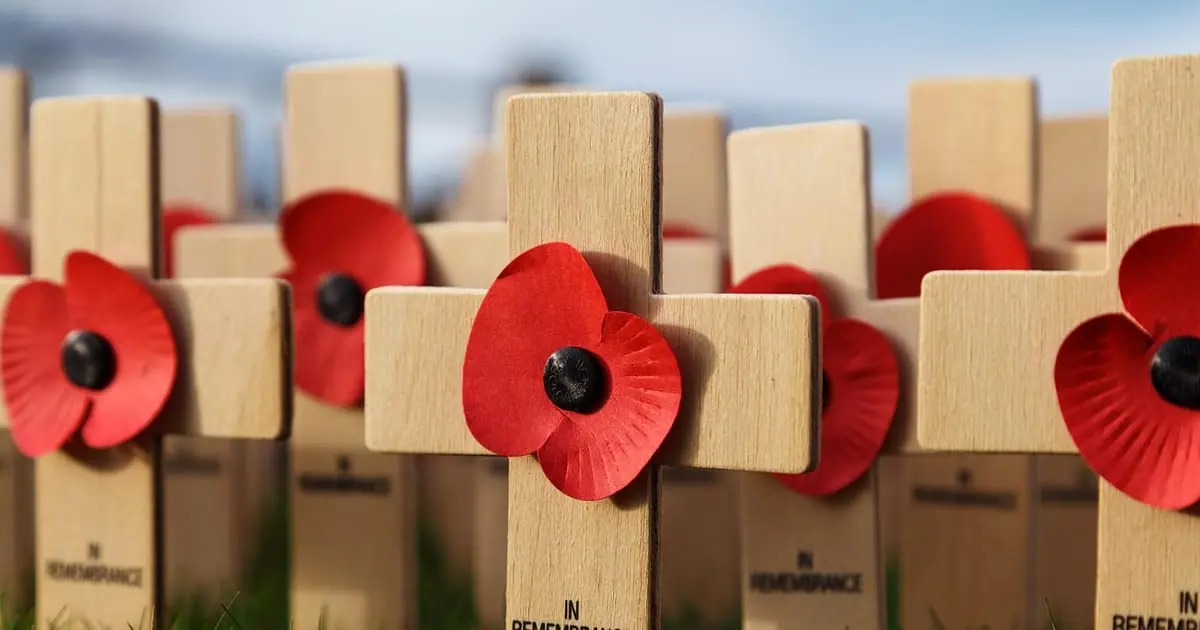
"Lest we forget" means "so that we do not forget." It's an old English way of saying in case we forget, and on Remembrance Day (November 11) it's a promise to keep remembering the people who died in war. The phrase comes from Rudyard Kipling's 1897 poem "Recessional." Kipling borrowed it from the Bible. After the First World War it became the line carved on memorials across Britain, Canada, Australia and New Zealand. At a service it's usually the spoken reply after the Ode of Remembrance, the famous verse that ends "We will remember them."
This page traces the 13 quotes people search for most on November 11. Each one has its author, where it first appeared and when, plus a note on how to use it. After the quotes you'll find 31 short lines our editors wrote for cards, posts and school or office notices, and a simple way to write your own.
Where "Lest we forget" comes from
Kipling wrote "Recessional" for Queen Victoria's Diamond Jubilee, and The Times printed it on July 17, 1897. The jubilee was a celebration of empire, but the poem is a warning against pride: power fades, and a nation that forgets its humility will fade too. Each verse ends with the same refrain.
"Lord God of Hosts, be with us yet,
Lest we forget—lest we forget!"
— Rudyard Kipling, "Recessional," The Times, July 17, 1897
Notice that Kipling wasn't writing about soldiers. In the poem, the thing not to forget is God and humility. The meaning moved after 1918. Towns that had lost a generation of young men needed a few words for their memorials, and "Lest we forget" was short, solemn and already familiar. It was often the only wording on a war memorial, and the poem itself was sung at the burial of the Unknown Warrior in Westminster Abbey.
Kipling's source is the Book of Deuteronomy, where Moses warns the Israelites not to grow comfortable and forget where they came from:
"Then beware lest thou forget the LORD, which brought thee forth out of the land of Egypt, from the house of bondage."
— Deuteronomy 6:12, King James Version (1611)
So the phrase has gone from scripture to a poem about empire to a war memorial. In every version, "lest" carries the same idea: forgetting is the danger. That's why "Lest we forget" works as a complete message on its own. You don't need to add anything after it.
Here is how the best-known Remembrance words line up in time:
1897: Kipling, "Recessional": "Lest we forget" (The Times, July 17)
1914: Laurence Binyon, "For the Fallen": "We will remember them" (The Times, September 21)
1915: John McCrae, "In Flanders Fields," written May 3, printed in Punch December 8
1918: Armistice at the 11th hour of the 11th day of the 11th month; Moina Michael's "We Shall Keep the Faith"; J. M. Edmonds's epitaph in the Times Literary Supplement (July 4)
1919: First two-minute silence, London, November 11
1940: Churchill's "so much owed by so many to so few" (August 20)
1954: The US renames Armistice Day as Veterans Day
The verse read at every service: Binyon's Ode
Laurence Binyon wrote "For the Fallen" in September 1914, only weeks into the war, while sitting on the cliffs of north Cornwall, between Pentire Point and The Rumps, where a plaque now marks the spot. The Times published it on September 21, 1914. Its fourth stanza became the Ode of Remembrance:
"They shall grow not old, as we that are left grow old:
Age shall not weary them, nor the years condemn.
At the going down of the sun and in the morning
We will remember them."
— Laurence Binyon, "For the Fallen," The Times, September 21, 1914
At a Remembrance or Anzac Day service, one person reads the stanza and the crowd answers "We will remember them," often followed by "Lest we forget." In Australia and New Zealand, veterans' clubs read it every evening at 6 p.m., followed by a minute's silence. The first line is "They shall grow not old," not "They shall not grow old." People in Australia have argued over the wording, but Binyon's printed text has "grow not old." Copy it that way on a card or a plaque. Edward Elgar later set the poem to music in The Spirit of England (1917).
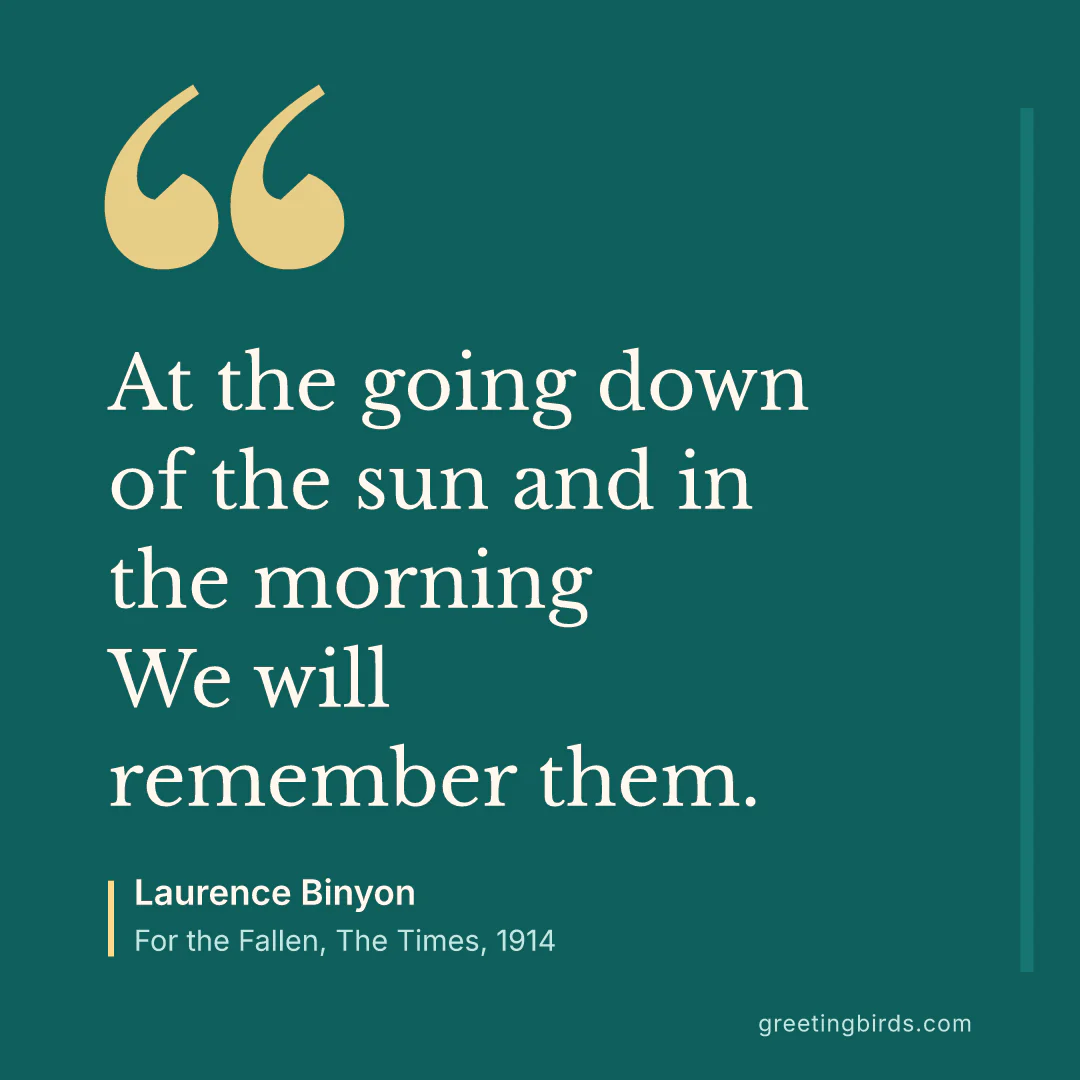
For a card to a family that lost someone in service, the last two lines are enough on their own. For a school assembly, read the full stanza slowly. It takes about 20 seconds.
Poppies, McCrae's poem and the American who answered it
The remembrance poppy owes most to one poem. John McCrae was a Canadian doctor serving as a field surgeon at the Second Battle of Ypres. He wrote "In Flanders Fields" on May 3, 1915, after the funeral of his friend Lieutenant Alexis Helmer, killed in the same battle. Punch printed the poem, without his name, on December 8, 1915.
"In Flanders fields, the poppies blow
Between the crosses, row on row,
That mark our place; and in the sky
The larks, still bravely singing, fly
Scarce heard amid the guns below."
— John McCrae, "In Flanders Fields," Punch, December 8, 1915
The opening is gentle: birds, flowers, rows of crosses. That gentle opening suits children, and the first two lines fit under a photo of poppies. The poem is spoken by the dead ("We are the Dead. Short days ago / We lived"), which is why it hits so hard when read aloud.
The last verse asks the living to carry on:
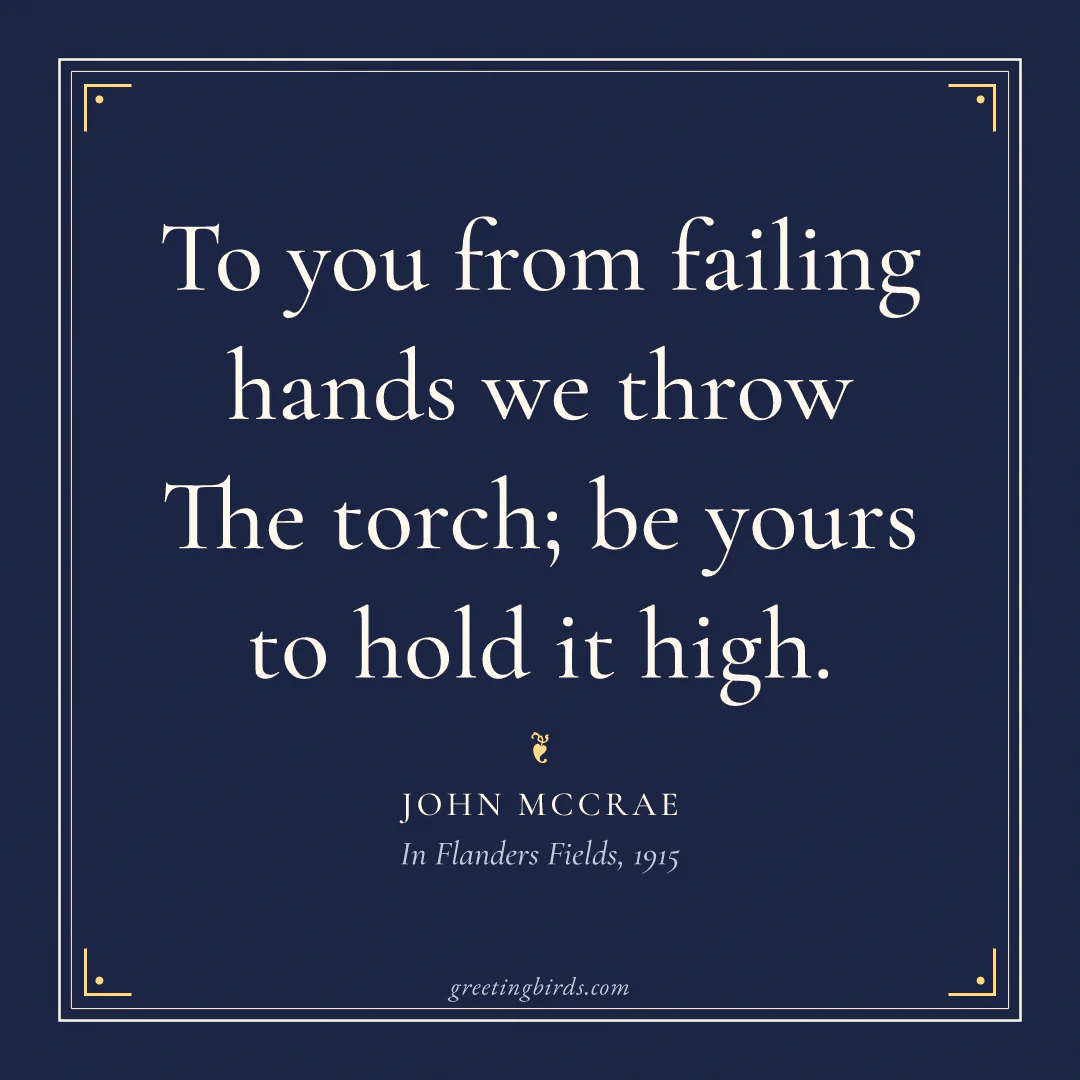
"To you from failing hands we throw
The torch; be yours to hold it high."
— John McCrae, "In Flanders Fields," 1915
This is the most "active" line in Remembrance writing: it asks the reader to do something. It suits a graduation-to-service card, a retirement from the forces or a teacher handing a project on to students. One caution: the next lines ("Take up our quarrel with the foe") were a call to keep fighting in 1915. If you want a message of peace, stop at "hold it high."
Moina Michael, an American professor volunteering at a YWCA training headquarters during the war, read McCrae's poem in November 1918 and wrote a reply. She vowed to wear a red poppy always, as a sign of remembrance:
"Oh! you who sleep in Flanders Fields,
Sleep sweet – to rise anew!
We caught the torch you threw"
— Moina Michael, "We Shall Keep the Faith," November 1918
Her reply picks up McCrae's torch, so the two poems work well read one after the other. Anna Guérin, a French campaigner, then took the idea abroad. Poppies were sold in London for Armistice Day 1921, and the custom spread across the British Empire. In the US, the American Legion Auxiliary still hands out paper poppies around Memorial Day and Veterans Day.
Words from the war itself
The next four lines were written during the two world wars or soon after. Two of the writers died in service. They're quieter and more personal than the public poems above.
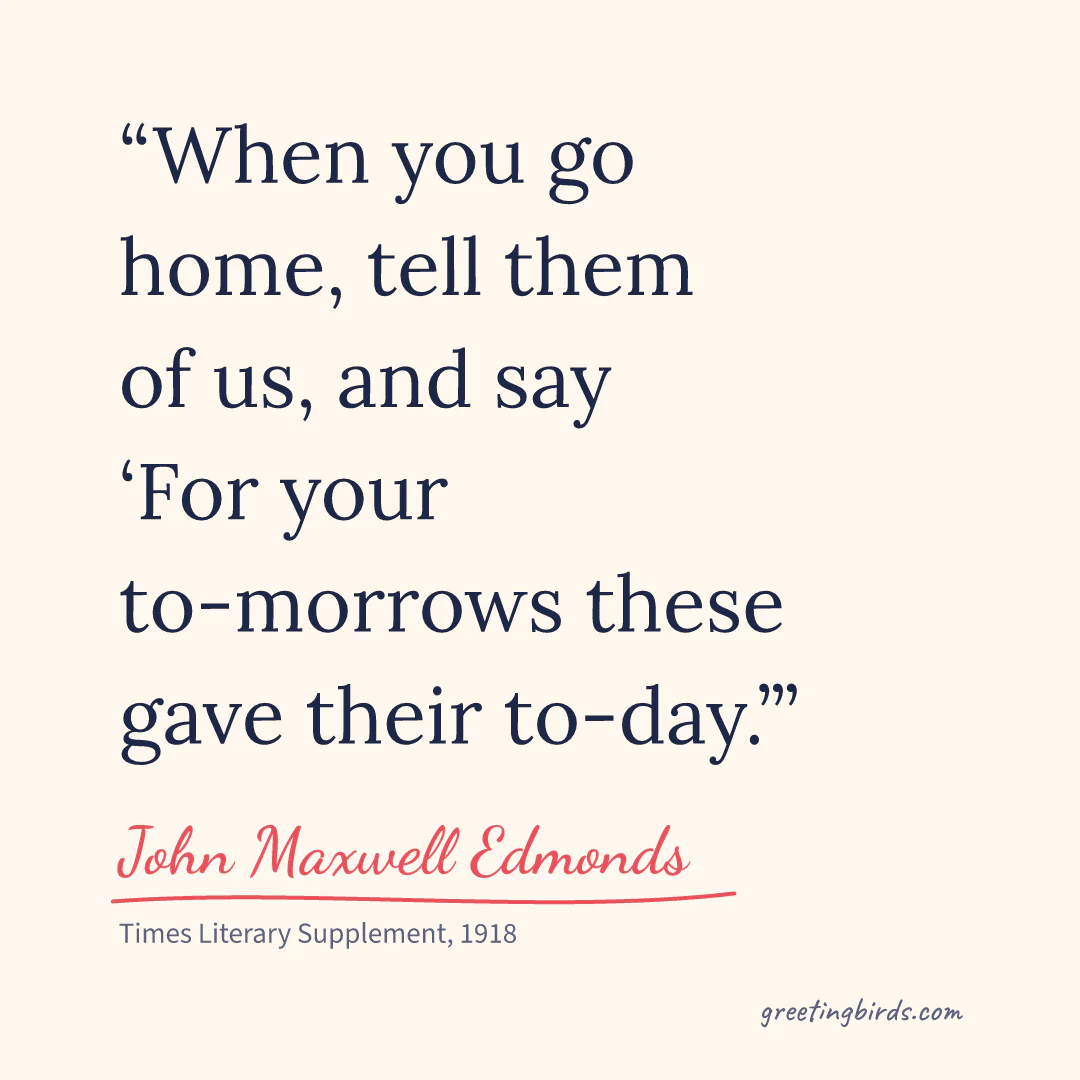
"When you go home, tell them of us, and say
'For your to-morrows these gave their to-day.'"
— John Maxwell Edmonds, Times Literary Supplement, July 4, 1918
Edmonds's couplet echoes the ancient Greek epitaph for the Spartans who died at Thermopylae. It's best known as the Kohima Epitaph. The 2nd British Division carved a version of it on their memorial at the Kohima War Cemetery in northeast India. That version reads "For your tomorrow, we gave our today," and it's the one most people know. Either version is fine. Just name Edmonds if you're printing it.
"If I should die, think only this of me:
That there's some corner of a foreign field
That is for ever England."
— Rupert Brooke, "The Soldier," from the sonnet sequence 1914
Brooke wrote this in 1914, full of the early war's idealism. He died in April 1915, and the poem was published that year in 1914 and Other Poems. The idea of a soldier resting forever in a foreign grave still speaks to families whose relatives are buried overseas. If the person served for another country, change only the name in your own words. Don't edit Brooke's line.
"What passing-bells for these who die as cattle?"
— Wilfred Owen, "Anthem for Doomed Youth," written 1917
"My subject is War, and the pity of War. The Poetry is in the pity."
— Wilfred Owen, draft preface for his poems, 1918
Owen wrote "Anthem for Doomed Youth" while recovering from shell shock at Craiglockhart War Hospital in Edinburgh. Siegfried Sassoon helped revise it, and suggested the words "anthem" and "doomed." Owen was killed on November 4, 1918, a week before the Armistice, and most of his poems came out after his death. His lines are angry rather than comforting, which makes them right for a history lesson or a talk about the cost of war. For a sympathy card, choose Binyon or Edmonds instead.
"Greater love hath no man than this, that a man lay down his life for his friends."
— John 15:13, King James Version
Jesus says these words to his disciples on the night before the crucifixion. Because the verse speaks of laying down a life for others, it's carved on many war memorials and military graves. It fits a church service, a religious family or a card to a chaplain. For a mixed or secular audience, use "Lest we forget" instead.
From the Second World War
"Never in the field of human conflict was so much owed by so many to so few."
— Winston Churchill, speech to the House of Commons, August 20, 1940
Churchill was talking about the RAF and Allied pilots in the Battle of Britain. He first said a version of it four days earlier, leaving the RAF operations room at Uxbridge. It's about a small group carrying a heavy load, so it suits air force veterans in particular. It also works as a thank-you to a small unit or crew.
A line that's often misattributed (and unsourced lines to skip)
"Only the dead have seen the end of war."
— George Santayana, "Tipperary," in Soliloquies in England and Later Soliloquies (1922)
You'll often see this credited to Plato, and General Douglas MacArthur credited it to Plato too. Wikiquote lists the Plato attribution as wrong. The earliest known source is the Spanish-American philosopher George Santayana, who wrote it in 1922 and didn't credit anyone else. If you use it, name Santayana.
Two more things to watch out for:
Polished lines with no author. Many social media posts share lines like "Hope is the wreath we lay upon their memories" or "We honor the fallen by seeking peace with the same fervor that they defended it." Readers have searched our site asking who said them. We couldn't find a book, speech or poem for any of them. They read like modern filler, possibly machine-written. Don't put a famous name under a line like that. If you like the wording, use it as your own message without quotation marks.
"Lest we forget" isn't part of Binyon's Ode. The two are said together so often that people assume one poem holds both. The Ode ends "We will remember them." "Lest we forget" is Kipling's, from 17 years earlier.
Remembrance Day messages you can write
These 31 lines are originals by our editors, grouped by where they'll be read. Change a detail or two so they sound like you.
Short posts and photo captions
Keep these short. A photo of a poppy or a memorial says most of it already.
- At the eleventh hour, we stop and remember. Lest we forget.
- Two minutes of quiet for a lifetime of gratitude.
- Wearing my poppy today for the ones who didn't come home.
- November 11: a day to stand still and remember.
- Their names are on the stone. Their stories are ours to keep. Lest we forget.
- Red poppy, grey morning, full heart. We will remember them.
- Remembering everyone who served, and everyone who waited for them at home.
- Peace is their legacy. Remembering it is ours.
To a veteran or someone serving now
Talk to the person directly and keep it simple. Most veterans prefer a sincere "thank you" to big words about heroism.
- Thinking of you this Remembrance Day, and of the friends you served with. Thank you.
- Today I'm remembering the people you lost, and I'm grateful you're here.
- Thank you for your service, Grandpa. I'll be at the memorial with you at eleven.
- I know November 11 brings back a lot. Coffee's on me whenever you want company or quiet.
- To everyone deployed this November: you're remembered at home too. Stay safe.
- Thank you for carrying the torch. We won't let it go out.
For a family that lost someone in service
This is a sympathy message first. Use the person's name if you knew it, and don't explain their sacrifice to the people who lived through it.
- Thinking of you today and remembering Daniel with you.
- His name is read every year, and so is yours in our thoughts. With love this Remembrance Day.
- We will remember him. Holding your family close today.
- No words fix this day, but you won't stand at the memorial alone. I'll be there.
- Remembering your grandfather today. Thank you for sharing his story with us.
- Lest we forget, and we won't. With love to all of you.
For a recent loss, our condolence messages are written for the first weeks and months.
For a classroom or school notice
Children understand concrete things better than abstract ones: a poppy, a minute of silence, someone's great-great-grandfather.
- Today at 11 a.m. we'll be quiet for two minutes to remember people who died in wars.
- The poppy reminds us of the flowers that grew in the fields where soldiers were buried.
- Ask someone at home: did anyone in our family serve? Bring their story to share.
- We remember so that we can choose peace. Lest we forget.
- Thank you to the veterans who visited our school today. We will remember your stories.
- Remembering is something we can all do, at any age.
For the office, a newsletter or a team chat
Workplaces mostly need a short, calm notice that works for everyone, including colleagues from countries that mark a different day.
- We'll pause for two minutes of silence at 11 a.m. today. Join from wherever you are.
- Today we remember those who died in service, and we thank our colleagues who have served.
- Poppies are available at reception, and donations go to the veterans' fund.
- To our team members who are veterans or military family: thank you. Lest we forget.
- Remembrance Day is a good moment to check in on anyone for whom today is hard.
Write your own in three parts
1. The act of remembering. "Today we remember," "Thinking of," "At eleven o'clock."
2. Who you're remembering. Be specific: a name, a unit, "the ones who didn't come home," "everyone who waited for them."
3. A promise or a closing. "We will remember them," "Lest we forget," "Thank you."
Worked example (to a friend whose great-uncle died at Normandy): "Thinking of you this morning and remembering your great-uncle Tom, who never got to come home from Normandy. We will remember him."
Use "Lest we forget" or "We will remember them" only once, at the end. They're endings, not openings.
What to avoid on November 11
"Happy Remembrance Day." It's a solemn day of mourning, so most people avoid "happy." "Thinking of you this Remembrance Day" or simply "Lest we forget" is safer.
Mixing it up with Veterans Day. In the US, November 11 is Veterans Day and honors everyone who served, living or dead. Remembrance Day mainly honors those who died. For American friends and family, our Veterans Day greetings and thank-you quotes for veterans are a better fit.
Politics in a sympathy card. Keep views on current wars out of a message to a grieving family.
Unchecked quotes. See the section above. A memorial plaque or school printout with the wrong name lasts for years.
Poppies, the silence and the dates in 2026
The day. Remembrance Day is Wednesday, November 11, 2026. The two-minute silence at 11 a.m. marks the moment the 1918 Armistice took effect, "the 11th hour of the 11th day of the 11th month." The first silence was held in London on November 11, 1919.
By country. The UK holds its main services on Remembrance Sunday, the Sunday nearest November 11, which is November 8 in 2026. In Canada it's a statutory holiday for federally regulated employees, six of the ten provinces and all three territories. Australia always marks November 11 itself, but it isn't a public holiday. New Zealand puts most of its remembrance into Anzac Day on April 25.
Wearing a poppy. There's no strict rule. The Royal Canadian Legion suggests the left lapel, "as near the heart as possible." Since 2000, many Canadians lay their poppy on the Tomb of the Unknown Soldier after the service. White poppies, from the Peace Pledge Union, remember all victims of war, including civilians. Purple poppies remember animals that served and died.
Cards. Remembrance Day isn't a greeting-card holiday. A short handwritten note to a veteran or a bereaved family means more than a printed card. Send it the day before, or bring it with you to the service.